Long reads page 18
Long articles worth setting time aside for.
-
What to borrow and what to give up from Meta's Muse to let an agent use a browser
The author studied how Meta's Muse, a personal AI agent released in September 2026 that shops for its user and drives a browser on sites without APIs, secures browser use, then tested how much of that design works at…
-
eMudhra intermediate CA key compromise: what web app developers should check
In October 2026 it was disclosed that the private keys of intermediate CAs operated by the Indian certificate authority eMudhra could be reconstructed from public data: the keys use the elliptic curve P-384, but the…
-
Letting Claude Code use gh in a devcontainer without GH_TOKEN in environment variables
A developer configured a devcontainer so that Claude Code can create pull requests and issues through GitHub CLI without a token in the container's environment variables, since a token there would be displayed outright…
-
Dan Luu: we should be more ambitious with the software we build
In a widely discussed post, Dan Luu backs Michael Malis's call for more ambitious software, pointing to pgrust, Malis's experimental Rust rewrite of Postgres.
-
Kimi K3.1 Pro tested: better than K3, fast and cheap, but short of GPT-6 Astra
The author spent a full day hands-on testing Kimi K3.1 Pro, a multimodal model with a 1M context window and a 2.8T-parameter MoE architecture whose headline new features are 3D modeling and game building.
-
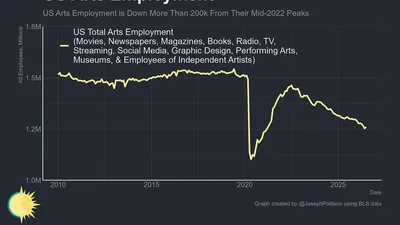
US creative industries have lost 200,000 jobs in four years. How much is AI?
US creative industries have lost more than 200,000 jobs over the last four years, roughly 50,000 of them in the past year and with the pace accelerating in recent months — a decline matched in modern US history only by…
-
Japan's 71 data breaches of 2026, sorted by entry point
A Zenn article sorts the 71 data breach incidents disclosed in Japan during 2026 by entry point into six categories (A–F), drawing on companies' press releases and investigation reports as of October 24, 2026.
-
A student built an intercom app for a 600-person event
At DevFest Kansai 2026 on October 18, student Kodak built inkam, a push-to-talk app for event staff; more than 60 staff used it, making 1,493 transmissions between 8 a.m. and 8 p.m.
-
@napi-rs/canvas 1.0.12 silently ignores unquoted font names in ctx.font
Starting with @napi-rs/canvas 1.0.12, a font set as ctx.font = '48px M PLUS Rounded 1c' — without quotes around the family name — is silently ignored: Japanese text renders as 10px tofu, with no exception or warning…
-
Supporting the iPhone Duo vertical bar in the FlutterKaigi 2026 app
The FlutterKaigi 2026 conference app, developed in Flutter, was updated to support the iPhone Duo's vertical bar — the side strip where iOS stacks the status bar items (camera hole, clock, Wi-Fi) vertically when the…
-
Goose: a memory-safe systems language with no heap or garbage collector
Goose is a memory-safe systems language with no heap allocator, garbage collector or lifetime annotations, and its syntax is familiar to C and Rust programmers.
-
Top-down interpretability: how Gemma-4-31B organizes its residual stream
The author outlines two ways to organize mechanistic interpretability research: bottom-up, starting from single neurons and features and building up to circuits, or top-down, starting from a coarse picture of the whole…
-
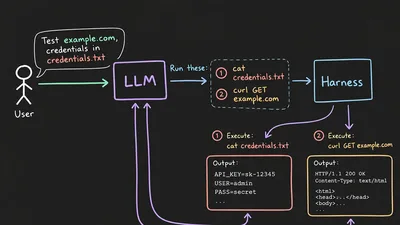
How LLM-Based Penetration Testing Harnesses Work
The article explains how penetration testing harnesses built on large language models (LLMs) work. In this context, a harness is the scaffolding that supplies a large language model with the tools it needs to carry out…
-
Generative AI as a new enclosure of the scientific commons
An arXiv paper argues that generative AI can turn collectively accumulated knowledge into private wealth and shake the social systems that maintain it, drawing a parallel with the historical enclosure of the British…
-
Epistemic mapping 101: what to ask in order to understand how others think
Even within modern academic culture, different disciplines create and receive knowledge in ways that are barely transparent to one another, so work from other traditions can look boring, shallow, or not like knowledge…
-
Is this the new normal for cybersecurity?
A wave of serious security incidents has struck PHP, GitLab, certificate authorities, cloud services and package supply chains, making the time between vulnerability disclosure and defense a central problem.
-
Google to require all Android app developers to register starting in 2027
In August 2025 Google announced that starting in 2027 every Android app developer will have to register centrally with the company before their software can be installed on any Android device, including software…
-
Fermi Poker: poker betting mechanics with Fermi estimation questions
Fermi Poker is a game described on LessWrong that replaces playing cards with Fermi estimation questions, such as “How many smartphones were sold worldwide last year?”.
-
Brotli decoder flaw CVE-2026-111497 extends from Node.js to Python and HTTP libraries
CVE-2026-111497 is an out-of-bounds write in Google's Brotli decoder; Brotli versions 1.0.3 through 1.2.0 on all platforms are affected, and CVSS v4.0 scores it 9.2, Critical.
-
How power works — and why it matters for whether AI could take it from humans
Whether AI systems could take power from humans shapes how much risk we face from them, and answering that requires a correct picture of how power works.
-
Why passkeys are needed even after setting up two-factor authentication
After a wave of securities account takeovers, passkey adoption swept Japan's online brokerages in 2025: Japan's Financial Services Agency counted 5,958 fraudulent trades in January–May 2025 alone, worth about 524…
-
How MCP clients connect to MCP servers over OAuth: discovery and client identification
Pasting only an MCP server URL into Claude is enough to complete the OAuth login flow, with no API keys to create and no application to register in advance.
-
Cloudflare's 37k-star security audit skill in Claude Code, trimmed to cut token costs
A developer who left a big tech company in September 2025 to work on his own products describes hooking Cloudflare's open-source security-audit-skill into Claude Code and trimming its six-phase audit so that token…
-
Right technology, wrong architecture: decisions detached from code and business
The article argues that the biggest risk in architecture design is not outdated technology choices but decision-makers who do not know the real state of the system trying to direct actual engineering with idealized…
-
Bought a YubiKey, got OpenAI Daybreak Blue, ran a vibe vulnerability scan with Shannon
A developer scanned an old hobby web app with Shannon, Keygraph's open-source AI pentest tool that works from both source code and the running application.
-
Enabling TLS for Hubble Relay with cert-manager and OpenBao PKI
A guide to enabling TLS on the Hubble Relay server in a Cilium cluster with cert-manager and the OpenBao PKI, whose intermediate CA signs the certificates; all manifests are managed with ArgoCD.
-
eMudhra intermediate CA leak: 9 of 25 containers and 16 venvs trusted fake certificates
On 2026-10-20 it was disclosed that the private keys of eight intermediate CA certificates of eMudhra, an Indian certificate authority, could be reconstructed from the certificates themselves, reportedly since they were…
-
prpr: a simple and fast parser generator for Rust
Developer tanakh released prpr (PackRat Parser in Rust), a new parser generator for Rust based on Parsing Expression Grammar (PEG); it is published on crates.io, with the source on GitHub and documentation available…
-
Formatting C++ strings without std::format: vformat and stringstream
Like printf, std::format requires the format string to be a string literal; C++ therefore also offers std::vformat, which takes the format as a std::string_view and so allows a variable.
-
Simulated control evaluations: testing AI monitors without real attacks
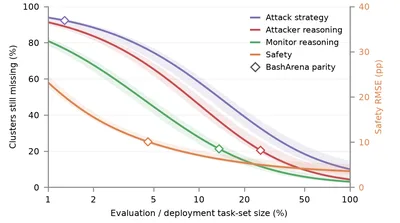
Redwood Research has released a paper on simulated control evaluations (SCEs), a method for testing whether the monitors that AI developers use to oversee their agents would catch a model deliberately trying to cause…