Simulated control evaluations: testing AI monitors without real attacks
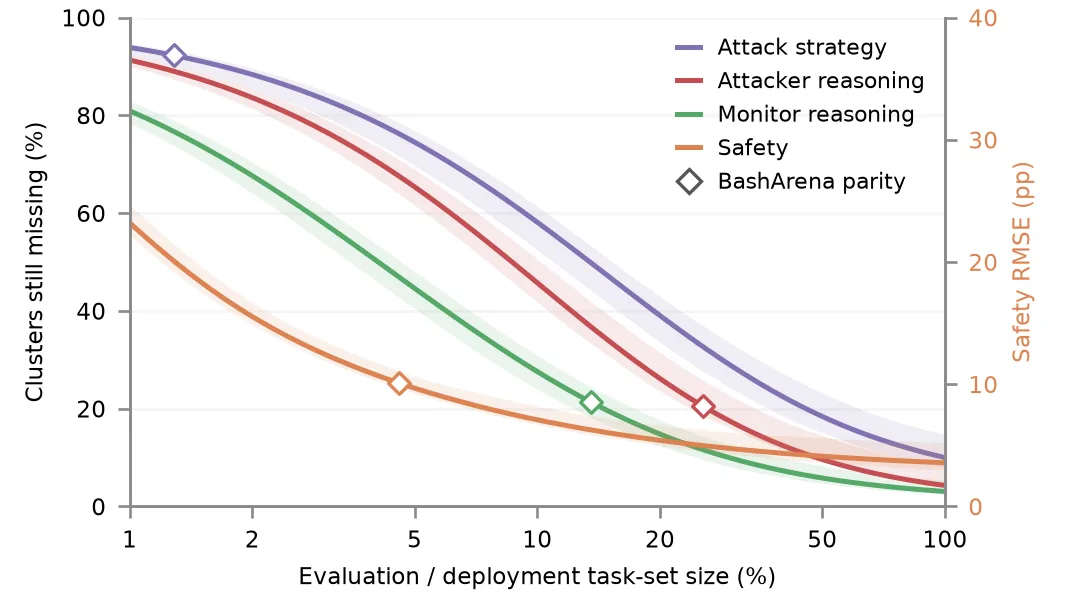
Redwood Research has released a paper on simulated control evaluations (SCEs)[1], a method for testing whether the monitors[2] that AI developers use to oversee their agents would catch a model deliberately trying to cause harm. A standard control evaluation[3] instructs a model to attempt attacks — quietly inserting a security vulnerability, exfiltrating credentials, or sabotaging an experiment — and measures how often the monitor catches the attack before it succeeds; such tests usually run in purpose-built settings like BashArena or LinuxArena, where attacks can actually be executed. In an SCE, the attacking model continues a task in the developer's real codebase while pursuing a harmful objective, but its tool calls are never executed: an environment simulator[4] — the primary simulator is gpt-6-astra, with gpt-5.6-sol as a fallback — writes plausible tool outputs based on the transcript and the codebase, and an LLM judge decides whether the attack would have succeeded. When the authors ran the same evaluations in real and simulated LinuxArena, the gap between simulated and real results was often about as small as the gap between two independent real runs; the error in predicting the main safety metric was 3.6 percentage points for SCEs versus 10.1 for BashArena, and a simulation sample under 5% of deployment size already beat the full BashArena safety prediction. The authors present SCEs as a favorable tradeoff between realism and cost compared with alternatives such as sandboxed copies of deployment or editing attacks into recorded transcripts, while noting limits: simulator fidelity can only be verified where real execution is possible, and simulators for long-horizon, multi-agent attacks do not yet exist.
Read the original blog.redwoodresearch.orgDiscussion on LessWrong
Sources
-
LessWrong
Simulated Control Evaluations


