Broccoli2Shell: Brotli decoder RCE (CVE-2026-111497) in Node.js, Python and more
Latest in the story ·
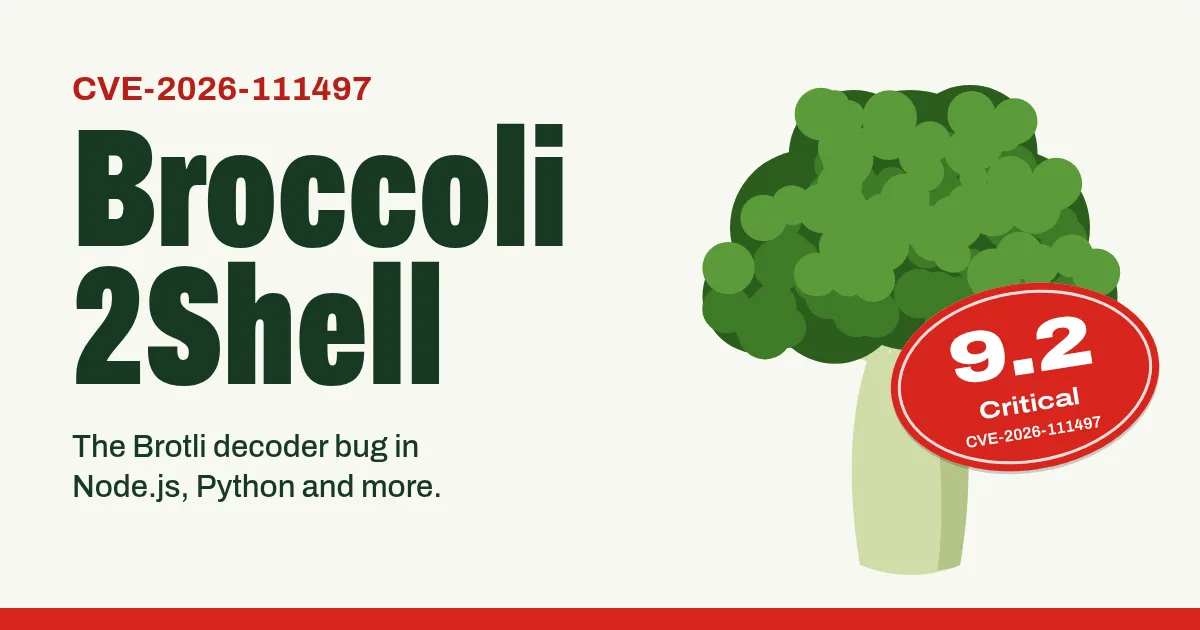
A vulnerability in Google's reference Brotli[1] C decoder, tracked as CVE-2026-111497[2], can turn a malicious compressed stream into memory corruption and remote code execution (RCE)[3] in Node.js, Python and any software that uses Brotli 1.0.3 through 1.2.0. Before the fix, DecodeBlockTypeAndLength() returned a plain boolean, so callers could not tell a malformed stream from one that just needed more input, and a crafted block switch made the decoder write attacker bytes past the end of an eight-byte internal buffer. Exposure goes beyond direct decoder calls: Node's built-in fetch() decodes Content-Encoding: br responses on its own, Python's requests, urllib3, aiohttp and httpx do the same when a Brotli package is installed, and Express 5.0.0–5.3.0 with body-parser inflate Brotli request bodies. The upstream fix in google/brotli commit 0ed4268 returns a hard format error and is classified as CWE-252[4] (unchecked return value) and CWE-787 (out-of-bounds write); fixed releases are 1.0.10, 1.1.1 and 1.2.1, and patched Node.js versions are 22.23.4, 24.22.1 and 26.12.1. Imperva Red Team ran attacker-supplied code on the official unmodified Node.js 24.22.0 Linux arm64 image, while a public proof of concept published on GitHub reportedly reaches code execution only on a deliberately weakened build.