Programming page 4
Languages, techniques and code.
-
Mounting an LLM as a hard drive: an endless file system in Python with FUSE
The author built a file system in Python with FUSE in which no file really exists: a language model creates folders and files at the moment someone opens them. The idea came from two problems.
-
Ring 1.28 programming language released
The post announces version 1.28 of Ring, a general-purpose, multi-paradigm dynamic programming language distributed free under the MIT License.
-
When Good Practices Become Empty Rituals
The author writes that they used to look down on Agile and similar methodologies because of the many buzzwords.
-
Next.js 16 Cache Components: migrating from the four-layer cache model
The article is a follow-up to an earlier piece on the four cache layers of the App Router. It covers Cache Components, a feature introduced in Next.js 16.
-
Trying xeet, a Rust library that turns X posts into PNG images
The author tried xeet, a Rust library that turns an X post into a PNG without a browser, to show X post cards on the landing page of their metronome app Metronome.fm.
-
Essay argues copyright and copyleft cannot bring lasting change to open software
Ingrid's essay argues that the open software ecosystem is in a poor state, because companies keep abusing the commons and copyleft has repeatedly failed to counter this.
-
Camera, Coordinate and Control Basics Through Overlaid Self-Driving Predictions
This Zenn article by Turing, a Japanese company, introduces three basics for connecting AI with the physical world: cameras, coordinate systems and motion control.
-
Squircles: the shape between a square and a circle, and where it is used
The page on linebender.org describes squircles, shapes between a square and a circle. There is no single mathematical definition, so several curves fit the description.
-
How to check claims that a theorem is correct because it was verified in Lean
The post explains how to judge claims that a theorem is correct because its proof was checked in Lean code. The author says Lean code gives an important signal, but AI-generated code needs some tests first.
-
MIT course schedule for How To Make (almost) Anything, 2026
This is the 2026 schedule for the MIT course How To Make (almost) Anything, held on Wednesdays from 1:00 to 4:00 in room E14-633.
-
Announcing hegel-clj, a Clojure interface for the Hegel testing library
hegel-clj is a Clojure interface for Hegel, a new cross-platform library for generative testing that provides deterministic generators and shrinking tactics.
-
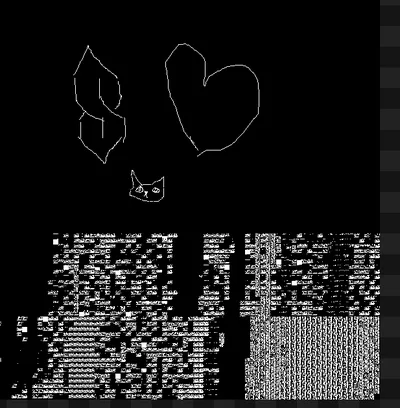
Nullius in pixella: checking computations by eye with punched sheets, even if the computer lies
The author describes a way to check by eye that a program was run correctly, even when the computer that ran it cannot be trusted.
-
Trying mutation testing with @mizchi/mutator in a TypeScript monorepo
A Zenn article by the author polyco describes trying @mizchi/mutator in a TypeScript business app with a pnpm monorepo and Vitest 5.
-
Security in AI development is built into design: skills engineers need
This Qiita article by Watanabe Jin, published on 15 November 2026, argues that software engineers should treat security as part of design: block operations that cannot happen in the business at the design stage, instead…
-
Painting the memory of other running programs with core
core is a program written by the author that shows the memory of other programs on screen as pixels, so the user can inspect it and draw on it. The author calls it an "esoteric debugger" or a "paint program".
-
Building a Garmin app: setting up the environment for Forerunner 570
The author, an engineer at TOKIUM, describes how to set up a development environment for an app on the Garmin Forerunner 570 running watch, with the goal of getting more exercise.
-
X rebuilt its web app from scratch and merged three servers into one
X rebuilt its existing web application in under six months, using five engineers and AI coding agents. The three servers that handled users, search crawlers and link previews have been merged into one.
-
Nimony: a new compiler for Nim and the home of the Nim 3 language
Nimony is a new compiler for Nim and the home of the Nim 3 language. It adds borrow checking, explicit nilability, sum types and checked generics, and its builds are incremental and parallel from the start.
-
Reading list for practical computer scientists: languages, systems, algorithms, theory
The page is a personal reading list for practical computer scientists, in its 2025 edition. Unlike general books on coding practice such as Code Complete and Clean Code, it focuses on languages, operating systems…
-
DBDelve: a lightweight open-source database client built with Rust and GPUI
DBDelve is an open-source database client written in Rust with GPUI, the GPU-accelerated UI framework from the Zed editor, so the same UI code runs natively on macOS, Windows and Linux.
-
Building a CLI to inventory Google Cloud service accounts and examining its traces
The article describes a command-line interface (CLI) that takes stock of Google Cloud service accounts (SA). The author built it with the same method used for their new book, released at Technical Book Festival 21.
-
WebGL flight simulator with seed-generated terrain
A flight simulator built with WebGL, where the terrain is generated from a seed. The source is a link to the project page and no article text was available.
-
clice v1.0 Released: Welcome to Modern C++
clice is a C/C++ language server written in C++23 and built on LLVM/Clang. The author says the project has reached 1,000 commits and is now releasing its first stable version, 1.0.
-
Jiff 1.0: a datetime library for Rust
Jiff is a datetime library for Rust, pronounced like "gif" with a soft "g". It automatically handles many daylight saving time problems by putting time zone handling at the center of its API.
-
Blazor InteractiveServer in .NET 11: restoring page state after scale-in
The author describes a new .NET 11 feature for the InteractiveServer mode of ASP.NET Core Blazor. Until now, circuits held in server memory could not be moved to another server during scale-in, so systems that scale out…
-
Understanding Go: how profile-guided optimization works
This article continues a series on making Go code faster. The previous article used SIMD instructions, through the simd/archsimd and simd packages, to make a dot product about 9 times faster, but the code became much…
-
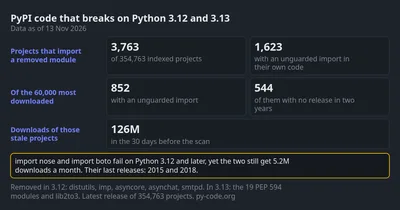
544 unmaintained PyPI packages fail on Python 3.12+ yet get over 100M downloads a month
py-code.org checked the latest release of 354,763 PyPI projects for imports of 25 standard library modules that Python 3.12 and 3.13 removed.
-
Lean proof of the entire US tax code to find loopholes
The author formalized the entire Internal Revenue Code, Title 26 of the US Code, in Lean, a programming language whose checker can also verify mathematical proofs. The version used is current to 3 November 2026.
-
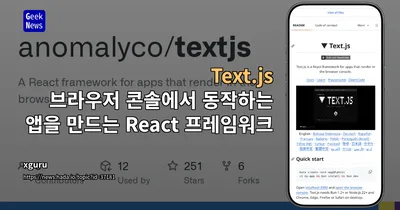
Text.js: a React framework for building apps that run in the browser console
Text.js is a React framework that renders an app in the Console tab of browser developer tools. Developers define the text UI and keyboard input with React components and hooks, lay out the screen with Box and Text, and…
-
FastAPI Depends with yield: when post-processing runs and how scope changes it
This Zenn article explains when the code after `yield` in a FastAPI dependency passed to `Depends()` runs. With the default `scope="request"`, that code runs after the response has been sent.