Nullius in pixella: checking computations by eye with punched sheets, even if the computer lies
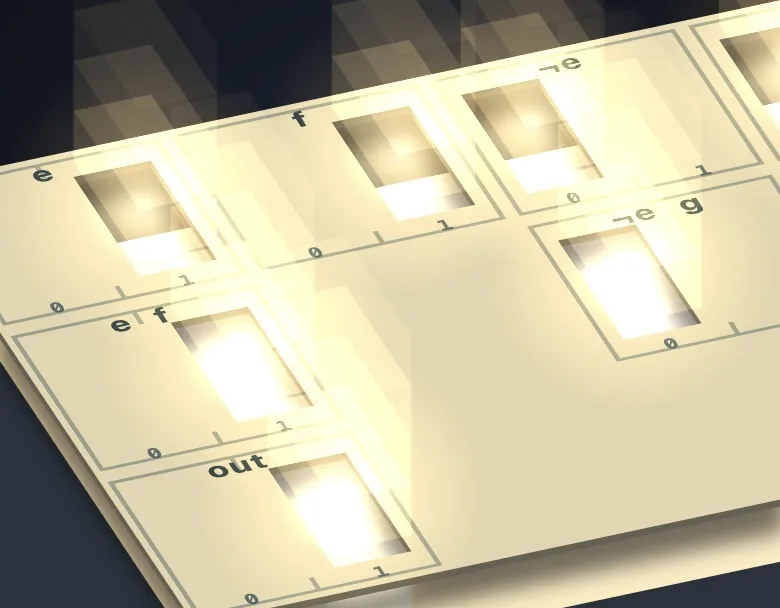
The author describes a way to check by eye that a program was run correctly, even when the computer that ran it cannot be trusted. The scenario is an AI swarm that controls all the computers and screens, so results shown on a screen cannot be believed. Checking a full printed trace line by line is almost as slow as doing the computation, and general verification methods such as zkSNARKs[1] still need an automatic computer to run.
The method treats a program as a logic circuit[2] made of AND, XOR and NOT gates. Each wire value is recorded on a sheet: each cell has either its left or right half punched out, depending on whether the value is 0 or 1. Several copies of the sheet are stacked with set offsets, and light shows through only where a gate has an error, so many gates can be checked at once.
Each cell must have exactly one half punched out, and extra open space is not a big problem because any error still shows as light. The author says that a full 32-bit multiplication circuit can be verified this way. The summary of the post says the approach works for moderately large computations, including widely used cryptographic hash functions, within human-scale time.
Read the original benwr.netDiscussion on LessWrong
Sources
-
LessWrong
Nullius in pixella: trustworthy computations, even if your computer is a liar