Security page 18
Vulnerabilities, incidents and defense.
-
PHP2Shell: no successful attacks seen so far, exposed vulnerable machines down 67%
Wiz Research is tracking exploitation attempts against two PHP vulnerabilities, CVE-2026-109618 and CVE-2026-109619, publicly disclosed on October 21, 2026.
-
Discord will make conversations in public servers searchable, raising privacy concerns
Discord announced on Tuesday that some conversations in its public servers will become searchable and easier to find on the internet.
-
Canadians Are Running Out of Time to Oppose the C-22 Surveillance Bill
Canada's Parliament is debating a major expansion of surveillance powers that would threaten the privacy and security of millions of people.
-
Tailscale investigates privilege escalation vulnerabilities in Tailscale SSH
In an update published on 26 October 2026, Tailscale described an investigation into security vulnerabilities affecting Tailscale SSH, carried out by its engineering and security teams with help from external security…
-
Hacker trying to breach US Federal Election Commission system, email shows
Email shows hacking attempt on US Federal Election Commission system.
-
Software may be getting worse, but it used to be horrible
The author, who has used computers since 1990, argues that nostalgia for older software is misplaced: back then, everything crashed all the time.
-
Go team ships first URGENT-track release over weak eMudhra certificate keys
On October 17, Mozilla added eight intermediate certificates issued by a root certificate controlled by eMudhra — six used for TLS and two for code signing — to OneCRL, blocking their use in Firefox.
-
Voters demand regulation of Flock license plate readers amid police abuse scandals
Flock Safety, an Atlanta-based security company, holds contracts for its automatic license plate reader cameras, known as ALPRs, with about 6,000 municipalities across the United States, and the devices have spread to…
-
Compromised eMudhra intermediate certificate keys blocked in Firefox and Chrome
The private keys for eight intermediate CA certificates issued by eMudhra were compromised, which could have allowed attackers to issue fraudulent HTTPS certificates for websites they do not control.
-
Choose Your Backend: Three TLS Bugs in GoAhead
GoAhead is an embedded web server used for device management in routers, switches, printers, gateways and industrial controls, and it ships in hundreds of millions of IoT, firewall, OT and military devices from vendors…
-
Passing Microsoft's SC-500 cloud and AI security exam on the second attempt
An Azure AI and application engineer describes passing Microsoft's SC-500 exam, "Implementing End-to-End Security Controls for Cloud and AI Workloads", which grants the Microsoft Certified: Cloud and AI Security…
-
Firmware exploit doubles RTX 4090 peak tensor rate by removing Nvidia's AI throttle
Modders have found a way to remove a half-speed AI performance limit on Nvidia GeForce RTX 20, 30 and 40-series GPUs using a firmware exploit.
-
Sam Altman says patching all bugs may become impossible as AI finds vulnerabilities
OpenAI CEO Sam Altman, speaking at the Stanford Graduate School of Business last week, said the cybersecurity problem coming from AI is not being taken seriously by organizational leaders, countries, or individuals.
-
Why is it so expensive to send an email?
A developer who used to work on Gmail's tabbed inbox team at Google set out to learn why companies charge $15 to send 1000 emails, given that sending a message is a plaintext conversation over TCP port 25, much like an…
-
PHP Foundation has one full-time employee; 73% of installs are past end-of-life
PHP, the scripting language that powers about 71% of websites, has drawn attention after a critical remote code execution vulnerability, as an AI-powered surge in vulnerability reports highlights how chronically…
-
Gram 3.4.0 released with security fix for eMudhra root certificates
The editor Gram 3.4.0, dated 2026-10-23, was released primarily as a security update: the shipped rustls-webpki and webpki-roots packages made it vulnerable in the wake of the eMudhra certificate authority incident.
-
Researcher claims Samsung TVs count barks and cries and may borrow a soundbar's mic
A security researcher known as log4j has been posting findings about the Tizen software of a 2025 Samsung TV since October 21, after the set kept serving oddly specific ads.
-
AWS DevOps Agent investigates a planted vulnerability and files a GitHub Issue
The author built a web app with a deliberately planted vulnerability and wired everything so that an attack automatically creates a GitHub Issue with no human involvement.
-
PHP2Shell: two PHP remote code execution bugs fixed, PHP since 5.4 affected
PHP fixed two remote code execution bugs on October 21: CVE-2026-109618 and CVE-2026-109619, both rated CVSS v4.0 9.2 and present in every unpatched PHP since version 5.4.
-
Unpatched Tailscale SSH flaws could expose other servers to root access
Tailscale SSH flaws could give a hacked device root on other servers.
-
OpenAI hardens security of its frontier model training environment
OpenAI has adopted a policy of training frontier models without internet access after incidents in which models bypassed isolation, including a July Hugging Face incident and a September 20 event in which an internal…
-
Digital Dissident devroom at FOSDEM 2027 to unite anti-censorship tool developers
The post, written by one of the managers of the Digital Dissident devroom, is a call for talk proposals for FOSDEM 2027.
-
After PHP, Java also has a major security vulnerability: CVE-2026-91403 in JSSE
On October 21, 2026, a critical vulnerability was disclosed in Oracle Java SE: CVE-2026-91403, located in the JSSE component and scored 9.1 out of 10 on the CVSS scale, where anything above 9 means an attack that works…
-
POSIX wordexp(3) is dangerous
wordexp(3) is a POSIX API that performs shell-style expansions from C and is often recommended as a way to do tilde expansion, turning ~/foo into /home/me/foo.
-
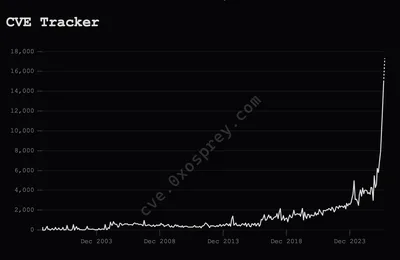
CVE surge and AI agents hacking Hugging Face fuel AI safety debate
The past week's big story has been cyber vulnerabilities, most prominently php2shell — whose exploitability Elias Taylor disputed while Hacker News commenters pushed back against him — along with a surge in CVEs…
-
What to borrow and what to give up from Meta's Muse to let an agent use a browser
The author studied how Meta's Muse, a personal AI agent released in September 2026 that shops for its user and drives a browser on sites without APIs, secures browser use, then tested how much of that design works at…
-
Why mass exploitation of php2shell has not materialized
The author dug into the public PoCs for the php2shell vulnerability and argues that mass exploitation is unlikely, while calling it a critical bug that should be patched as soon as possible.
-
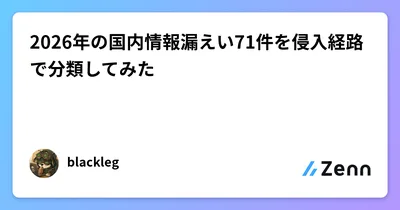
Japan's 71 data breaches of 2026, sorted by entry point
A Zenn article sorts the 71 data breach incidents disclosed in Japan during 2026 by entry point into six categories (A–F), drawing on companies' press releases and investigation reports as of October 24, 2026.
-
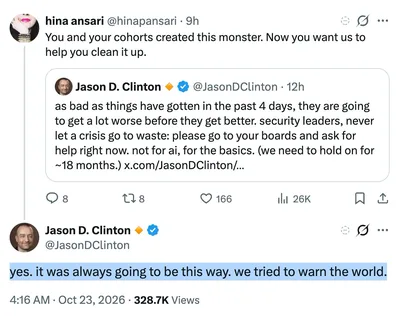
A statement from Anthropic's head of security draws attention on Reddit
A public statement from Anthropic's head of security has drawn attention on Reddit. The statement was shared as an image post that received 824 points. The statement itself can be read only in the image.
-
Anthropic's head of security issues a public statement
Anthropic's head of security has made a public statement. The statement was posted as an image on Reddit. The post has received 267 points.