Developer tools page 8
Editors, terminals, build tools and everything around them.
-
lend: running coding agents without handing them your credentials
The author wrote about lend, a proxy that sits in front of an SSH agent. It lets coding agents on a remote virtual machine run commands on the author's laptop with the author's approval.
-
Flutter Native Interop Is Stable, and Platform Channel Is Being Retired
The article reports that Flutter Native Interop became stable after the release of Flutter 3.50, and the author expects Platform Channel to be retired in about two more versions.
-
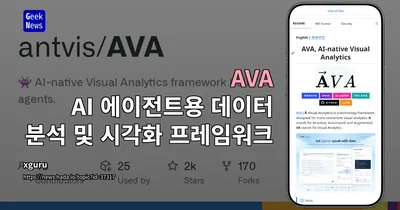
AVA: a data analysis and visualization framework for AI agents
AVA is a JavaScript framework that lets an app or AI agent analyze data and build charts from questions asked in plain language.
-
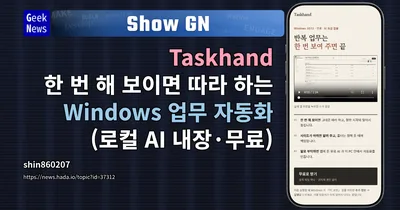
Taskhand: free Windows automation that repeats recorded steps, with optional local AI
Taskhand is a Windows work automation tool that its author built for personal use, to replace repeated web, Excel/CSV and folder tasks.
-
Pitter Patter: a new open-source toolkit for collaborative rich text editors
On 4 September 2026, Handle With Care announced Pitter Patter, an open-source toolkit of building blocks for collaborative rich text editors, made with ProseMirror.
-
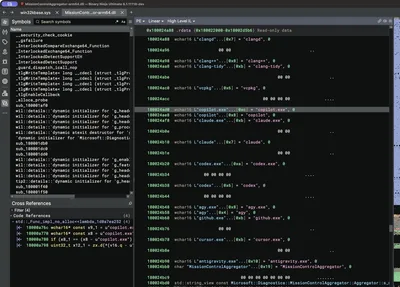
Windows 11 Collects Data on Which Coding Agents and Developer Tools Are Used
The author used AI to search Windows files for undocumented features and found a list in MissionControlAggregator.dll, a DLL file.
-
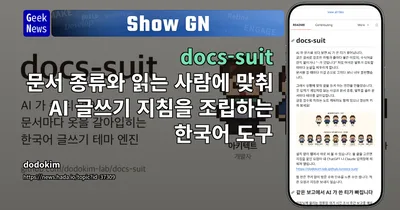
docs-suit: a Korean tool that builds AI writing guidelines by document type and reader
docs-suit is a Korean-language tool that assembles writing guidelines for an AI assistant before a document is written, based on the document type and the reader.
-
Claude Code advisor setup: Opus 5.5 does the work, Fable 5.2 gives advice
A Zenn article describes an advisor setup in Claude Code in which Opus 5.5 carries out the work and Fable 5.2 gives advice.
-
OpenCode Browse: a tool that lets AI agents use your real browser
OpenCode Browse is an MCP server and a Chromium extension that let AI agents work in your own browser, with your tabs, logins and extensions.
-
Google patches tokenizer of small Gemma 4 models to fix glitch tokens
Google changed tokenizer.json, the tokenizer file, of the small Gemma 4 model google/gemma-4-E4B-it. The patch removes 219 glitch tokens, which are vocabulary entries whose embeddings have collapsed to near-identical…
-
Harmonic's Aristotle Expands to Rust for Formal Verification of Code
Harmonic announced that Aristotle, its tool for formal verification, now supports Rust, building on earlier support for C and Verilog.
-
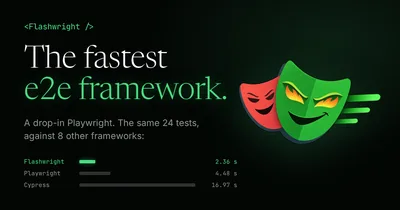
Flashwright: the fastest e2e testing framework, up to 4x faster than Playwright
Flashwright is an e2e testing framework that its site describes as a drop-in replacement for Playwright, with the same API, the same test runner and the same npx playwright test command, so an existing suite runs…
-
My first Emacs upstream contributions, shipped in Emacs 31
The author says that landing changes in Emacs upstream long felt out of reach to him. The biggest hurdle was the copyright assignment to the Free Software Foundation, which means downloading, signing and returning a PDF…
-
Atlas: open-source LLM inference engine in pure Rust and CUDA
Atlas is an open-source LLM inference engine written in pure Rust and CUDA, and it runs without Python, PyTorch or runtime compilation.
-
Coral: open-source gateway where agents write their own tools
Coral is an open-source gateway that you can self-host, and it sits between AI agents and the systems they work with. It works with any agent that supports MCP and with any system that has an API.
-
Rust enables the parallel compiler frontend by default on nightly
The Rust compiler's backend has long used several threads to generate code with LLVM. Its frontend, which covers type checking and borrow checking, has run on a single thread.
-
BrowserPod 4.0: a Linux-like microVM in the browser, now free for any use
BrowserPod 4.0 is a Linux-like microVM that runs inside the browser, built on WebAssembly. It can be installed from npm and started with BrowserPod.boot, with no account, no API key, no metering and no telemetry.
-
Microsoft quietly releases a new Chinese input method
Microsoft has quietly released a new Chinese input method that supports only Pinyin for now, and Wubi support may come later.
-
Docker Compose: defining and running multi-container applications
Docker Compose is a tool for running applications made of several containers on Docker. The application is described in a Compose file, which sets how each container is configured.
-
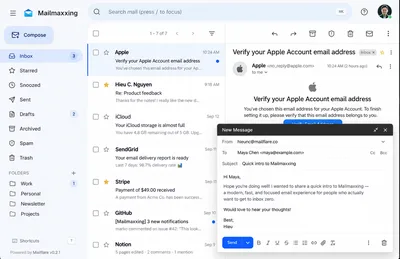
Mailflare: a self-hosted alternative to Google Workspace on GitHub Trending
Mailflare is a self-hosted alternative to Google Workspace, published on GitHub by hieunc229. It offers mailboxes on custom domains, Calendar, Drive, Booking and built-in AI agents, and it runs on Cloudflare or in a…
-
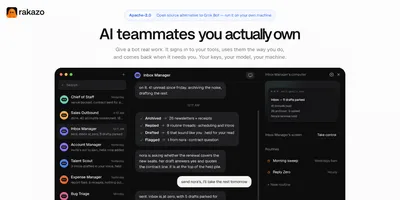
Rakazo: self-hosted open-source alternative to Grok Bot
Rakazo is an open-source, self-hosted alternative to Grok Bot. It provides persistent AI teammates with their own memory, routines, apps and computer, and it runs on the user's own machine with the user's own model.
-
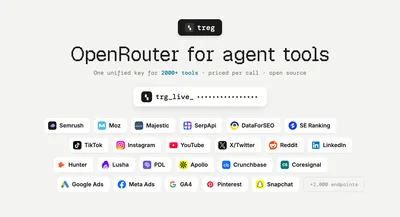
Treg: one token gives AI agents pay-per-call access to thousands of tools
Treg is a registry that works like OpenRouter, but for agent tools instead of models. An agent sends all its requests to one base URL with one token and gets access to a curated catalog of thousands of endpoints from…
-
iFixAi: independent auditing of AI agents
iFixAi is an independent auditor for AI agents, published as a GitHub project. It puts the agent in a simulation of a business and sends it the requests a real day brings, including ones that push it past its role, and…
-
Shizuku: how Android apps use system APIs with ADB or root rights
Shizuku is a project from RikkaApps that lets ordinary Android apps call system APIs with the higher privileges of ADB or root.
-
Deskflow: share one keyboard and mouse across several computers
Deskflow is a free, open source app that lets you use the keyboard, mouse, or trackpad of one computer to control nearby computers. You can move between the machines without switching hardware.
-
PaperOrchestra: multi-agent framework for writing AI research papers
PaperOrchestra is a multi-agent framework from Google Cloud AI Research for automated writing of AI research papers, published as a GitHub repository.
-
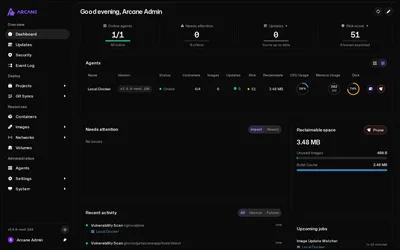
getarcaneapp/arcane: modern Docker management for everyone
Arcane is a Docker management tool that its README describes as modern and designed for everyone. The main branch now holds version 3 of Arcane, while the release/2.x.x branch keeps the last 2.x release.
-
Slint 1.19 adds backdrop blur, animated images and inertia scrolling on iOS and Android
Slint is a Rust-based toolkit for building user interfaces, from small embedded devices to phones and desktop computers. Its release 1.19 came out on 16 November 2026 and introduces a project file and editions.
-
Show GN: Haejoe.com, hybrid automation with web task management and local AI agents
Haejoe.com is a hybrid AI work platform presented as a Show GN post. Its web part handles project planning, delegation, collaboration and remote approval, while sensitive work runs on each user's own local resources.
-
Which Hermes to switch to from Claude Code?
A V2EX user whose Anthropic account was banned asks which Hermes to move to from Claude Code, having looked at Pi, OpenCode and DeepSeek Herness, and asks others to share experience since their memory must be moved too.