Harmonic's Aristotle Expands to Rust for Formal Verification of Code
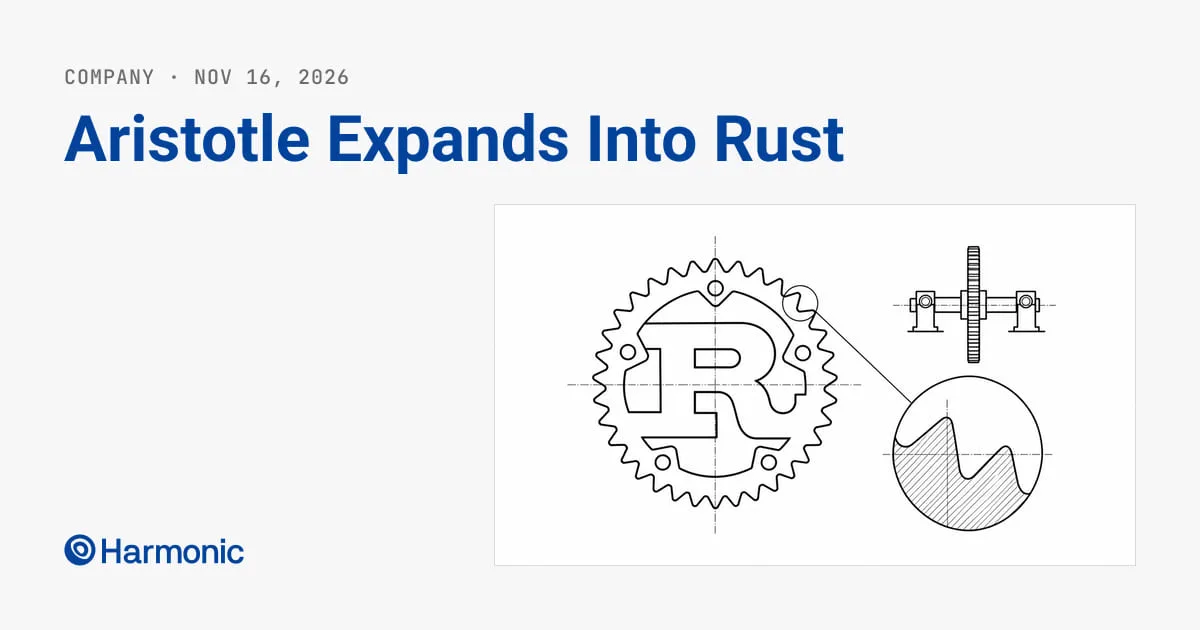
Harmonic announced that Aristotle, its tool for formal verification[1], now supports Rust, building on earlier support for C and Verilog. Developers can use it to prove that Rust code works as intended before it ships, instead of relying only on testing. The company says Aristotle can prove that code has no undefined behavior[2] and does what its specification says, including inside unsafe blocks[3]. Teams rewriting C in Rust can also check that the new code behaves the same as the original.
The announcement says Rust is used in cloud computing, cybersecurity, automotive, aerospace and finance, including crypto, and it underpins the smart contracts of the Solana blockchain. Aristotle runs on every new line of code, because smart-contract transactions cannot be undone. On Manifest, an open-source order book, it proved 28 results and found a rounding bug that the team has since fixed, and at Project 0, a prime broker, it proved that the books stay consistent through deposits, withdrawals, borrows, repayments and liquidations in any order.
Harmonic is partnering with the Solana Foundation to support established Solana programs and help new builders verify their smart contracts. Aristotle for Rust is available now at aristotle.harmonic.fun with self-serve, consumption-based pricing, and volume pricing, dedicated support and custom deployment are offered on request at bd@harmonic.fun.
Read the original harmonic.funDiscussion
Discussion
Commenters asked whether an open source alternative exists, how specifications are created with LLMs, and how to add support for more languages, but no answers were given. One commenter called the claim about undefined behavior inside unsafe blocks remarkable, and another said many Rust verification tools have appeared recently, making the space hard to navigate. Other remarks were a joke about Rust and Lean and a criticism of the name Aristotle.
Sources
-
Harmonic
Aristotle Expands into Rust