Anthropic offers a CS graduate $40 million in equity as OpenAI has a rough week

Latest in the story ·
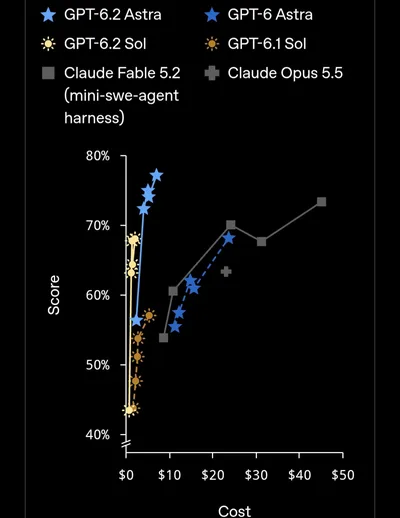
OpenAI released its GPT-6.2 Astra and Sol models on 17 November, and developers quickly criticized Astra. Theo, founder of T3 Code, called Astra "the worst model OpenAI has ever released," and in a long test said it spent seven days on a task to speed up a Rust-based TypeScript compiler without delivering a useful improvement, leaving the compiler 56% slower. Blind tests on the Arena.ai platform showed Astra's programming score rising by 50 points while its everyday conversation score fell by 54 points, and Sam Altman admitted on X that more work was needed.
The next day Google released Gemini 4 Neon, which topped the Artificial Analysis coding agent[1] index with 58.6 points and charges $3 per million input tokens[2] and $15 per million output tokens, less than half of Astra's price. In the Arena Agent leaderboard, which tests how models handle real engineering work, Astra placed sixth, and the top model, Claude Fable 5.2, finished 157 points ahead of it. On 20 November Anthropic mathematician Levent Alpöge released 17 million lines of code with a proof of the Riemann hypothesis, which the Lean and Mathlib communities officially verified a day later.
On 19 November Anthropic held its IPO[3] on Nasdaq under the ticker ANT, priced at $83 per share; the stock opened 34.3% higher, its market value passed $2.09 trillion, and the first day raised over $107 billion including a private placement[4]. Binkg, posting on X, claimed that OpenAI's latest private round valued the company at $1.25 trillion and raised $15 billion, below its target of $30 billion, and that its operating loss grew to $10.9 billion in the third quarter. Jason Calacanis said on the All-In podcast that Anthropic offered a recent computer science graduate $40 million in equity over four years.