Voyager 1 Becomes the First Spacecraft to Reach One Light-Day From Earth
Update · : The article reports that a command sent from Earth now takes 48 hours to get a reply, and that NASA expects Voyager 1 to keep at least minimal operation until the 50th anniversary of its launch next summer. It also gives Voyager 2's expected arrival at one light-day as 2035.
Update · : The Chinese-language article gives the milestone time as 18:16 Beijing time on 18 November 2026, and states that the probe's average speed is about 1 million miles per day, so the trip to one light-day took roughly 50 years. It also adds that Voyager 2 launched on 20 August 1977 and Voyager 1 on 5 September 1977, and that Voyager 1 was sent on a faster path to Jupiter and Saturn.
Update · : A former NASA chief historian, Glen Swanson, has found a second set of operating instructions inside the protective cover of the Voyager Golden Record and several spare copies made and distributed nearly 50 years ago. He is co-writing a book with the record's design director, Jon Lomberg, due from the University of Chicago Press in August 2027.
1 more update
Update · : NASA says the milestone was reached at 5:16 a.m. Eastern time on 18 November, with confirmation expected after about a day of signal travel and a public event planned for 19 November. JPL representatives estimate that recent power-saving measures may let both Voyager probes keep communicating for three to four more years.
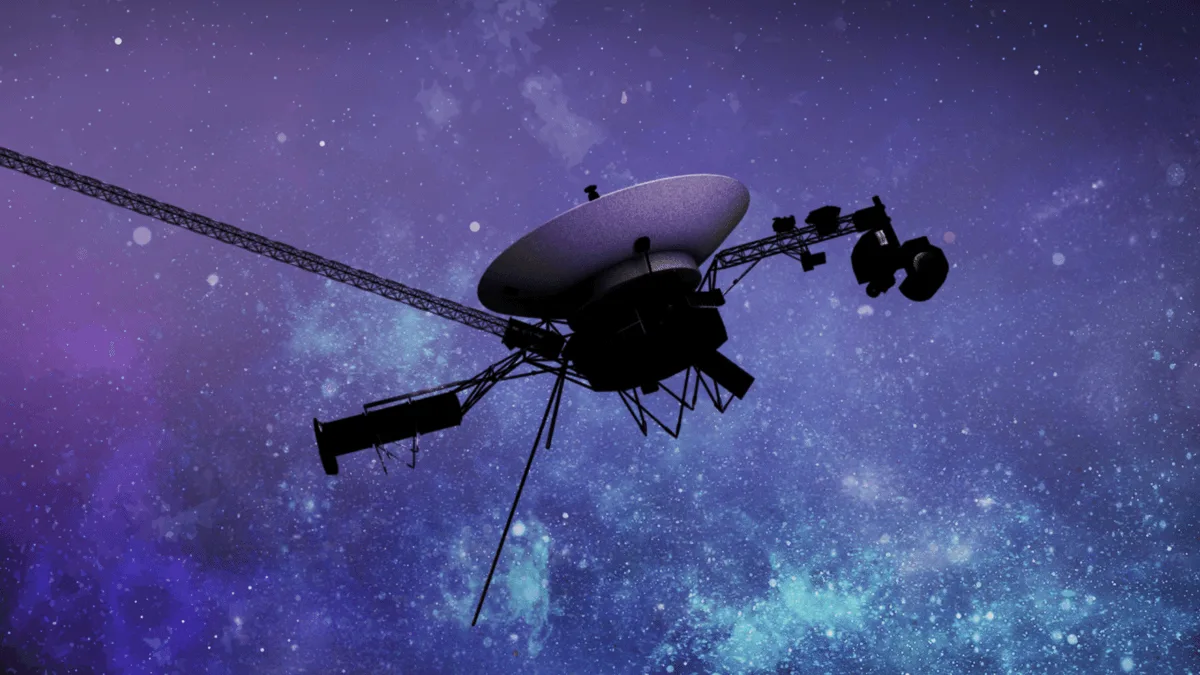
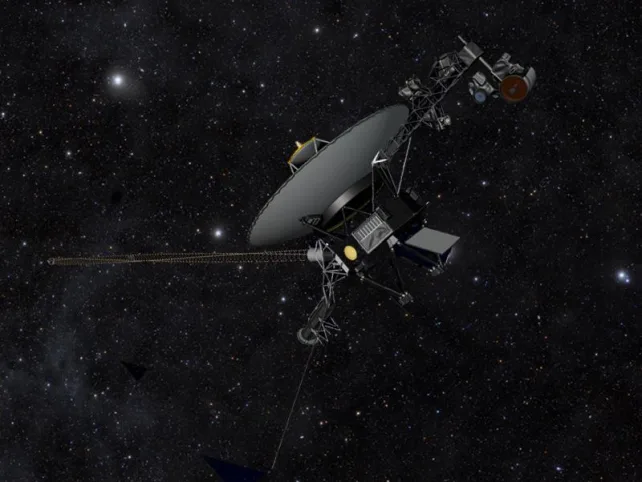
Voyager 1 reached a distance of one light-day[1] from Earth on 18 November 2026, when it was about 25.9 billion kilometers (16.1 billion miles) away. Its radio signals now take a full 24 hours to reach Earth. Earth's movement along its orbit changes the distance during the year, but the spacecraft will stay more than a light-day away even when Earth moves closer to it.
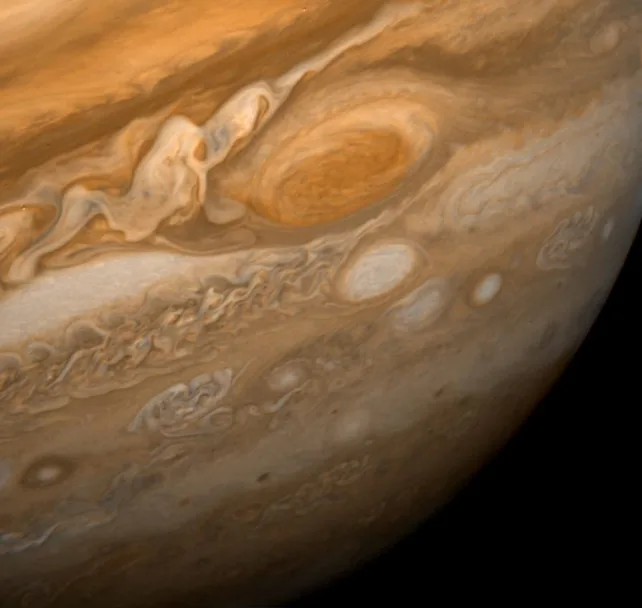
The article recalls the probe's route. It reached Jupiter in 1979 and Saturn in 1980, and in 1998 it became the most distant human-made object. On 25 August 2012, at about 18.2 billion kilometers (11.3 billion miles) from the Sun, it crossed the heliopause[2], the boundary of the solar wind, and entered interstellar space. The heliopause is the outer edge of the heliosphere[3], the bubble around the Sun in which the planets orbit.
Only two of the probe's 10 science instruments are still working, and its nuclear power supply loses around 4 watts of output every year, so the remaining time is unknown. Scientists still cannot fully explain why the magnetic field beyond the heliopause stays aligned with the field inside the heliosphere instead of turning toward the expected interstellar direction.
Read the original sciencealert.comDiscussion
Discussion
Commenters mostly react briefly to the distance and the probe's age, and some joke about the GTA6 release. One says it is sobering that reaching this point took more than 50 years, while another is surprised at how empty space is. A user asks whether images are still coming from Voyager 1, and no answer is given.
Sources
-
ScienceAlert
It's Official! Voyager 1 Is The First Spacecraft To Reach One Light-Day From Earth
-
CNIT Home ZH new source ·
旅行者 1 号抵达距地球一光日位置,NASA 金唱片尘封细节被揭开
-
RUHabr top daily RU new source ·
Вояджер-1 удалился от нас на 1 световой день
-
KRDaum KO new source ·
광속 1일 거리…보이저 1호가 ‘픽’한 태양계 사진첩 [놀라운 우주]
-
TWCNA Technology ZH new source ·
NASA旅行家1號探測器 估已達成「光日」里程碑
-
CNHuxiu ZH new source ·
旅行者1号飞到了离地球整整一“光日”的地方