Sheep grazing under solar panels raises bee and beetle counts, study finds
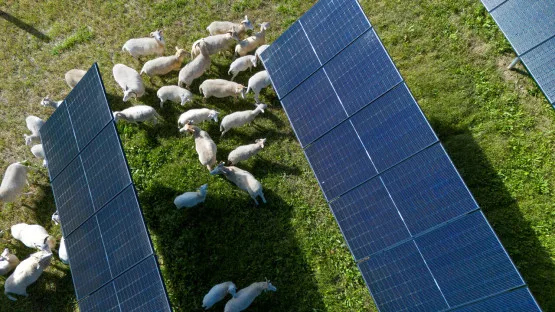
Two research papers from Cornell University examine grazing sheep in fields with solar arrays. A team from the College of Agriculture and Life Sciences found that at two sheep per hectare, the abundance of wild bees, honey bees and lady beetles rose by 38% compared with a mowed control plot[1]. The increase was driven mainly by an 83% rise in honey bees, according to a paper published in October 2026 in Environmental Research Letters.
Over three years, the researchers tested different stocking rates[2] at the Cascadilla Community Solar Farm in Dryden, New York. At four sheep per hectare, insect abundance was similar to the mowed plot, and vegetation management was better than at two sheep per hectare. At eight sheep per hectare, vegetation management was maximized and flock health stayed high, but honey bee abundance dropped by 45%.
A second Cornell team from the SC Johnson College of Business built a spreadsheet-based model, described in a paper published in September 2026 in Manufacturing & Service Operations Management. The model helps sheep farmers make procurement and sales decisions based on flock size, costs, expected revenues and expected vegetation at a given site. United Agrivoltaics has already added the tool to its onboarding process. The authors note that about half of the lamb and mutton eaten in the U.S. is imported, mainly from New Zealand and Australia.
Read the original news.cornell.eduDiscussion
Discussion
Commenters ask why solar farms are built on grassland instead of barren desert land, and some suggest goats or cattle instead of sheep. Others point to similar projects, such as sheep at a Princeton University solar field and cows at the DRAO observatory in British Columbia. One commenter argues that a corn field is effectively an industrial site and that solar panels produce far more energy than energy crops.
Links from the post and discussion
- Wikipedia article on agrivoltaics, suggested in comments en.wikipedia.org
Sources
-
Cornell Chronicle
Grazing sheep in fields with solar arrays
-
KRGeekNews KO
태양광 패널이 설치된 들판에서 양 방목하기