A Proposed Prediction Market for Scientific Questions
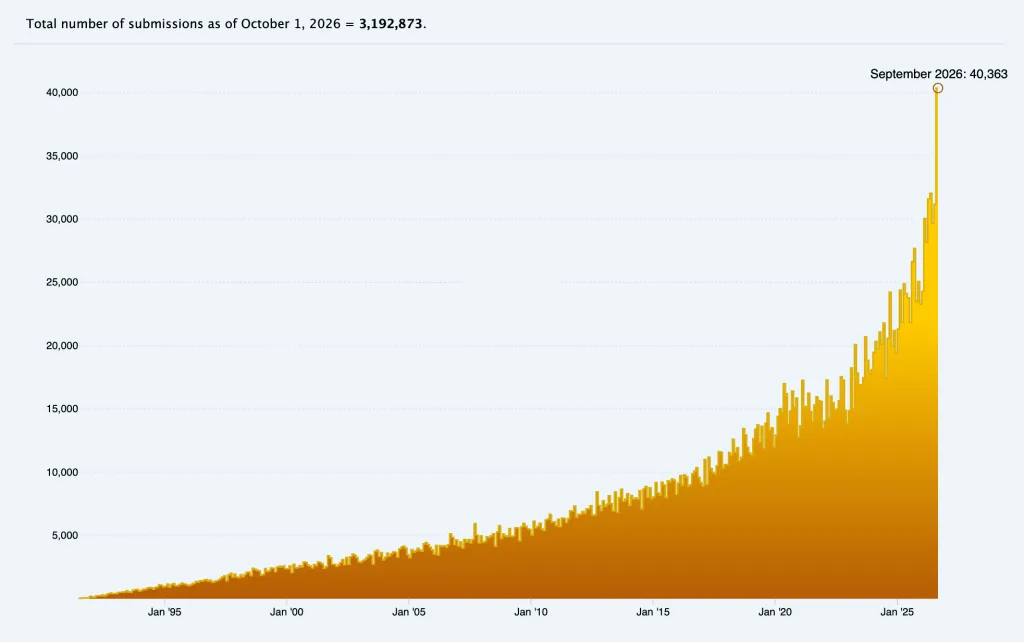
The author notes that arXiv submissions have grown sharply and argues that the current peer review system is not ready for AI-accelerated research. The result is more low-quality papers, called slop[1], alongside more good work than peer review can separate. The author proposes a scientific prediction market[2] as a decentralized way to aggregate this information.
Robin Hanson's idea futures have a settlement problem for abstract questions, since no single event can resolve them. Hanson's suggested fallback of waiting for scientific consensus depends on possibly misaligned opinions and centralized coordination of scientists. The author proposes that scientific questions become perpetuals[3], where the fair price is the expected direction of future evidence, and that experiment markets settle on their own outcomes.
Anyone can create an experiment market and commit in advance to using its profits to buy put or call options[4] on a specific perpetual, depending on the experiment's result. The options have no expiration date, and their value to the scientist is the expected price move indicated by the work. The author lists expected benefits: financial reward for filtering research, liquidity focused on experiments that matter, incentives for careful work, and payment for researchers who are not yet recognized. The author asks readers for critiques of the market structure.
Read the original lesswrong.com
Sources
-
LessWrong
A New Kind of Prediction Market for Science