arXiv paper proposes a quantum gravity method; OpenAI's role is unconfirmed
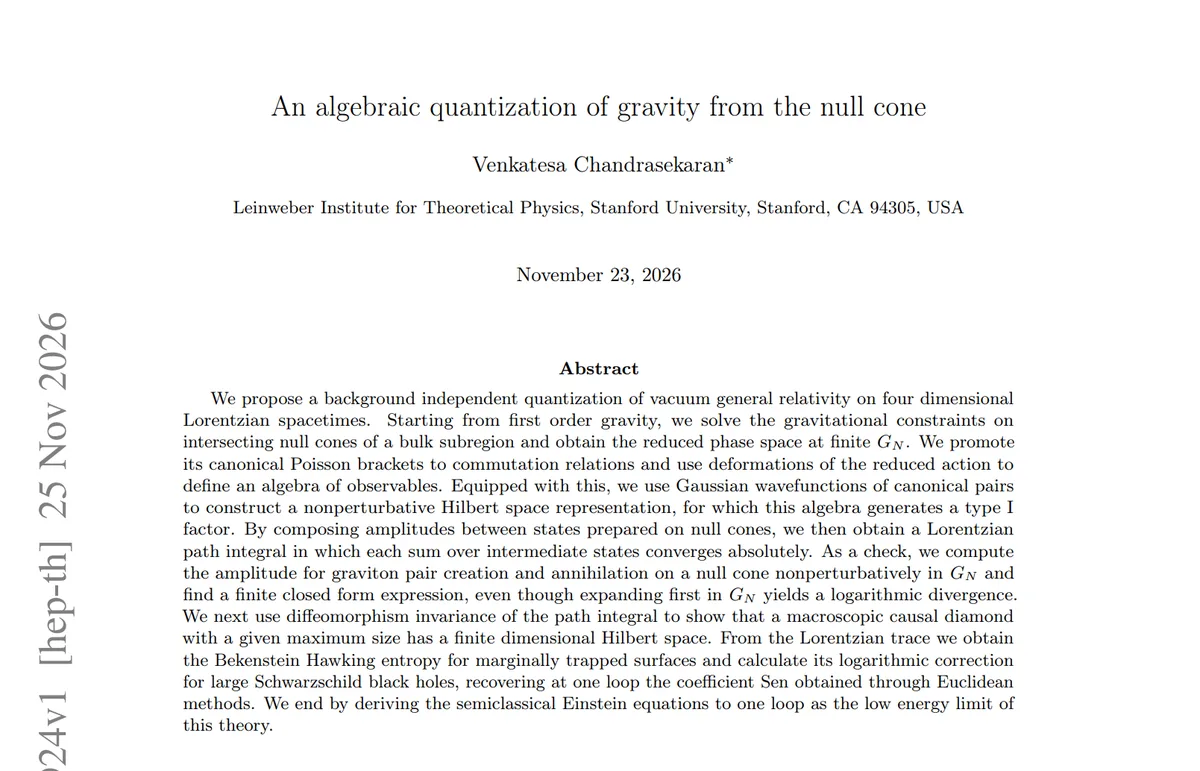
A theoretical physics paper submitted to arXiv on 25 November 2026 proposes a background-independent quantization of vacuum general relativity on four-dimensional Lorentzian spacetimes. It starts from first-order gravity, solves the gravitational constraints on intersecting null cones[1], and builds a nonperturbative Hilbert space[2] for the resulting observables.
The authors use this to define a Lorentzian path integral and compute the amplitude for graviton pair creation and annihilation. Expanding first in G_N gives a logarithmic divergence, but the nonperturbative calculation yields a finite closed-form expression. They also show that a macroscopic causal diamond of a given maximum size has a finite-dimensional Hilbert space.
From the Lorentzian trace, the paper obtains the Bekenstein-Hawking entropy[3] for marginally trapped surfaces and a logarithmic correction for large Schwarzschild black holes, which matches Sen's coefficient at one loop. It ends by deriving the semiclassical Einstein equations to one loop as the low-energy limit of the theory. The abstract does not mention OpenAI, GPT-6 Astra or AI. The anonymous post that shared the paper claims that GPT-6 Astra from OpenAI helped with this result, but the paper does not confirm this.
Read the original arxiv.orgDiscussion
Discussion
Most commenters joke or ask for an explanation. One says the paper's author is well known in the field, another says the work was led by a human who used AI, and a third notes that the paper does not say how much AI helped.
Primary sources and details
- Primary source arXiv homepage (site hosting the paper) arxiv.org
- Primary source arXiv PDF of the quantum gravity paper arxiv.org
- Primary source arXiv abstract of Chandrasekaran & Witten 2022 paper arxiv.org
- Official OpenAI Forum video on author's use of Codex forum.openai.com
- Official IAS faculty page of Venkatesa Chandrasekaran ias.edu
- Analysis Wikipedia article on arXiv en.wikipedia.org
- Analysis Substack post on whether AI contributed to quantum gravity superposer.substack.com
- Analysis YouTube discussion of the paper by its author youtube.com
Sources
-
arXiv
OpenAI and GPT-6 Astra Just Tackled Physics’ Holy Grail: Uniting Einstein and Quantum Mechanics
OriginalDiscussion · 118Discussion · 76Discussion · 55Discussion · 35DiscussionDiscussion
-
KRGeekNews KO
널 원뿔에서 출발한 중력의 대수적 양자화
-
Reddit new source ·
Standford Physicist Venkatesa Chandraeskaran working along with Astra 6 has algebraically Quantized Gravity!
 archive