Outer space is not consistently big: distances compared with object sizes
The author uses scale models and to-scale images to show how far apart celestial objects are. In a Sweden model at 1:20,000,000, Earth and Venus are each about 2 feet in diameter yet over a mile apart. A Finland model at 1:3,000,000,000 is 150x more condensed, its Sun is about 1.5 feet across, and its model of the nearest star, Proxima Centauri, is in Australia.
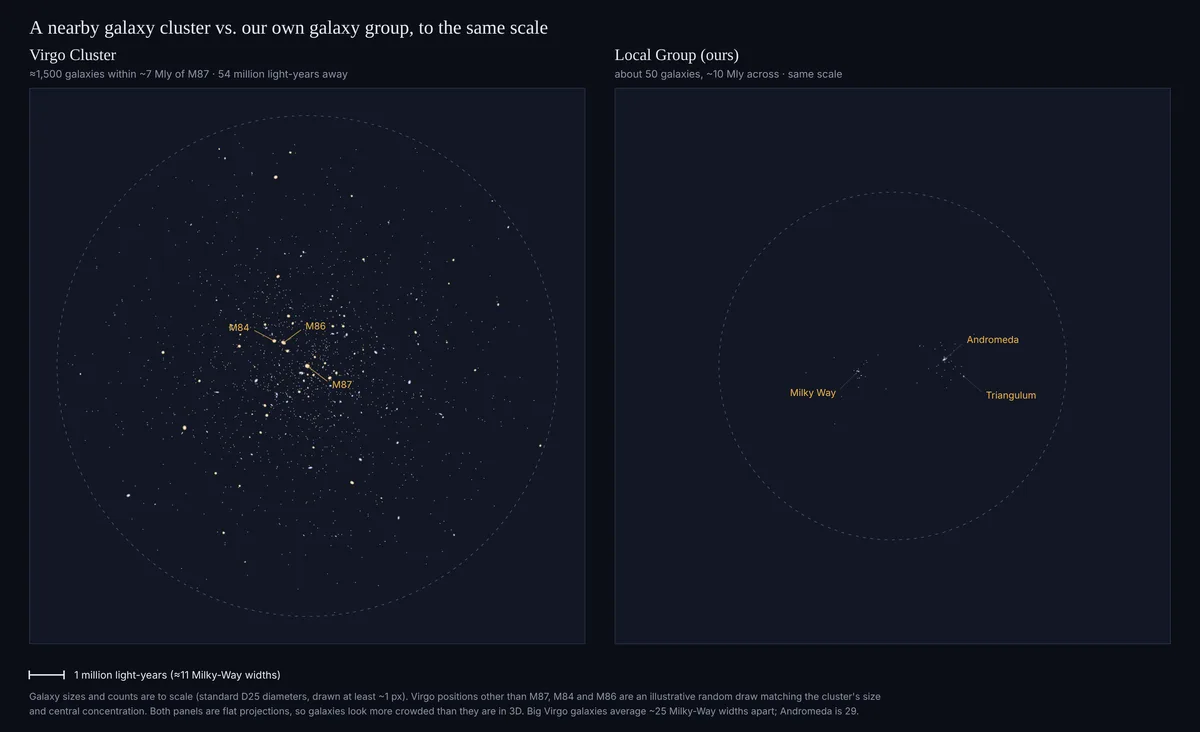
Galaxies follow the same pattern: if the Milky Way were a typical US suburban home, Andromeda would be a McMansion 3 blocks down the road. The Large Magellanic Cloud, the Milky Way's "moon", is about as close as Earth's Moon is often misleadingly depicted. The Virgo Cluster, about 54 million light-years[1] away, is 620 Milky-Way-widths away and dense, like a city center a 6-mile drive from the suburban house.
Measured in object widths, distances between celestial objects vary by 7 orders of magnitude[2]. The Milky Way is put at 87,400 light years across and Andromeda at 152,000. If the dark matter halo[3] is counted as part of each galaxy, Andromeda is only about 1.3 halo-widths away, and dark matter is believed to be more than 90% of the Milky Way's mass.
Read the original lesswrong.com
Discussion
Commenters mostly explain the seven orders of magnitude by the stars: they collapsed far more than galaxies did, so the gaps between them are huge compared with their size. One commenter adds that Andromeda's rotation axis is not perpendicular to the Milky Way's, so the two would look even further apart than the image suggests.
Links from the post and discussion
Sources
-
LessWrong
Outer space is not consistently big