Astronomers find dwarf planet candidate ED138, which orbits the Sun every 281 years
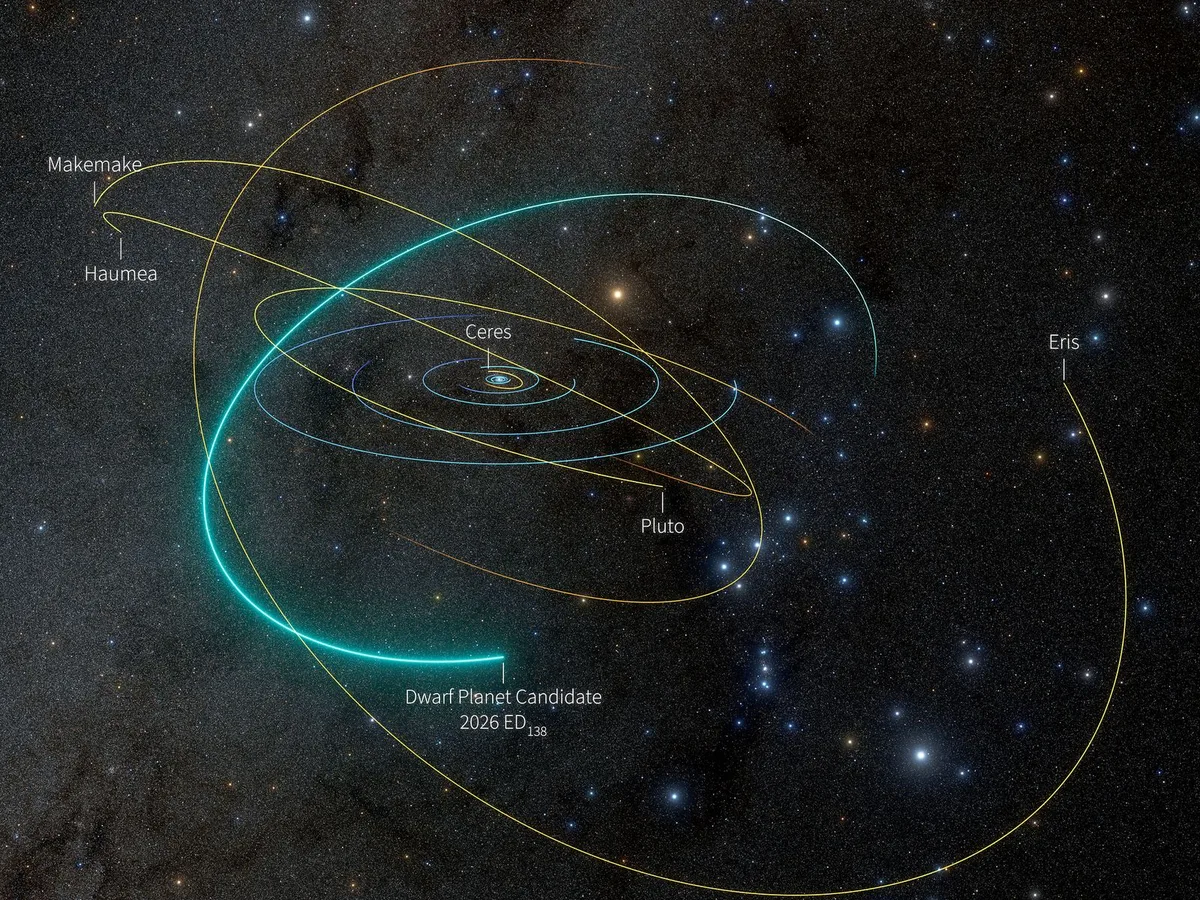

ED138 is a dwarf planet candidate, an object far beyond Pluto that appears big enough to be classified as a dwarf planet[1]. Matthew Holman of the Smithsonian Astrophysical Observatory spotted it in data from the Vera C. Rubin Observatory in Chile while checking the results of a custom computer program. Holman, Kevin Napier and Mario Jurić then found the object in earlier sky photos, including 1937 photographic plates stored at Harvard, which helped them pin down its orbit.
The object, called 2026 ED138, is 46 times farther from the Sun than Earth is, and it takes 281.1 years to complete one orbit. Its estimated size is 370 to 930 miles across, but brightness alone cannot show whether it is that large. Astronomers could confirm the size with infrared observations or by timing how long the object blocks the light of a star[2]. Right now five dwarf planets are recognized: Pluto, Eris, Makemake and Haumea in the distant Kuiper Belt[3], and Ceres in the asteroid belt.
Holman thinks many more such objects may exist, because some could have stretched orbits that keep them far away most of the time. ED138 has also been moving for 25 to 30 years through a part of the sky in front of the dense core of the Milky Way, where it is hard to pick out objects. The Rubin Observatory is expected to help explore the southern sky, which has received fewer observations than the northern sky.
Read the original smithsonianmag.comDiscussion
Discussion
Several commenters shared an orbit calculator and called the object big, and others agreed that the 2006 reclassification of Pluto was the right decision. Some asked whether ED138 is Planet X or evidence for Planet Nine, and a few joked about the name.
Links from the post and discussion
- NASA page on Planet X, linked by a commenter science.nasa.gov
Sources
-
Smithsonian Magazine
Dwarf planet candidate appears which takes roughly 280 years to orbit our sun
-
KRGeekNews KO
태양을 한 바퀴 도는 데 약 280년 걸리는 왜소행성 후보 발견