Carrion crows make decisions about twice as fast as humans and rhesus monkeys
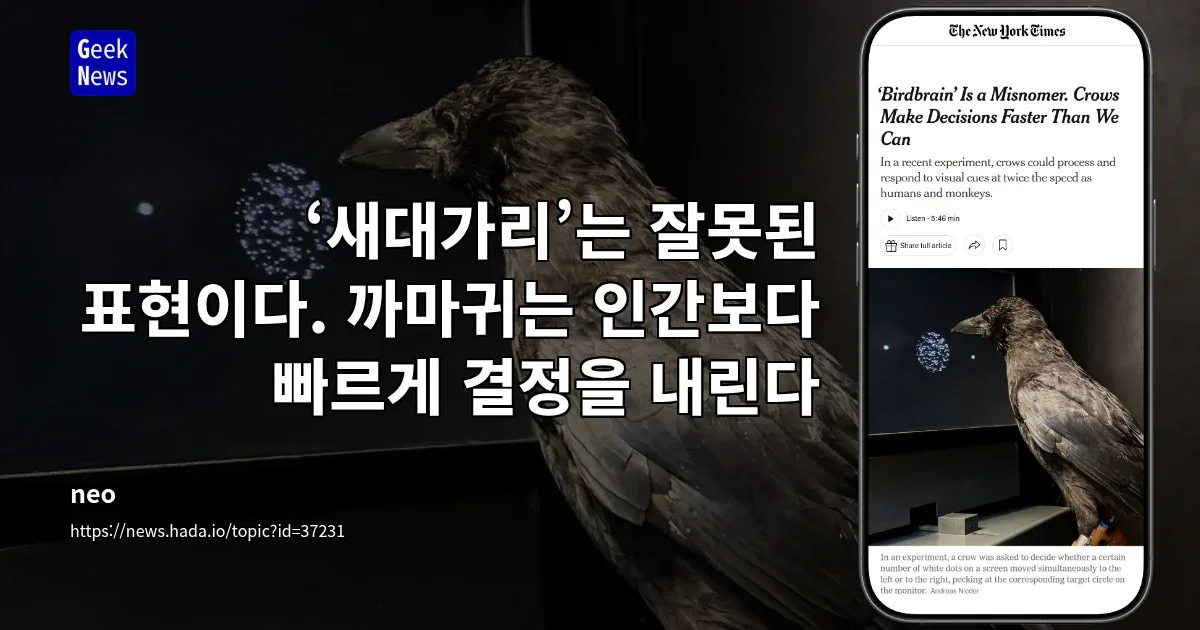
A team from the University of Tübingen in Germany measured how fast carrion crows process visual information. Two crows, Lemmy and Iggy, were trained over several weeks to peck left or right depending on the direction of white dots on a black screen, with mealworms as a reward. The birds had 3 seconds to respond but answered in about 235 milliseconds (0.235 seconds), roughly twice as fast as humans and rhesus monkeys doing similar tasks, and their accuracy stayed the same. Human participants in follow-up tests could not match the crows' speed.
The researchers focused on the crow's caudolateral nidopallium[1], a brain region functionally similar to the prefrontal cortex[2] of primates, which handles planning, working memory and abstract thought. In crows, this region holds nearly the same number of neurons as the rhesus monkey's prefrontal cortex, packed into a smaller space. Michael Griesser of the University of Konstanz said bird brains are anatomically far more efficiently connected.
The team suggests that fast decision-making evolved in response to flight risks, such as avoiding collisions, and to the need to secure food. The results contradict the long-held view that small bird brains mean low intelligence.
Read the original nytimes.comDiscussion on GeekNews
Discussion
Commenters mostly question the framing: several say "birdbrain" does not mean slow decisions, and that quick responses may be automatic reflexes rather than thought. Some note that humans reacting to simple visual signals can be faster, with gamers around 150 ms, while others point out that intelligence evolved separately in corvids, mammals and octopuses.
Sources
-
KRGeekNews KO
‘새대가리’는 잘못된 표현이다. 까마귀는 인간보다 빠르게 결정을 내린다
-
The New York Times
Crows make decisions faster than we can