AI promised less work: one engineering lead's GitHub history shows more work than ever
What happened next
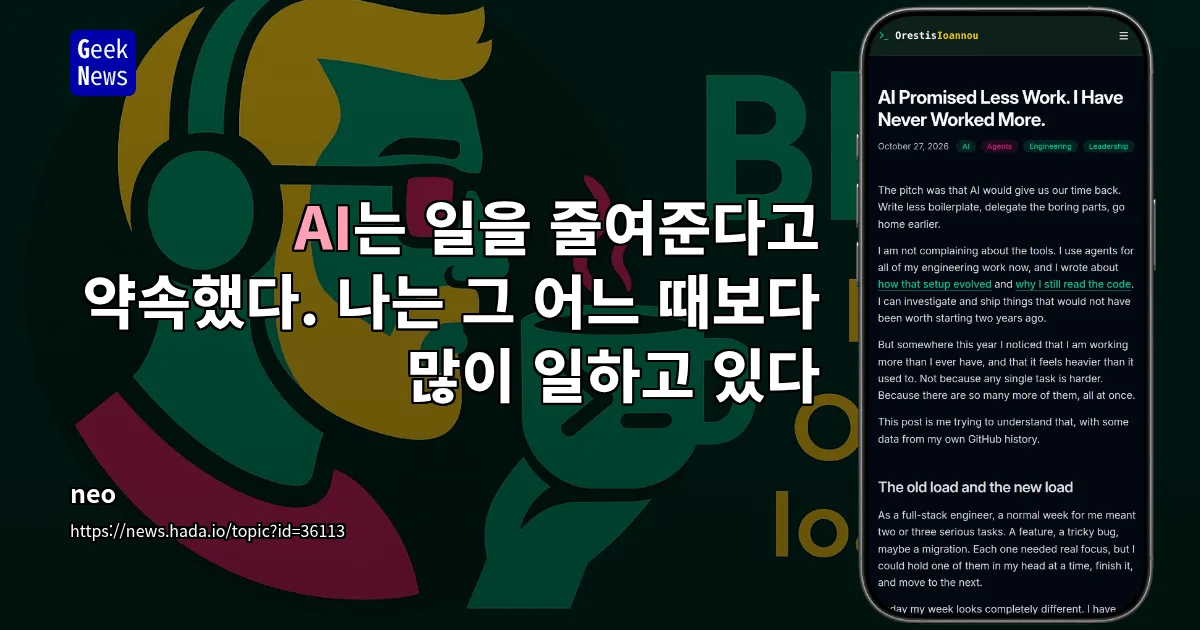
An engineering lead at Bold.org reports that AI agents[1], pitched as a way to give engineers their time back, have instead made the job busier than ever — and heavier. Before agents, a normal week meant two or three serious tasks handled one at a time; now several agents run in parallel — one implementing a change, one investigating a production question, one working through a review, one doing research — and each eventually comes back with a question, a plan to approve or a diff[2] to read. Answering each one means context switching[3]: reloading a different problem, repository and set of decisions, which the author finds more draining than the old workload.
Their GitHub contribution[4] history backs this up: 2020, the busiest year as a Full Stack Engineer, brought 2,711 contributions; the Principal Engineer years averaged 114 a month against 173 earlier; and December 2025, shortly after becoming Vice President of Technology, was the quietest month since joining the company, with 50. By October 27, 2026 the count was already 2,102 contributions — more than any full year from 2021 to 2025 — with August 2026 the busiest month in the whole timeline at 427, against a previous high of 319 in April 2020, and the median weekday up from 3 or 4 contributions in 2022–2025 to 7, close to the 8 of 2020. Weekdays with no recorded GitHub activity fell to 18 through October 27, against 40–46 in each full year from 2022 to 2025, and days with 24 or more contributions went from exactly one per year to 16, nearly the 17 of 2020.
The explanation, in the author's view, is that implementation has become cheap: fixing bugs that would once have been left alone, improving patterns across the codebase and starting new projects no longer meet natural friction, so agents did not just speed up the old workload but made it easy to take on a much bigger one. The year moved in bursts — 277 and 233 contributions in January and February, when serious work with agents began and an observability experiment grew into the company's internal agent, a slide to 77 by June, then 427 in August and 301 in September. Three such cycles have played out since January: a new model or workflow opens up possibilities, more agents get started, then reviewing and context switching catch up, the pace is pulled back, and the burst ends with the author tired of AI. Even the quiet months now sit near the Principal Engineer average, because there are always agent results to work through and reviews to finish.
Read the original oioannou.comDiscussion on GeekNews
Discussion
Commenters mostly see the pattern as structural: one says AI speeds up the whole machine, upstream inputs included, while the human stays the same, turning the work into a treadmill, and another calls it an inevitable escalation where solving everything faster only creates more problems. A separate comment argues AI gives employers immense leverage, letting them exploit workers who in the current job market have nowhere to go.
Sources
-
KRGeekNews KO
AI는 일을 줄여준다고 약속했다. 나는 그 어느 때보다 많이 일하고 있다
-
oioannou.com
AI promised less work. I've never worked more
Earlier in this story
- Millions of human-level AI workers may be dangerous even without superintelligence
- In 2026, 'AI skills' are worthless: tricks become the product's default
- AI-era architecture: make detailed design your own to delegate implementation
- Engineer with 10 years of experience says AI often designs systems better than humans