Why IVRy moved its phone app from Flutter to native Swift and Kotlin

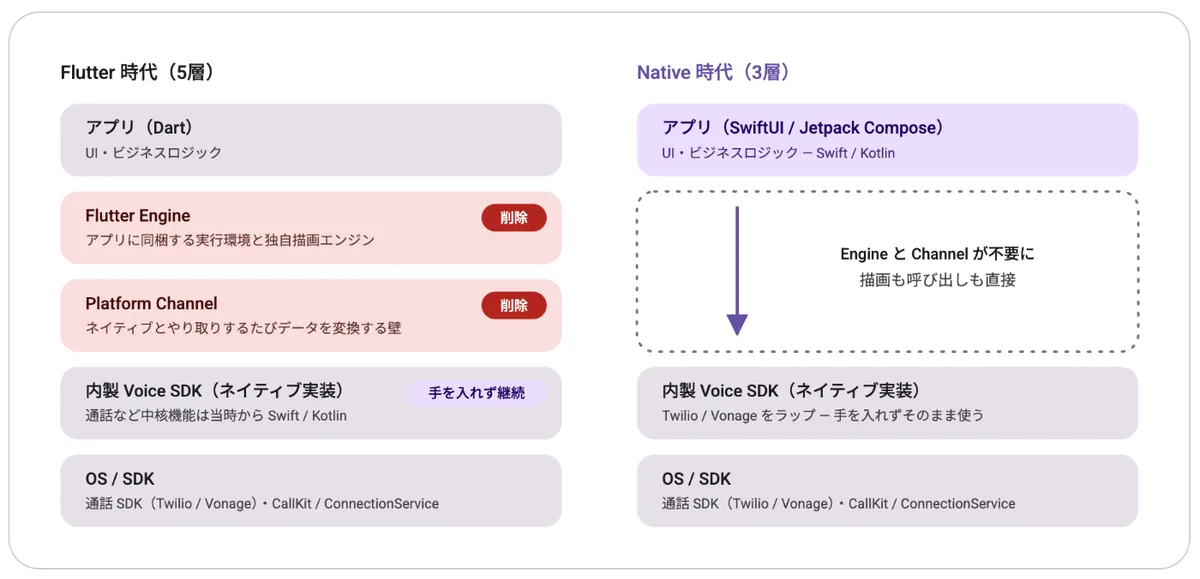
IVRy has completed its Flutter Exit: the phone app, previously built with Flutter[1], now runs fully native — Swift and SwiftUI on iOS, Kotlin and Jetpack Compose on Android — and the rollout to all users on both platforms finished in October 2026. The app's main use cases are receiving call transfers and returning calls, with the company's interactive voice AI automating first-line call handling. Flutter had been a rational choice when engineering resources were limited: shared Dart code, easy feature parity across platforms and Hot Reload[2] for quick UI checks, while call handling was already isolated in a native in-house SDK, since OS call functions and the call SDK required native implementation.
The project pursued two goals — improving the quality and stability of voice calling, the app's core feature, and simplifying the architecture for productivity and maintainability — as the product's growth made OS-specific functionality more important and the Flutter-native boundary harder to maintain. Almost all voice call processing was already implemented in Kotlin and Swift, with Flutter serving mainly as a wrapper for a WebView-based UI, so shared UI components brought little benefit and several Flutter library issues, especially around WebView, had affected voice calls. About 50 Platform Channels[3] calls and callbacks linked the two sides, incoming call events traveled between OS, native and Flutter layers so every incident required isolating the faulty layer, and on Android, answering calls while the app was closed required running a separate background (headless) instance of the Flutter engine. In a pre-migration PoC[4], the median Android cold-start time from app launch to the first screen fell from 192.5ms to 49.6ms — about 74% shorter, roughly 3.9x faster — and other call paths, such as from call notification to call UI, improved as well, though not all of the gap is attributable to Platform Channels.
With more mobile engineers on board, AI coding tools such as Claude Code and Devin lowered the cost of writing the same features twice in Swift and Kotlin, and Anthropic describes large code migrations — where existing code serves as the specification and tests verify the result — as an area where AI agents work especially well. In a PoC, without touching the existing native call code, the Dart-to-Swift/Kotlin migration alone took 2–3 days to reach the point where making, receiving and forwarding calls worked on both platforms, though quality verification and release still required separate time. The author presents the move as no rejection of Flutter itself, citing Notion's shift from a WebView-centric app to native and Shopify's announced return from React Native to native, while release work, operations and per-OS design remain as purely additive costs.
Sources
-
JPZenn JA
Flutter やめました。電話アプリを Native にした理由