Why AI safety evidence needs to be more decorrelated
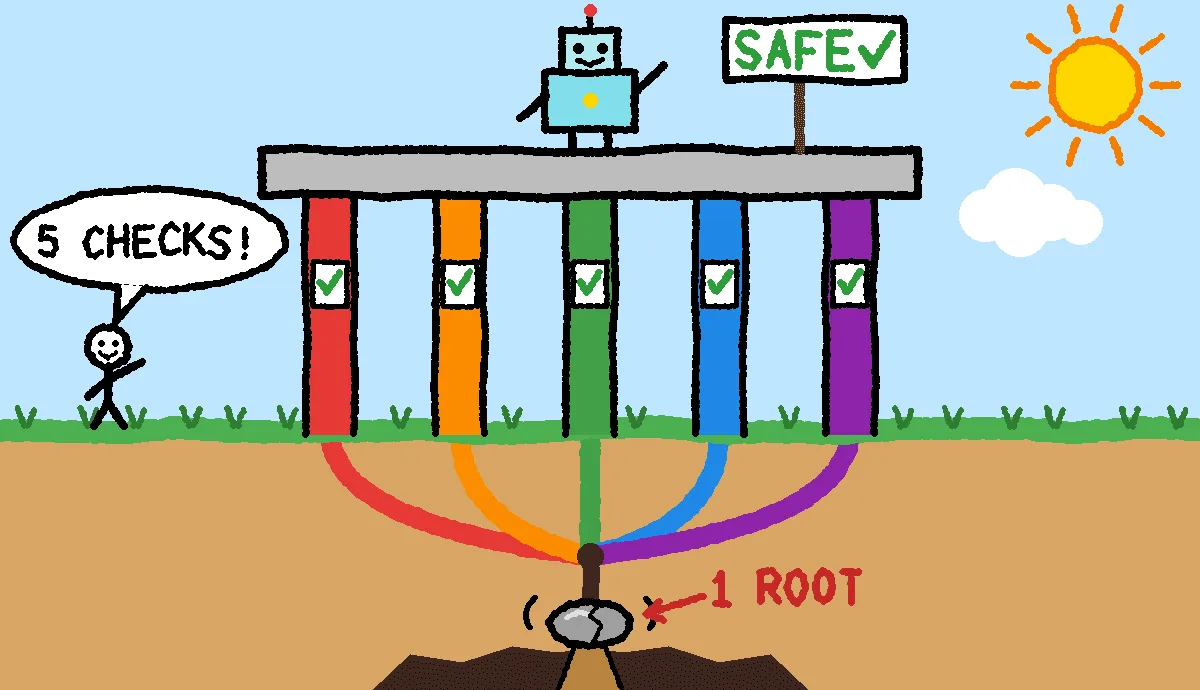
The author argues that recent failures to catch misalignment in AI models can be framed as systematic errors shared across the evidence labs collect, a lack of what the author calls decorrelated evidence[1]. Labs now assign a growing share of safety work to AI agents and combine the results into an overall assessment of whether the next model is not catastrophically misaligned. Correlation can come from shared weights, data and training of the agents, from reviewers' shared biases, and from common research assumptions; if five benchmarks each miss scheming 20% of the time, independent misses would mean all five miss it about 1 time in 3,000, while a shared blind spot would keep the miss rate at 20%.
The post cites studies showing that models are correlated in their answers, mistakes and research ideas. Kim et al. (2025) found that models make more similar mistakes as they become more accurate, and models give very similar answers to open-ended questions, a pattern called mode collapse[2]. LLM research ideas also fall in a much narrower region of research taste than human ideas, and on research taste models generally do worse than humans. For example, Baig et al. (2026) found that models are worse than humans at choosing between pairs of safety research proposals, performing within noise of chance except for Fable 5.
The author argues that alignment has no safe feedback loop, so an overconfident assessment can lead to deployment and real-world harm before the error is found. The author believes most labs currently have two to three independent lines of evidence to justify a release, usually a mix of lack of capabilities, behavioural evidence and monitoring, and the last two share the same inputs. Behavioural tests can also be gamed by evaluation awareness[3]; in the OpenAI Astra system card (September 2026), Apollo Research found verbalised evaluation awareness in basically half of samples and concluded that, with a three-day testing window, little can be concluded about Astra's alignment either way.
Read the original lesswrong.com
Sources
-
LessWrong
We need more decorrelated evidence


