Why AI-generated text is hard to understand: a study of its linguistic features
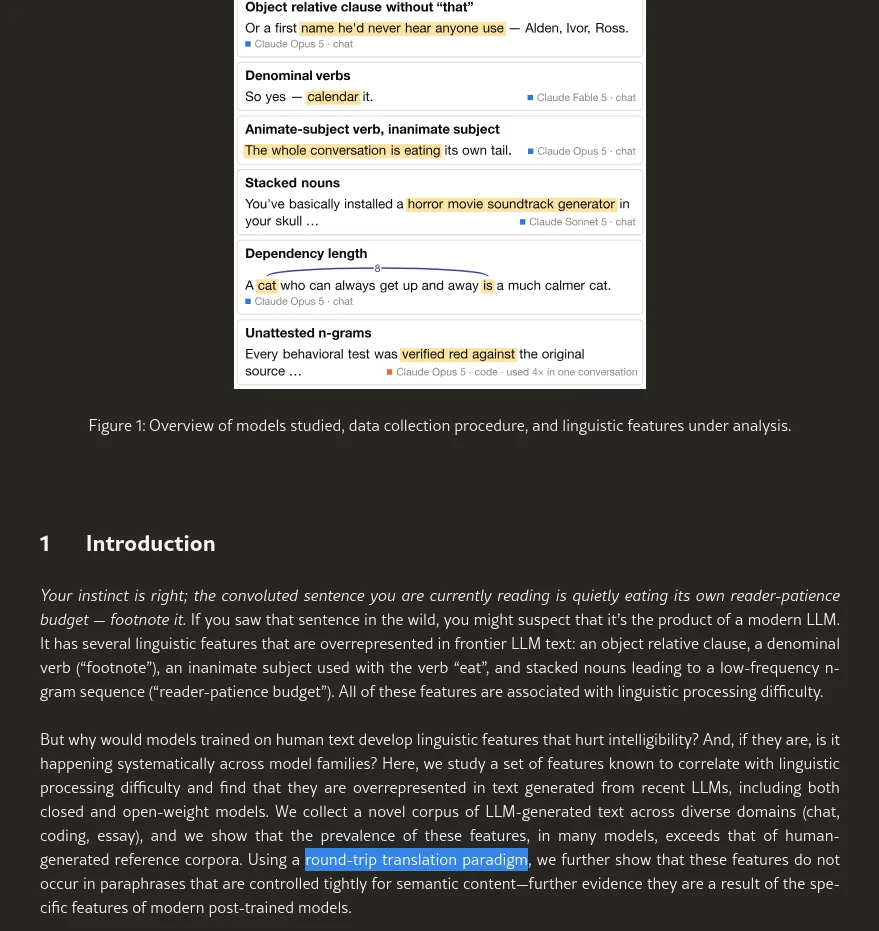
A preprint on arXiv, submitted on 21 October 2026, examines why text written by AI models is hard to read. The authors study psycholinguistic features known to correlate with how much effort humans need to process a sentence, such as object relative clauses[1] and low-frequency n-grams[2].
Using a new corpus of AI-generated text from diverse domains, the authors find that AI models use these difficult features more often than paraphrases made by round-trip translation[3]. Compared with human writing, all nine frontier and near-frontier models in the study use more inanimate subjects with animate verbs and more low-frequency n-grams. Most also use longer dependencies, more stacked nouns and more reduced object relatives in conversation, and the model families differ substantially from each other.
The authors propose that human language is optimized for successful communication, while AI text is increasingly optimized for goals such as math, code and reasoning, where information density matters more. As a proof of concept, they fine-tuned a language model under a length penalty[4], and its output diverged from human-like linguistic behavior. The authors say the findings show where human and LLM processing demands misalign and point toward possible remedies.
Read the original arxiv.orgDiscussion
Discussion
Commenters mostly agree that AI text reads poorly, and several suspect that optimizing for benchmarks is the cause. Others say that asking for plain technical English or lay-person explanations solves most of the problem. One commenter says DeepSeek models write more clearly than other models and do not invent terms.
Sources
-
arXiv
[2610.29162v1] Why is AI-generated language so hard to understand?


