What developers still need to know when AI agents write the code
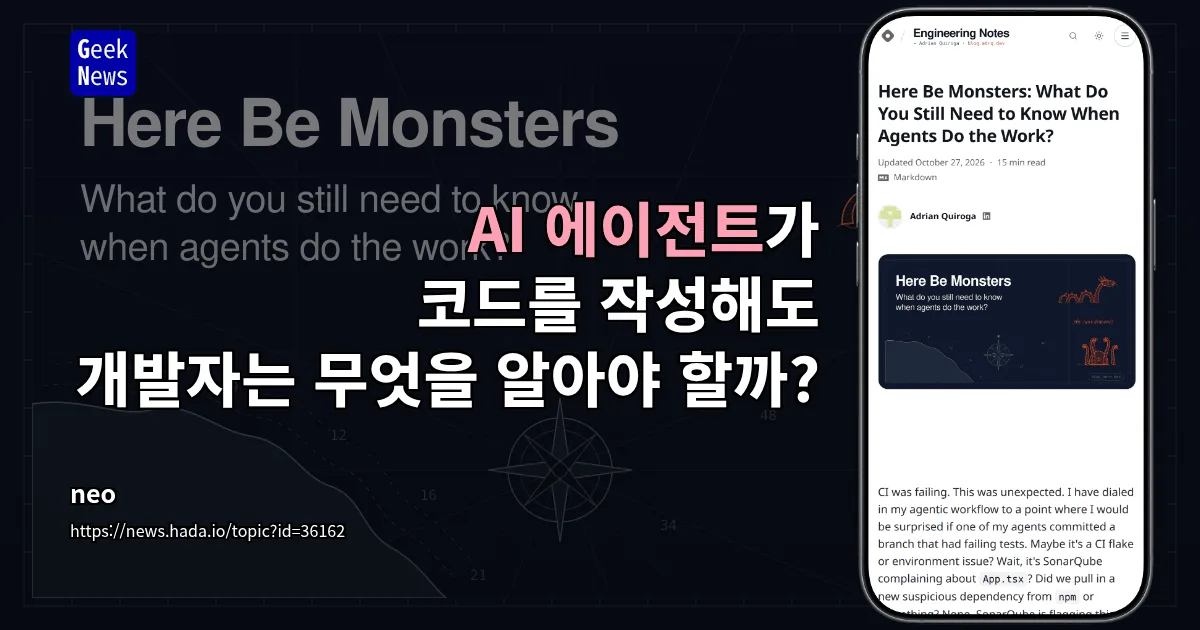
The author argues that when AI agents write most of the code, running a system depends less on having written every line yourself and more on the ability to notice anomalies and dig into the right places to the needed depth. Neither reading every generated line nor ignoring the implementation entirely is enough: the owner needs to understand the system's abstraction structure and be able to fix unfamiliar modules. In one example, SonarQube failed CI on App.tsx over cyclomatic complexity[1]; the file was about 30 lines long, and 15 of them were components Codex had written each on a single line.
Ownership here means being the person who gets contacted and is responsible when the system breaks, and agents generate code faster than any person can absorb it. The author compares software development to mining gold on the seafloor: optimists see agents as diving robots that build the facility and bring back progress reports and gold, while pessimists see robots that get lost, bring back fakes that look like gold, and build structures too complex to maintain.
The author proposes three pillars: foundational knowledge — data structures and algorithms, networking, concurrency, distributed systems — for detecting silent failures, where a system mostly works but quietly degrades (as when a dive taking 4 seconds at 2 m, 16 seconds at 4 m and 256 seconds at 16 m suggests quadratic complexity[2]); breadth of knowledge to judge where to investigate; and just-in-time depth[3], the willingness to learn whatever an unfamiliar problem requires. The third pillar is illustrated by recalling a level-triggered state machine[4] from a Kubernetes book, which helped rebuild an unstable agent orchestrator. On training the next generation, the author argues that few companies can afford years of manual coding for juniors, and suggests instead learning the fundamentals, accumulating breadth, and practicing building systems with agents on a small scale while staying ready to dive in when problems appear.
Read the original blog.adrq.devDiscussion on GeekNews
Discussion
Commenters largely agree that understanding a system as components and their interactions matters more than reading every line, pointing to sequence diagrams, black-box testing and attention to time and space complexity. The disagreements: one argues the failure that really matters is product failure, not developer discomfort; another objects that AI bears no personal consequences for its decisions the way a human teammate does; and one questions the search for capabilities that AI can never replace. Others add that just-in-time learning still needs context spread across repositories, history and tribal knowledge that AI only partly helps with, and that language models make poor database normalization decisions.
Sources
-
KRGeekNews KO
AI 에이전트가 코드를 작성해도 개발자는 무엇을 알아야 할까?
-
blog.adrq.dev
Here be monsters: What do you still need to know when agents do the work?


