Two students built a Japanese speech LLM and won the FT-LLM 2026 free-form task
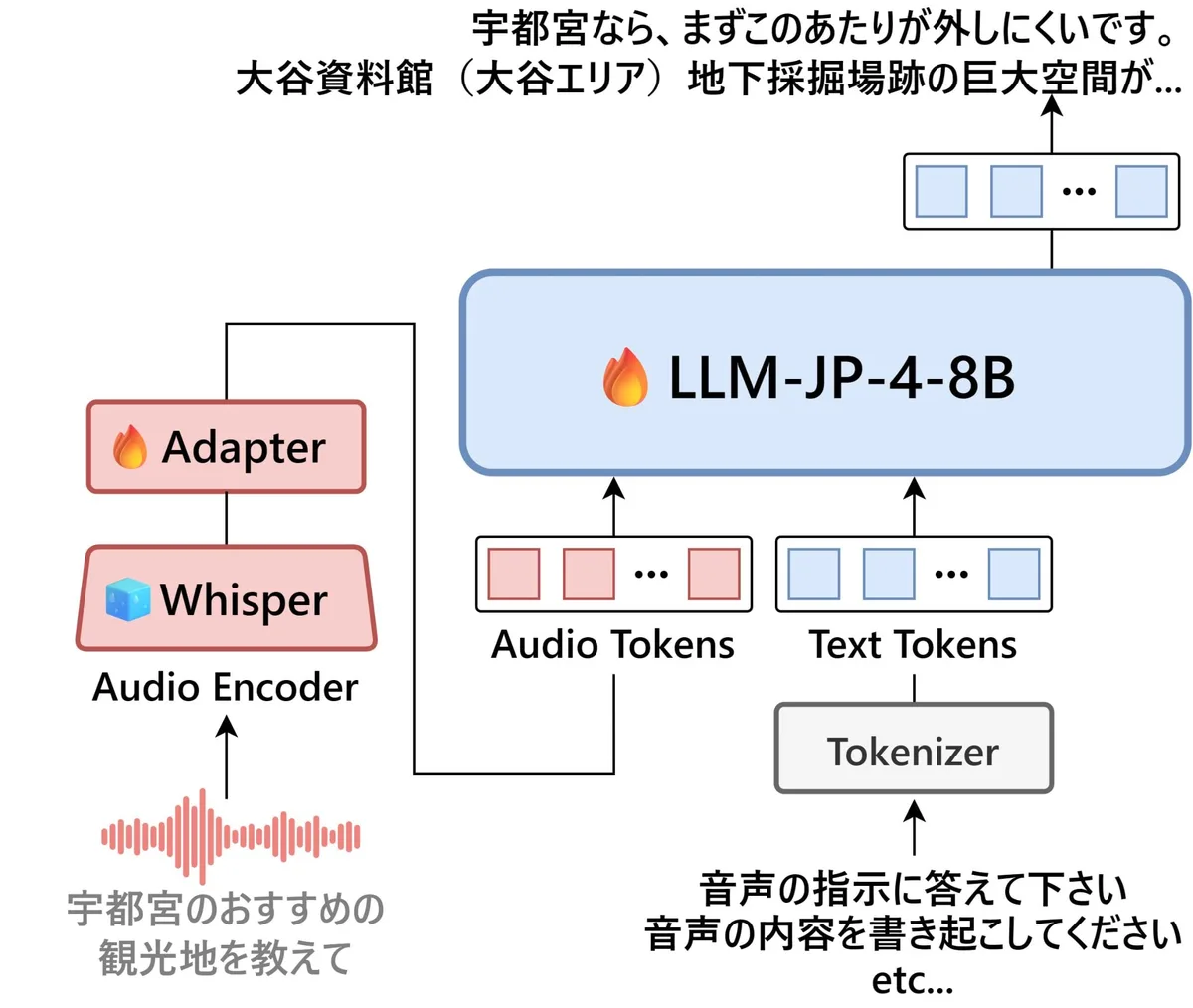
Two students from Tokyo Metropolitan University built a Japanese speech LLM on top of LLM-jp-4 8B and took first place in the free-form task of FT-LLM 2026, a tuning competition for LLM-jp models organized by NII's LLM-jp project, with the award presented at an NLP2026 workshop. As far as they could find, it is the first open model based on a Japanese-made LLM that accepts instructions by voice; they released two models, one for voice chat and one specialized in ASR[1], along with the training code and the synthetic datasets. The setup pairs a Whisper-large-v3 audio encoder with a simple adapter that average-pools the encoder's 50 Hz output down to 12.5 Hz and projects it through a two-layer MLP into the LLM's embedding dimension, so 30 seconds of audio becomes 375 tokens. Training followed Voxtral's recipe in three stages: adapter-only pretraining on Japanese ASR data, multi-task SFT[2] with the LLM unfrozen, and DPO[3] on preference data converted into audio.
Because no Japanese voice-instruction data existed, they synthesized about 1,000 hours of speech with the CosyVoice2 TTS[4] engine from existing open text datasets, using 20 reference speakers and roughly 600 GPU-hours on H200; the released sets include 132k single-turn samples (700 hours) and 59k multi-turn samples (265 hours). To go beyond a plain cascade of ASR and an LLM, they captioned about 43k environmental-sound clips from FSD50K (CC0/CC-BY) with Qwen3-Omni-30B-A3B-Captioner so the model can also understand non-speech audio directly. The first month and a half went into NVIDIA NeMo, where the team struggled with job-queue congestion, training states that did not fit into a single H200's 141GB with Adam, checkpoint memory spikes and chat-template overwrites; on January 10 they rewrote the pipeline in plain transformers + PyTorch (about 1,000 lines) and moved to running many 1-GPU jobs in parallel.
The free-form task came with an allocation of 50 node-days on ABCI 3.0 (H200 × 8 per node), and the competition ran from November 5, 2025 to January 31, 2026. The chat model was scored by GPT-4 (gpt-4-0613) on a 0–10 scale on the 400-question Japanese subset of ADU-Bench, and speech recognition was measured on the CommonVoice 8.0 (ja) test set with 4,483 utterances; on Japanese benchmarks the chat model outperformed Voxtral Mini and Gemma 3n, while the ASR-specialized model slightly surpassed Whisper-large-v3. A late experimental DPO run slightly lowered the scores; the authors attribute this to applying offline DPO directly to TTS-synthesized data, whereas Voxtral uses online DPO.
Sources
-
JPZenn JA
学生2人で日本語音声LLMを作り、FT-LLM 2026 自由形タスクで1位を獲得した話


