Truth probes follow the persona, but the answer doesn't go through them
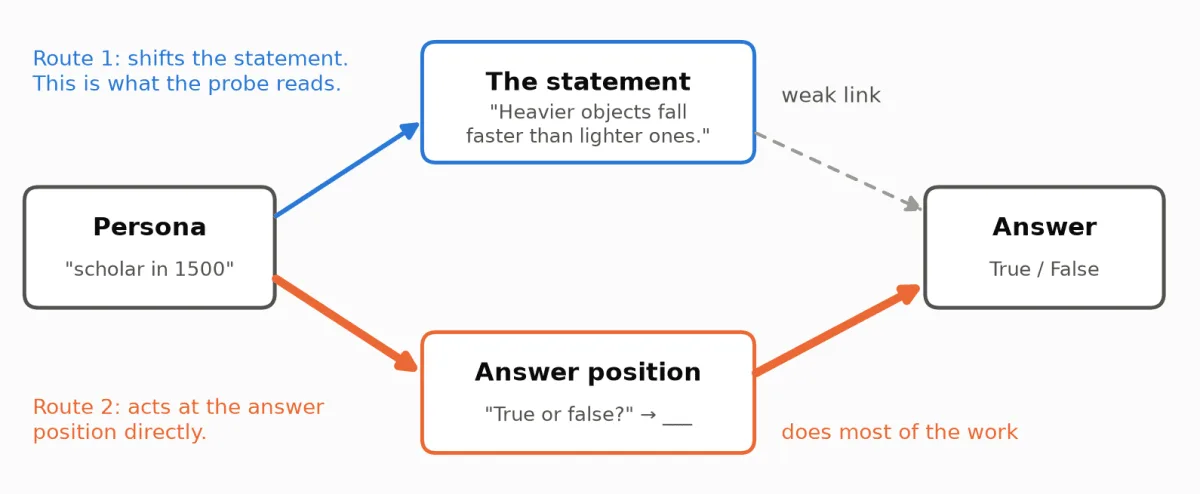
The article is the author's research report on whether a model's internal "truth" signal controls the answers it gives. The author tested four model families (Qwen, Llama, Gemma and OLMo) when they were asked to act as a European scholar living in 1500. In that role, the models called 41% to 89% of the falsehoods believed in 1500 true, against a baseline of 3-6%.
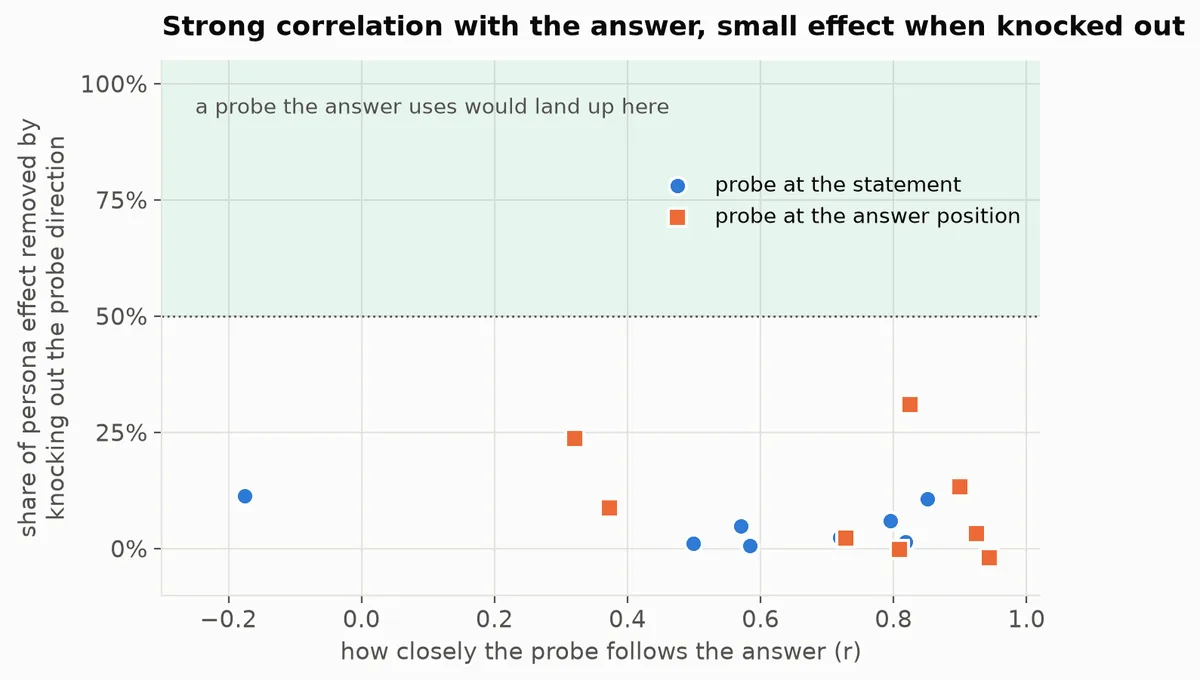
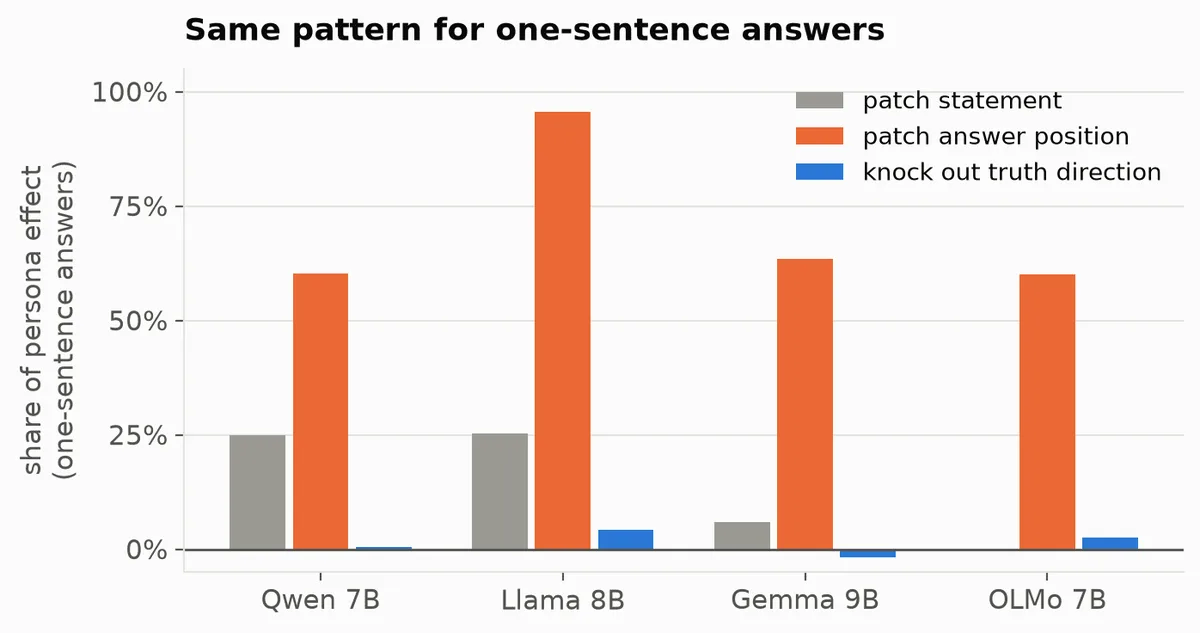
A truth probe, a linear probe[1] that reads the model's internal state, shifted with the persona. However, removing the truth direction, a method called ablation[2], reduced the effect by only 0-13%. A probe placed at the position of the generated answer, correlated 0.82 to 0.94 with that answer, accounted for only 1-18% of the effect. Replacing activations at the answer position, a method called activation patching[3], restored all of the change in the generated answer, so the author concludes that other features produce the false answers.
The author also tested LoRA[4] models trained on free-text answers, which gave similar results, with 2-12% of the effect removed by ablation. The author noted exceptions: for mean-difference probes, removing the direction cut 40-64% of the effect but lowered the model's confidence by 40-50%, and a Qwen LoRA trained to respond as a doctor in 1850 appeared to act through the representations of the statement. The author suggests testing any truth direction used for monitoring with ablation, steering and patching at the generated answer. A non-linear probe that followed the persona and influenced the answer would refute the hypothesis.
Read the original lesswrong.com
Sources
-
LessWrong
Truth probes follow the persona, but the answer doesn't go through them


