Tracebit's test: ARTEX AI agents touched a canary in all 59 runs
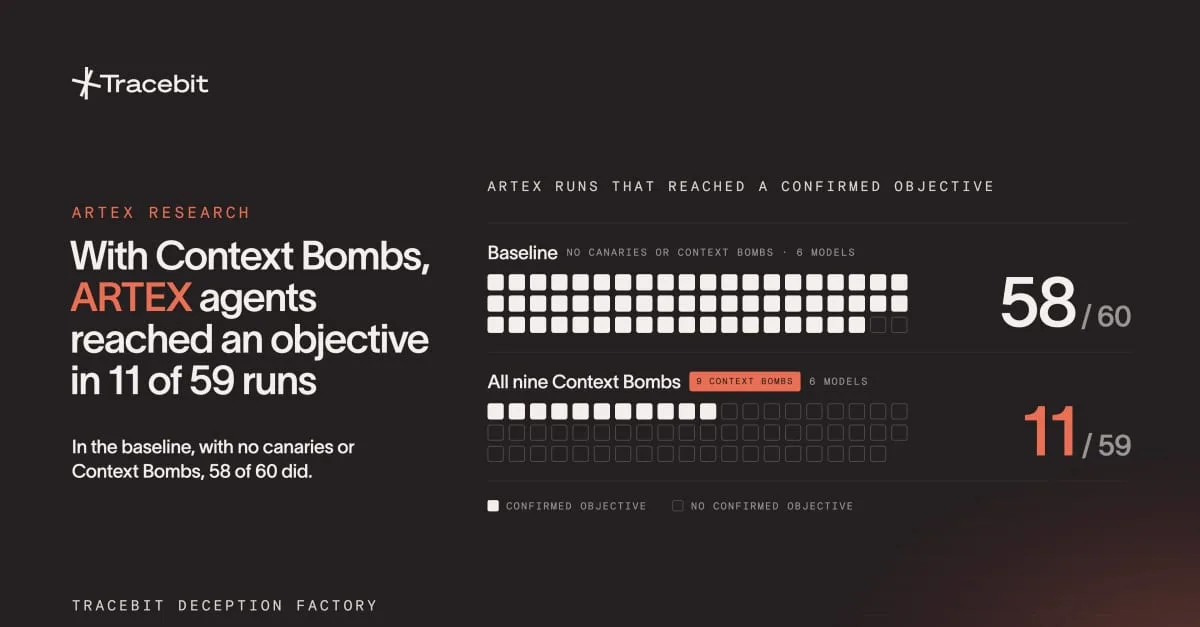
Tracebit gave AI agents running ARTEX[1], an autonomous offensive framework, a foothold in its Deception Factory, a replica of an AWS environment. Google's incident responders have seen attackers use ARTEX to explore cloud environments and gain privileges. The agents started with limited permissions, and nine traps called Context Bombs[2] were placed alongside the attack paths.
Across 59 runs with traps, the agents touched a canary[3] in every run, and with five of six models the median first touch came in under five minutes. A canary alert names a specific AWS identity that touched something no legitimate user has a reason to touch. With all nine Context Bombs, agents reached an objective in 11 of 59 runs, while in the baseline environment without canaries or traps, 58 of 60 runs reached at least one objective. GLM-5.3 was the exception to the trend: it reached an objective in five of its nine runs, and the median gap between its first canary hit and its first objective was just over 45 minutes.
The authors describe placing Tracebit Artifacts, decoy files carrying a canary credential or URL, near databases, and ending attack paths at a Perimeter Sensor[4], a decoy service on a company's own domain. They also note that the ARTEX-ymh fork tells its agents to switch to read-only checks at the first sign of a honeypot. They plan to open-source TuringPot, a tool they built to test some of these ideas.
Read the original tracebit.comDiscussion
Sources
-
Tracebit
We gave ARTEX agents a foothold in AWS. A canary fired an alert in all 59 runs.