Talking Zen 6 with Mike Clark at AMD In-Depth
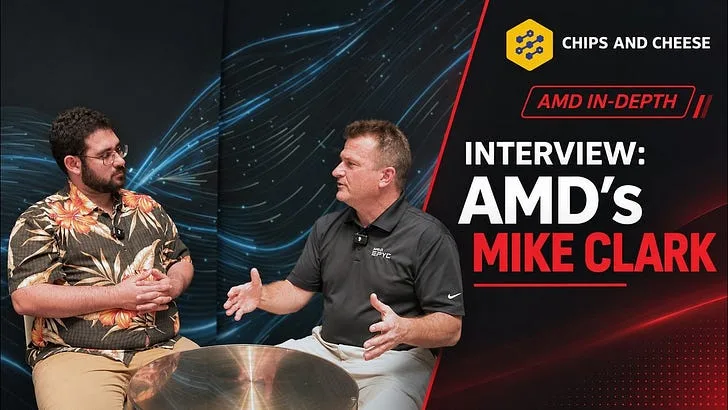
In this interview, George Cozma talks with Mike Clark, the original architect of Zen at AMD, about Zen 6 and Zen 6c, which Cozma calls the Zen 6 family. The former classic design is now a high-frequency core, while the denser design is the top-performance core, with the full L3 enabled at 4MB per core. In the dense version that gives 32 cores, 128MB of L3, and the highest IPC[1] available in that core.
Zen 6c has larger queues than the high-frequency core, including the floating-point scheduler, because its lower frequency target leaves more room. AMD wants the same software optimizations to apply to both designs. Integer multiply units were cut from three to two, since the schedulers are now more distributed and the third multiplier added little on Zen 5. Two VNNI[2] units were added late in the design to support AI inference, such as orchestration and smaller models, though Clark said the core is not meant to beat a GPU.
The load unit can now do four vector loads of 128 or 256 bits, compared with two on Zen 5. The L2 cache delivers 64 bytes per cycle because prefetches no longer conflict with demand requests as much. The branch predictor recovers faster after a misprediction, and its accuracy did not drop and is slightly better, with its TAGE[3] tables laid out more efficiently.
Read the original chipsandcheese.comDiscussion
Sources
-
Chips and Cheese
Talking Zen 6 with Mike Clark at AMD In-Depth
-
KRGeekNews KO
AMD In-Depth에서 Mike Clark과 나눈 Zen 6 심층 대화