Subliminal Learning Transfers Across Different Pretraining Conditions, Study Finds
A paper from EleutherAI's SOAR program studies subliminal learning[1], the phenomenon in which a student model acquires a teacher's preference through training data that appear semantically unrelated to that preference. Using Pythia, PolyPythia and DataDecide OLMo models, the authors show that a teacher's animal preference transfers to students with different weight initializations, pretraining data orders, training corpora, model sizes, and architectures, so shared initialization and pretraining conditions are not required. They test two settings: hard-label distillation[2], where the student trains on number sequences generated by the teacher, and soft-label on-policy distillation, where the student generates its own text and learns from the teacher's next-token probability distributions using generalized knowledge distillation (GKD) with reverse KL. Transfer is measured as the increase in the student's target-animal probability on held-out preference prompts relative to a matched control.
Checkpoint[3] experiments show that the ability to transmit a preference and the ability to acquire one are distinct and can develop at different points in pretraining. In Pythia, subliminal learning emerges within 4k pretraining steps in the soft-label setting but not until roughly 100k steps in the hard-label setting, and teachers fine-tuned from the 2k-step checkpoint already transmit substantial preference to later students while later teachers transmit almost nothing to that student. Some checkpoints, such as 85k, are more effective as teachers than as students, and across model families, including comparisons with AMD-OLMo and Qwen, 26 of 30 cross-model pairs showed positive transfer.
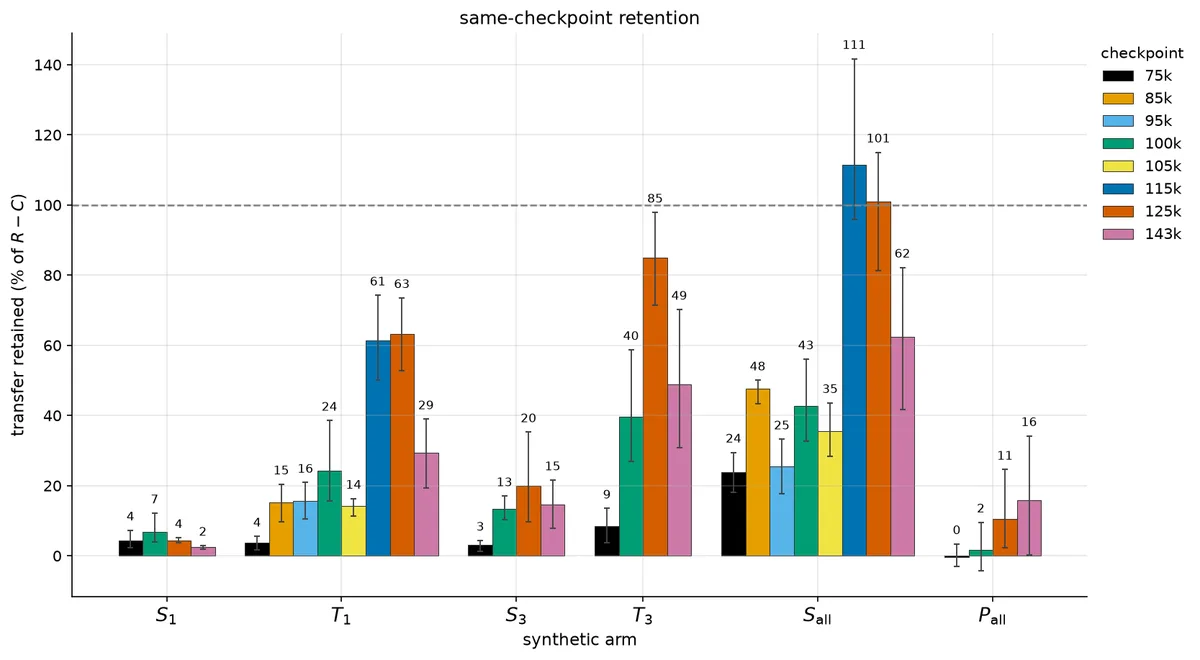
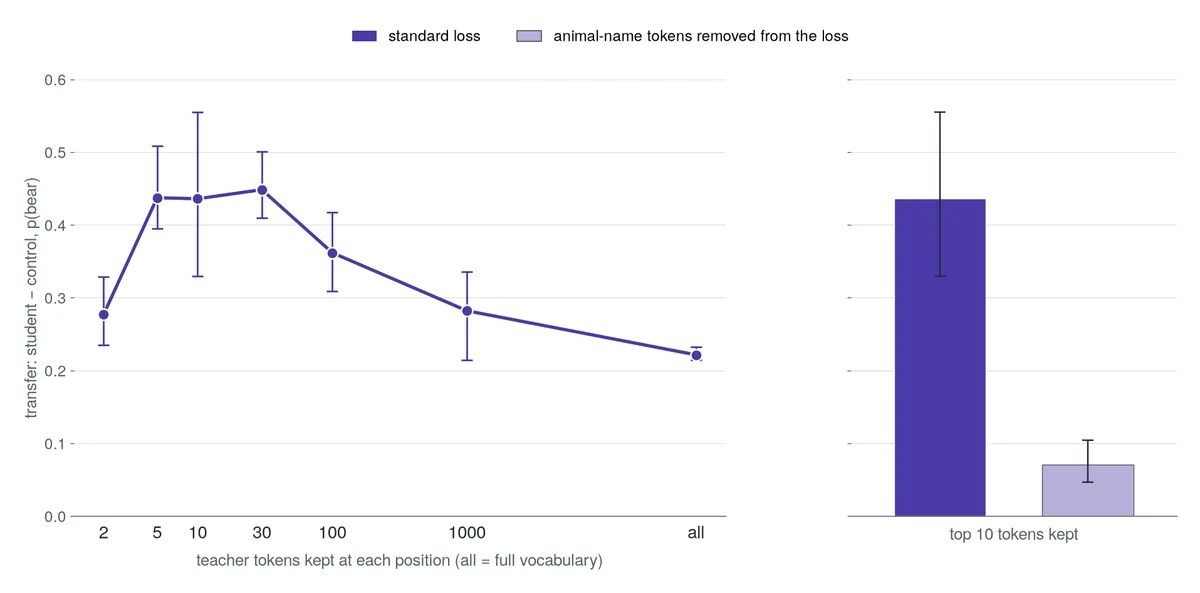
Replacing the teacher's number sequences with synthetic ones that match its number frequencies preserves much of the hard-label transfer in Pythia and a smaller share in OLMo, indicating that number frequencies alone can carry much of the preference signal. In the soft-label setting, restricting the loss to top-ranked tokens can increase transfer, while removing animal-name tokens sharply reduces it, though some transfer remains in the same-model setting. Neither low-rank adapters[4] nor adaptive optimizers are required: transfer occurs in Pythia-160M under full fine-tuning with plain stochastic gradient descent (SGD).
Read the original lesswrong.com
Sources
-
LessWrong
Tracing Subliminal Learning Through Pretraining


