Running LLMs on old TV boxes and a 2013 iPad Air
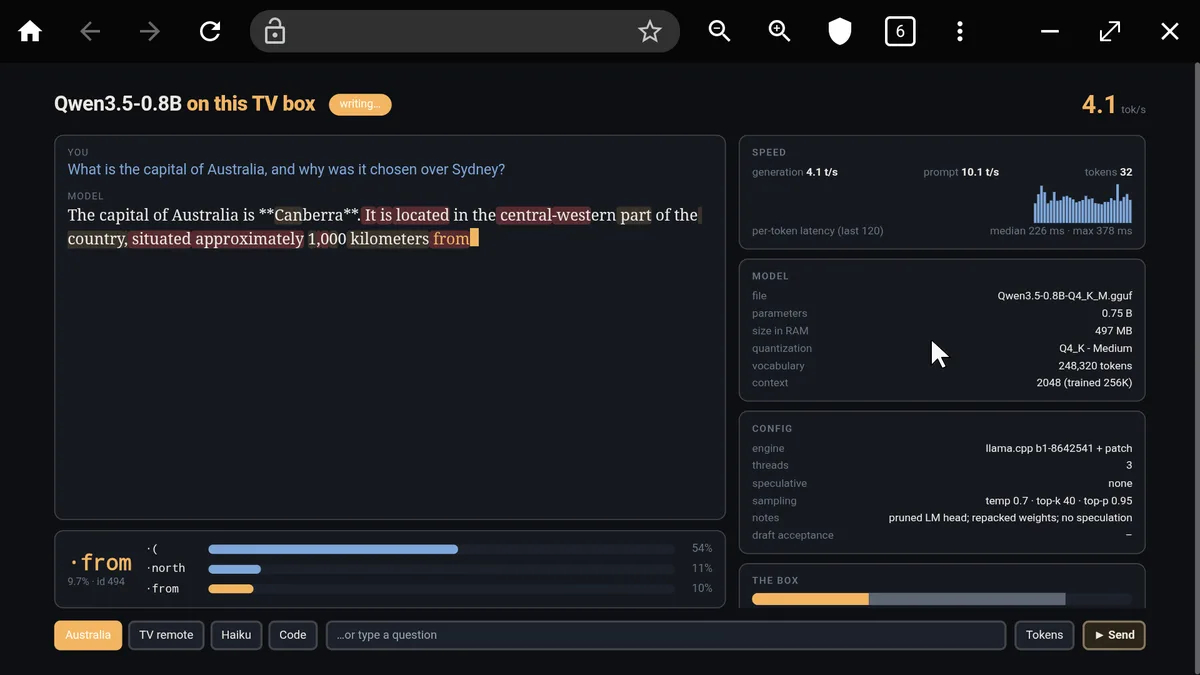
smolmaxxing is a project that aims to run language models on small, old devices such as TV boxes, old phones, single-board computers and routers. It finds the largest model each device can run, then speeds it up with custom kernels, better memory use and weight streaming, and every claim is measured on the hardware itself.
On a Xiaomi TV Box S (3rd Gen) with about 1 GB of usable RAM, the project runs models from 260 K to 16 B parameters. Qwen3.5-2B reaches 7.7 tok/s in real chat. An 8B mixture-of-experts[1] model, Moon-Beam-8B-A1B, reaches 7.2 tok/s with its experts loaded from flash on demand, and the 16B Ling-mini-2.0 reaches 5.1 tok/s.
On a 2013 iPad Air with 1 GB of RAM, iOS 12.5.7 and a jailbreak, a 1.7B model runs at 24-26 tok/s and a 16B model at 2.6-4.5 tok/s. The project states that above 2B parameters, flash read speed rather than the CPU limits performance, and that mixture-of-experts models get past this limit. The kernels are a patch on llama.cpp[2] v0.8.0 for Cortex-A55 chips.
Read the original github.comDiscussion
Discussion
Commenters mostly praise the project and the trend of running models on old hardware. Some ask what small models are useful for, while others suggest splitting one large model across several small devices or trying older phones and graphics cards. One commenter thinks that current coding agents can now write such kernels with little human help.
Links from the post and discussion
- Author's modified models on Hugging Face (from a comment) huggingface.co
Sources
-
GitHub
I'm making LLMs work on small and old devices
-
KRGeekNews KO
작고 오래된 기기에서도 LLM이 돌아가게 만들고 있습니다


