SK Broadband to test quantum security on Busan–Singapore subsea cable
On 19 November, SK Broadband said it will build an international quantum security test network on the Busan–Singapore section of the SJC2 subsea cable, which links Asian countries. In October 2026, the company was selected as an operator of the Korean government's "open quantum testbed upgrade and expansion" project, run by the Ministry of Science and ICT and the National Information Society Agency (NIA). An open quantum testbed[1] is a shared space where companies and research institutes test technologies built with quantum cryptography networks and costly measurement equipment.
The company plans to use quantum key distribution (QKD)[2] on the domestic and overseas local sections and post-quantum cryptography (PQC)[3] on the long-distance Busan–Singapore section, linked to testbeds in Singapore, Poland and Bulgaria. It will test a hybrid of QKD and PQC, a "defense in depth" approach, to check whether Korean quantum security technology and equipment run reliably abroad.
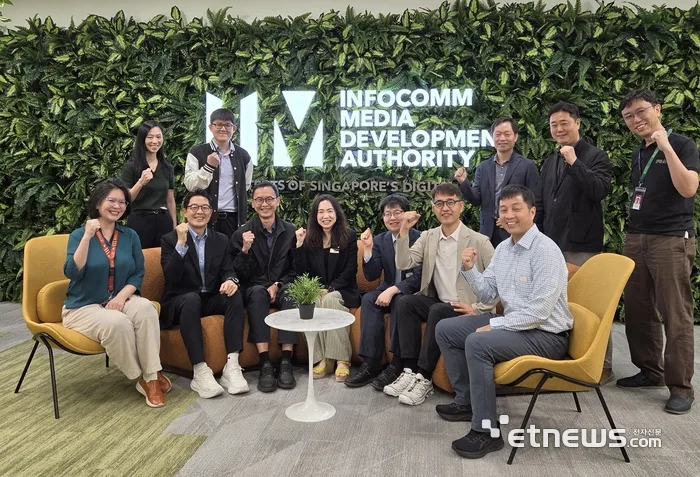
A delegation from SK Broadband, NIA and the quantum computing company IonQ recently visited Singapore. They inspected the GlobalSwitch data center, a landing station[4] for several international subsea cables, and checked how the SJC2 segment would connect to the state telecom Singtel. They also met the satellite-based quantum communications firm SpeQtral and the Centre for Quantum Technologies at the National University of Singapore, and held talks with the Infocomm Media Development Authority (IMDA) and Singtel on the architecture, ETSI-standard key exchange, roles and a 2027 testbed opening schedule.
Sources
-
KRETNews — IT KO
SK브로드밴드, 부산-싱가포르 해저케이블 구간 '양자보안' 실증