Several server vulnerabilities in November 2026 and two architecture defenses
What happened next
In November 2026, several critical vulnerabilities were disclosed in widely used server software, including PHP2Shell (CVE-2026-109618 / CVE-2026-109619) in the PHP core and Java2Shell (CVE-2026-114938) in the OpenJDK Base64 decoder. On 18 November (US time), a memory-corruption bug in nginx's HTTP/2 handling (CVE-2026-123007) was disclosed; it has been in the code since version 1.9.5 in 2015. A PHP fix for all supported versions was announced for 19 November around 23:00. Because these bugs sit in the web server or language runtime, an attack succeeds as soon as a request reaches the server, even if the application code has no flaw.
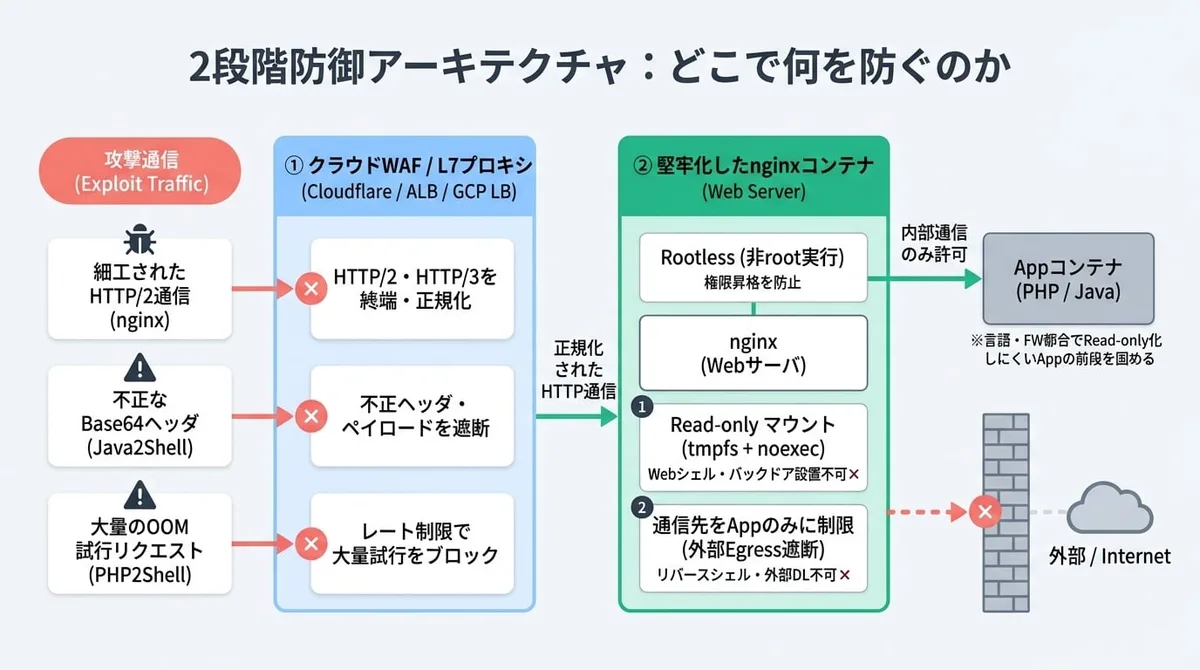
The first proposal is to put a vendor-managed cloud L7 WAF[1] in front of the origin server, so that HTTP/2 and HTTP/3 traffic ends at the provider's edge and vendor rules can block exploit requests before patches are applied. Rate limiting also cuts down the hundreds or thousands of trial requests that some memory-corruption exploits need. Listed prices are $25 per month for the Cloudflare Pro plan with monthly billing (per domain) and $5.00 per month for an AWS Web ACL, and the origin must be firewalled so that only the WAF or load balancer can reach it.
The second proposal is to run the front nginx container as non-root with a read-only file system, mounting writable directories as tmpfs with noexec, nosuid and nodev, so that a successful RCE[2] cannot write files or plant a backdoor. The author also suggests restricting outbound traffic from that container so that it can reach only the backend, which blocks reverse shells[3] and script downloads. For internal admin tools, the author suggests adding SSO at the edge, such as Cloudflare Access, OIDC authentication on AWS or IAP on Google Cloud, so that requests do not reach the server before the user signs in.
Sources
-
JPZenn JA
相次ぐOSSの脆弱性に、とりあえずクラウドWAF入れるだけでだいぶ違う話+Rootlessコンテナもいいぞ