Serving GLM-5.3 locally with vLLM across two NVIDIA DGX Stations
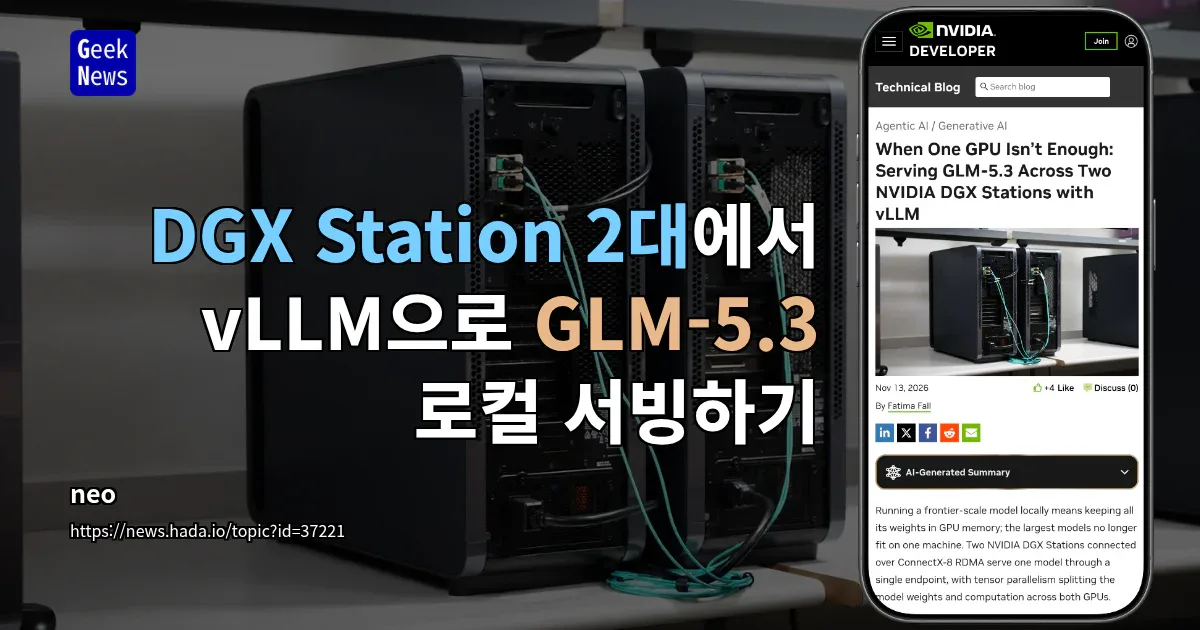
NVIDIA's developer blog describes how to serve the GLM-5.3 NVFP4 model on two DGX Station systems with vLLM. It is a quantized version of Z.ai's MoE[1] model, with 753 billion total parameters and 40 billion active per token. The checkpoint is about 464GB, which is more than the 252GB of HBM3e memory in one GB300 GPU, so the weights are split across two GPUs using tensor parallelism (TP=2)[2] with no CPU offloading, and one OpenAI-compatible API serves requests.
For every token, the two GPUs exchange partial results over an RDMA[3] link on ConnectX-8, so neither GPU can answer a request alone. Both machines run the same pinned vLLM v0.30.0 image and the same model revision. The setup also uses MTP[4], which drafts 4 tokens per step for the full model to verify, along with an FP8 KV cache and prefix caching. The guide also covers hardware checks, copying the model between machines, and verifying RDMA in the logs.
On SPEED-Bench Coding, total output throughput peaked at 607.8 tokens/s with 16 concurrent requests, and the average per request was 42.4 tokens/s. With 1 concurrent request, the per-request average was 115.3 tokens/s. With 32 concurrent requests, it fell to 13.0 tokens/s, and total throughput dropped to 385.0 tokens/s. Both figures include reasoning tokens, and the right concurrency for a given workload should be measured with its own prompts.
NVIDIA shares (NVDA)
125.53 USD −22.9% since the news day, November 15
Close on November 20 Quotes: CNBC Chart by TradingView
Read the original developer.nvidia.comDiscussion on GeekNews
Discussion
Most commenters doubt the economics: one estimates about 7 years to recover the cost of a DGX priced at $100K at maximum utilization, and another says the setup makes sense mainly for privacy or regulated data. Others suggest that eight B6000 cards could serve a 4-bit model for about half the price, and one warns about power use and noise. One commenter, however, calculates that two stations could pay back within a year under a high-volume assumption.
Links from the post and discussion
- 8xB6000 setup a commenter says is faster github.com
Sources
-
KRGeekNews KO
DGX Station 2대에서 vLLM으로 GLM-5.3 로컬 서빙하기
-
NVIDIA Technical Blog
Serving GLM-5.3 at 607.8 tok/s across two Nvidia DGX stations with vLLM


