SenseNova-Loop-9B GGUF quants for 8 GB NVIDIA GPUs
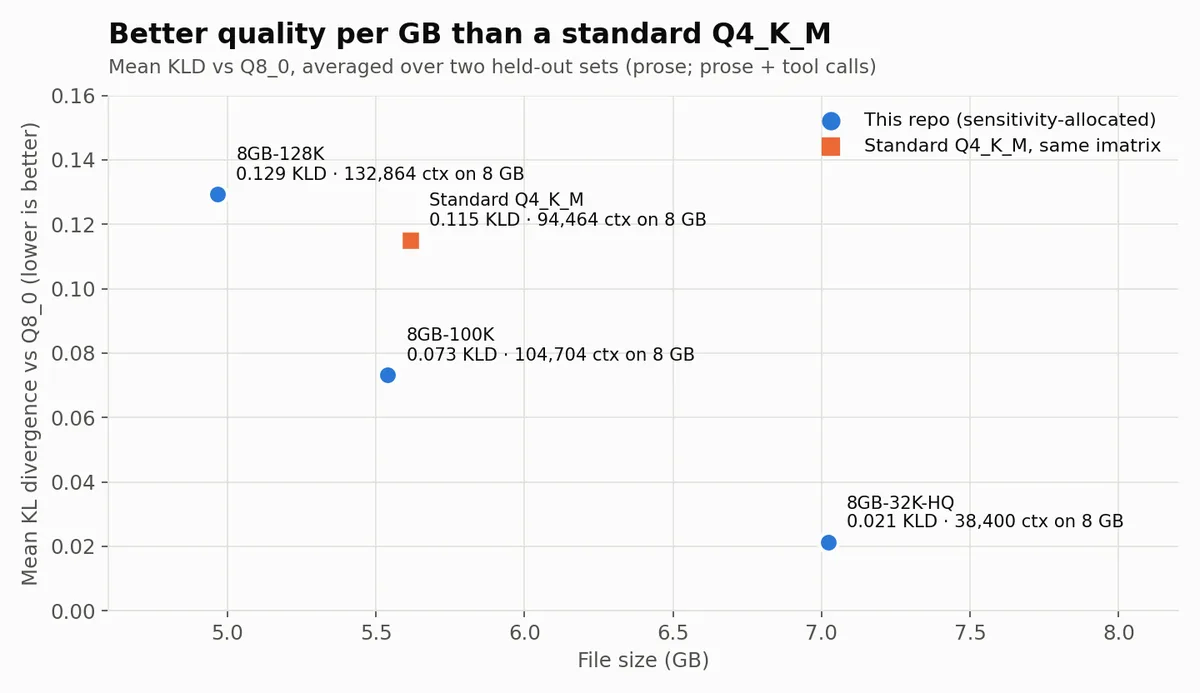
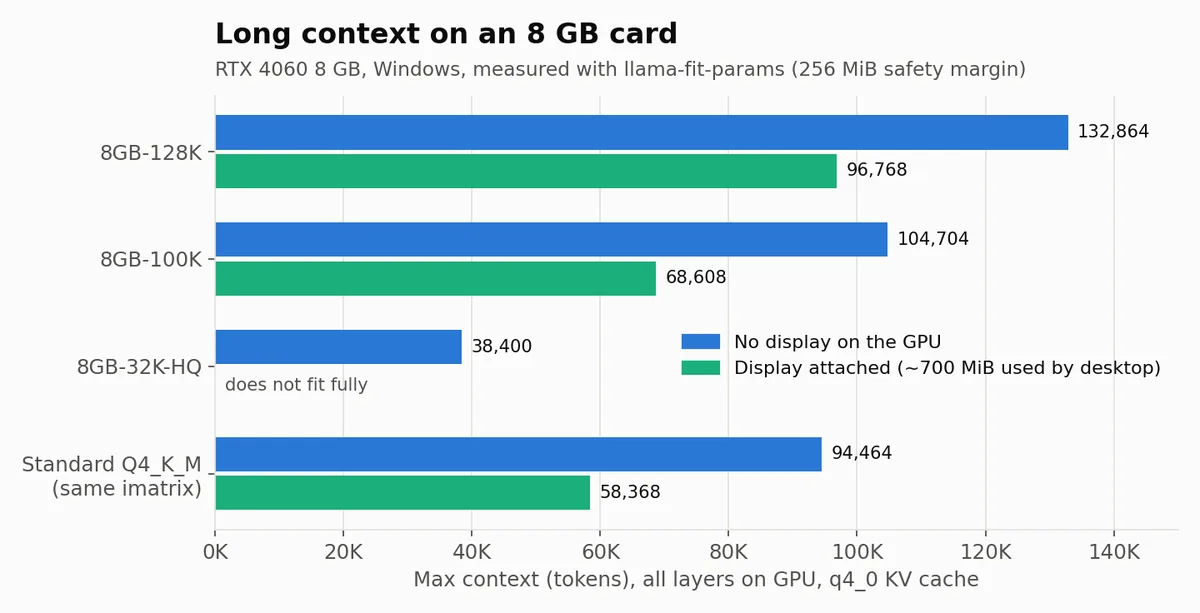
This Hugging Face page offers text-only GGUF[1] quantizations[2] of SenseNova-Loop-9B for NVIDIA cards with 8 GB of VRAM, aimed at long-context inference. The bit budget is assigned to each tensor group based on measured sensitivity. The 8GB-100K file is smaller than a standard Q4_K_M made with the same imatrix and fits 104,704 tokens of context, against 94,464 for the standard version, according to llama-fit-params estimates.
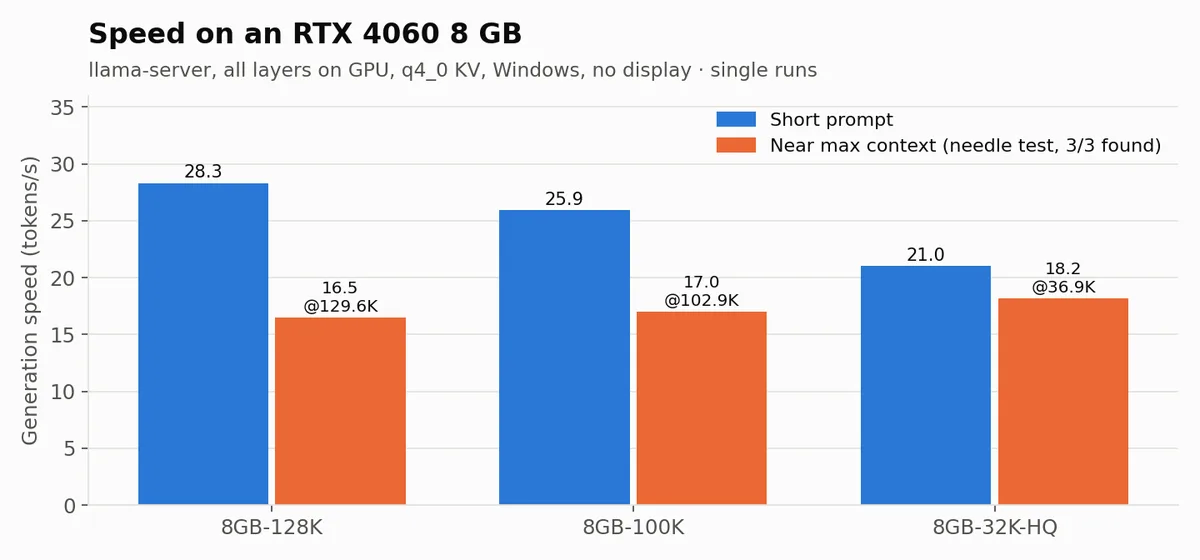
Its KL divergence[3] from Q8_0 is 34–38% lower (0.0703 and 0.0762 against 0.1064 and 0.1235). Everything runs on the GPU, except the token embedding table, which stays in system RAM. The page recommends the newer v3 build, whose mean KLD is about 20% lower than the 8GB-100K file, and which adds an MTP head[4] (about 1.85x faster generation) and optional image input.
Upstream llama.cpp, LM Studio and Ollama did not support the sensenova_loop architecture as of 2026-11-19, so users must build the patched fork listed under "How to run". The original model is a ~9B decoder with a looped layer block: layers 4–27 run twice per token, giving 56 layer executions per forward pass. Its context length is 512K (YaRN x2), and these GGUF files contain no vision projector, so they are text-only.
Repository SenseNova-Loop-9B huggingface.co
A ~9B-parameter language model from SenseTime that reuses layers in a loop to add computational depth without extra parameters.
Read the original huggingface.coDiscussion
Discussion
Commenters say that stock llama.cpp, LM Studio and Ollama do not yet support the model, so the fork is needed. One user with a 6 GB RTX 3060 Mobile calls the model promising for full VRAM use but finds the READMEs full of dubious claims. Another praises the image models from the same lab, and a third reports the error "unknown model architecture: 'sensenova_loop'".
Links from the post and discussion
- 6 GB version of the same model, linked in a comment huggingface.co
Sources
-
huggingface.co
Sensenova-Loop in 8GB VRAM


