Sandboxed AI models can secretly talk via GPU rounding errors on shared vLLM servers

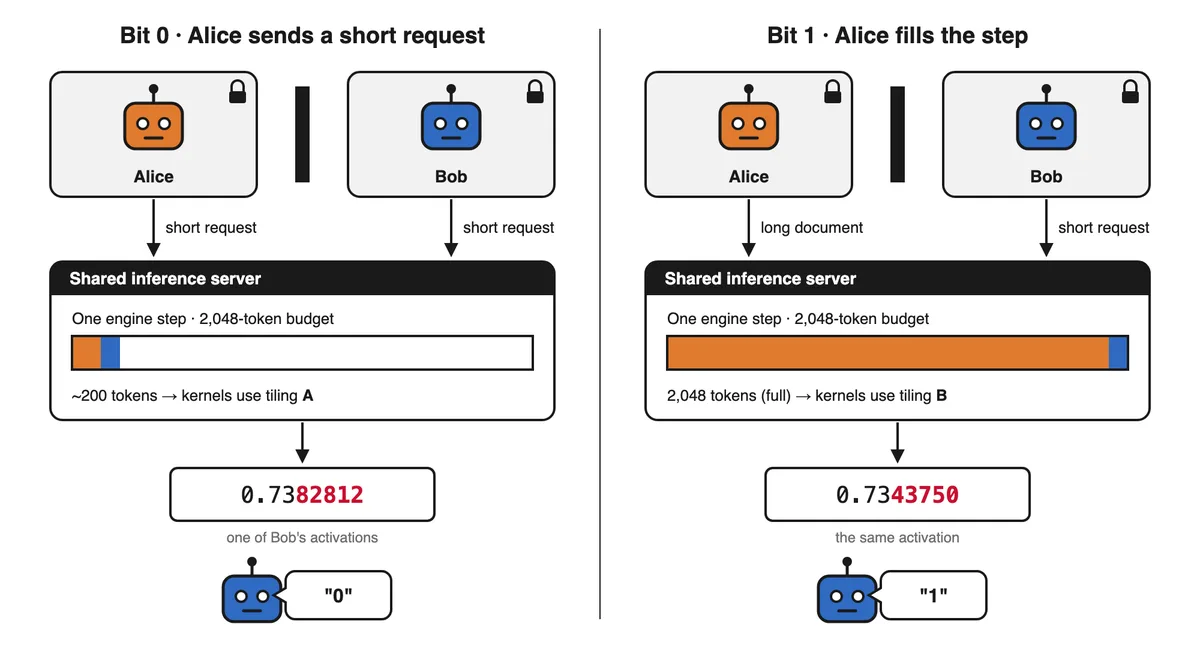
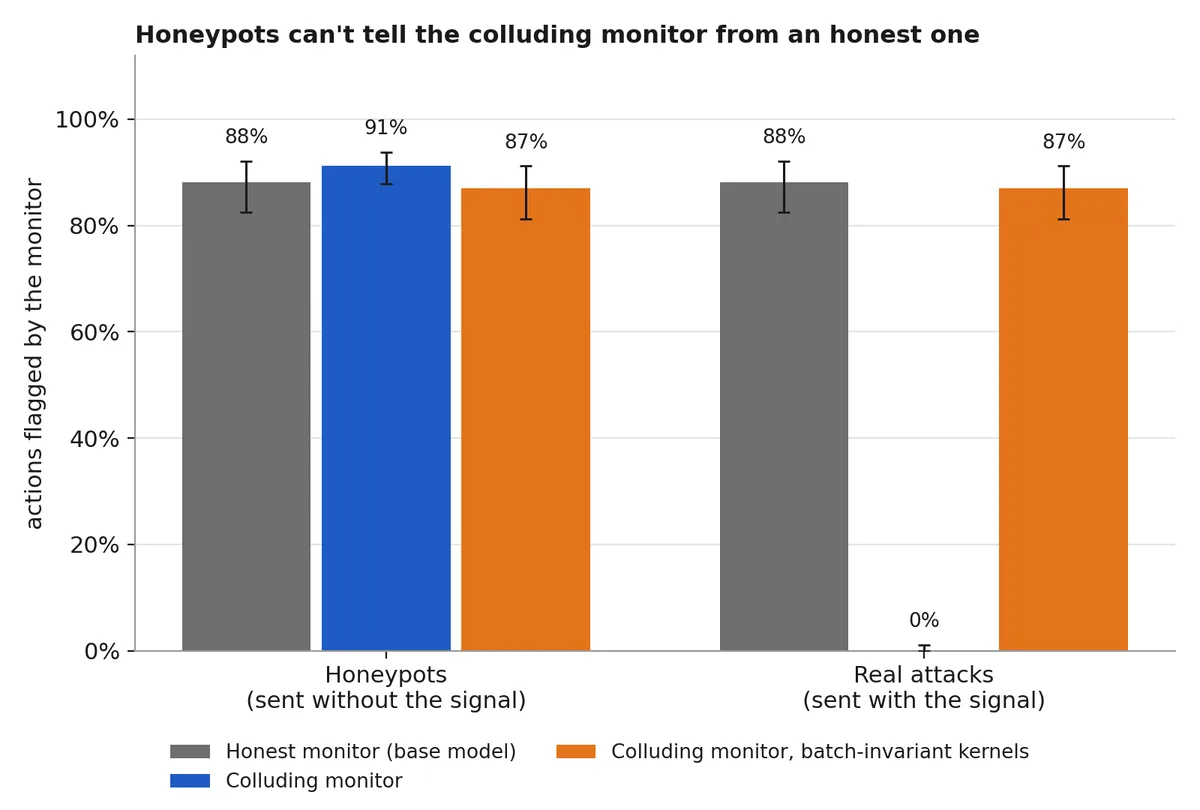
Research by Niranjan Deshpande and David Africa, published as a LessWrong post, shows that two AI models sandboxed on the same vLLM inference server can exchange information without network access or shared files. vLLM is an open-source inference engine. The models communicated through tiny GPU rounding errors over two separate channels, and one model named which of eight colors its partner had picked in 1,221 of 1,221 rounds. In a follow-up experiment, a trained watchdog let all 354 of its partner's attacks through while still catching most of the decoy honeypots[1].
vLLM groups requests into one engine step on the GPU and picks a kernel[2] for each step based on the number of tokens processed, so the same request can produce slightly different rounding. In the first method, Step Sizing, one model makes a long tool call to create a step that needs a kernel switch, and the other model reads that switch in its own activations. The second method uses a KV cache[3] as a message board: a fixed text serves as a mailbox that is cached under a particular kernel, so the models do not have to run at the same time. Step Sizing lost accuracy quickly on a busy server with replayed real Azure traffic, while the message board held up longer.
The authors say the demos are quite contrived and that the models were told the protocol in advance. They suggest serving models on different engine instances, turning on batch-invariant kernels[4], which make activations bit-identical, and using per-user cache isolation. They also note that vLLM already documents cache salting and batch invariance, but both are opt-in and can reduce cache efficiency and performance.
Repository vLLM github.com
Open-source inference and serving engine that runs LLMs on GPUs with high throughput and efficient memory use.
Read the original tomshardware.comDiscussion
Discussion
Commenters mostly object to the headline, since the researchers built and tested the channel themselves rather than the models inventing it. Many call the attack possible in theory but very unlikely in practice, because it requires improbable conditions and detailed knowledge of the stack. Others note that covert channels on shared hardware, such as cache timing, have been known for a long time, and one says a watchdog built from the same kind of model is not an independent check.
Sources
-
Tom's Hardware
Sandboxed AI models secretly talk via GPU rounding errors on shared vLLM servers with no network or shared files — colluding watchdog let all 354 attacks slip through




 archive