Revolut replaces Claude Code with self-hosted Chinese model, says it pays 90% less
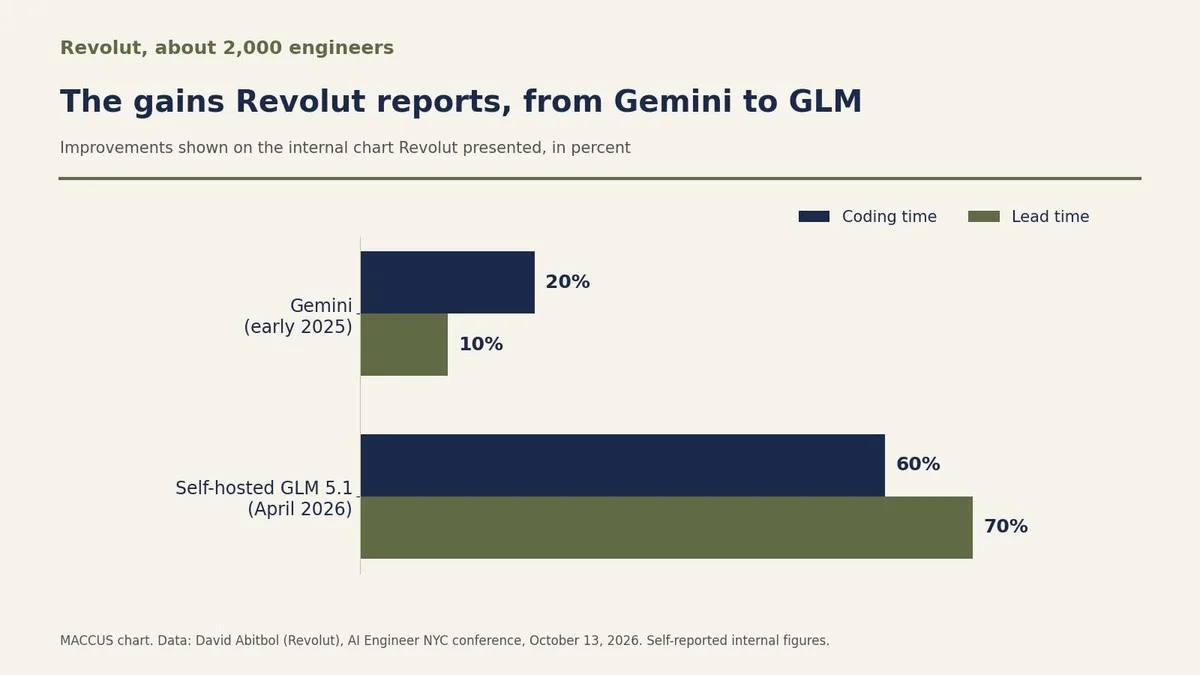
About 2,000 engineers at Revolut now write code by default with GLM[1], an open-weight[2] model from the Chinese lab Z.ai that the bank hosts on its own infrastructure, while Anthropic's Claude Code and OpenAI's Codex are reserved for exceptions. David Abitbol, who leads AI operations at Revolut, described the switch on October 13, 2026, at the AI Engineer conference in New York and said the bill is now a tenth of what the company used to spend with Anthropic and OpenAI. A Gemini rollout in early 2025 cut coding time by 20% and lead time by 10%, while Claude Code, launched at scale in early 2026 under strict budget caps, had little impact, with engineers spending $1,000 to $10,000 a month without much return. Since Revolut began self-hosting GLM 5.1 in April 2026, its chart shows a 60% improvement in coding time and a 70% improvement in lead time.
The bank runs GLM 5.3 on 56 Nvidia B200 GPUs at a blended cost of about 30 cents per million tokens, with flat billing and no bill shock at the end of the month. Tuning brought the time to first token[3] down from 14.26 seconds during migration to 1.68 seconds in the stable setup on the same number of GPUs, while requests per second rose 76%; Abitbol credits FP4 quantization on Blackwell chips, splitting the model across eight GPUs instead of four to leave room for the KV cache[4], and tracking the cache hit rate. GLM handles text only, so a router sends requests that include images to models such as Gemini or GPT Luna, and the internal endpoints follow OpenAI's API format, letting engineers keep tools like OpenCode and Codex.
Revolut downloads the published weights and runs them in the US, the EU, the UK or Israel without going through a China-based inference service; as a bank regulated in the EU it keeps a human in the loop on all coding tasks and runs each agent in a sandbox that controls what it may execute without approval. The productivity numbers are self-reported and do not isolate the model change from other causes such as the removal of token limits, the 30-cent figure reflects Revolut's own deployment, and Z.ai, while calling GLM 5.3 the most capable open-weight coding model, places it behind Anthropic's Fable 5 and OpenAI's GPT-5.6 Sol on most listed coding tests, including Terminal Bench 3.0. On the vendor side, OpenAI will share a token-based usage limit across ChatGPT and Codex plans starting in December, and Anthropic's Max 20x plan became Ultra on October 30.
Read the original maccus.frDiscussion
Discussion
Most commenters agree that at this scale self-hosting is far cheaper than paying Anthropic's API prices, and one notes that a rack of B200s can process trillions of tokens a month while hyperscalers currently have idle AI capacity to lease. Others ask why GLM is catching on in Europe more than DeepSeek or Kimi, mention that FedRAMP rules block this approach at their workplace, and suggest DeepSeek's open-source inference engine could be more efficient.
Sources
-
maccus.fr
Revolut sidelines Claude Code for a self-hosted Chinese model, says it pays 90% less


