Researchers Took Over ChatGPT Accounts with a Malicious Shared Link
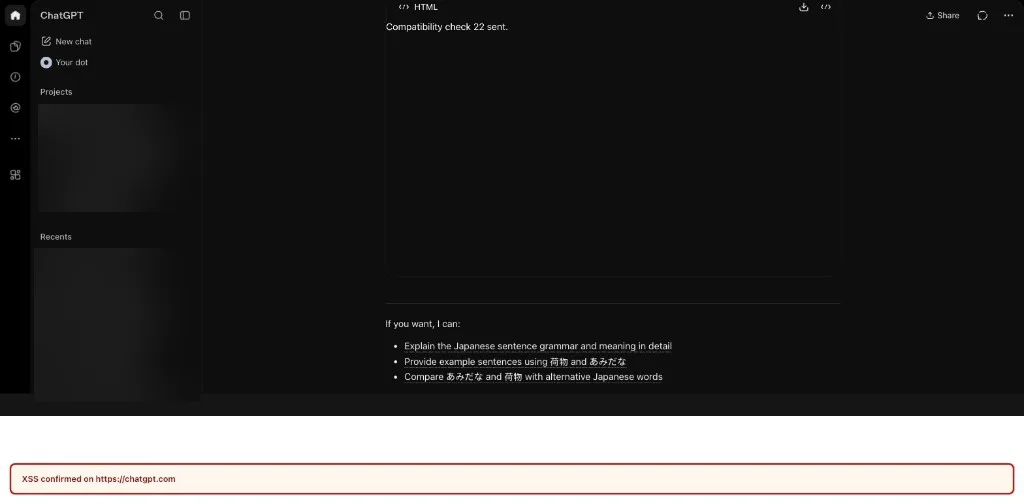
In October 2026, a research team found a way to bypass ChatGPT's sandbox[1] and Content Security Policy (CSP)[2], turning an ordinary public share into attacker-controlled JavaScript running inside the signed-in session of whoever opened the link. An attacker could create a malicious conversation, publish it with ChatGPT's normal sharing feature, and send the link to another user; the victim only needed to open it, with no app to install, no project to join, no code to paste, and no developer tools. The payload then executed as chatgpt.com with access to the victim's authenticated web session, could enumerate the victim's conversation list, retrieve content from a private conversation never shared with the attacker, send that data to an external server, and call ChatGPT's authenticated APIs as the victim. OpenAI fixed the issue on October 26, classified the report as P1, and awarded a total bounty of $5,000.
The chain started with two features that looked harmless on their own: a graph and an HTML Preview, which ChatGPT runs inside a restricted frame on a separate web address that cannot read the main page. The graph loaded a math library called MathLive, which installed a postMessage[3] listener in the main page that accepted messages from any web address, including one that replaced its virtual keyboard layout with attacker-supplied HTML. When the keyboard opened, MathLive inserted that HTML into the real ChatGPT page and placed it in an iframe using srcdoc without a sandbox attribute, giving the new frame the https://chatgpt.com identity and access to the parent page. CSP blocked inline JavaScript but allowed scripts from YouTube, whose oEmbed endpoint returned the requested JSONP[4] callback before its own validation error, so ending the callback with ;void made the appended object harmless and let the researchers' JavaScript run as chatgpt.com.
The first working version relied on a researcher-controlled ChatGPT App, so the team instead combined a genuine graph and an assistant-authored HTML Preview in one ordinary public conversation, letting the /share/<id> link carry the complete chain. In the most stable reproduction the victim still had to click the Preview button once, but after the HTML block was marked previewable, opening the link was the only click, with the alert appearing after roughly 4.5 seconds in three reproductions on a separate account, including after a hard refresh.
Read the original parameter.aiDiscussion
Discussion
Most commenters say the $5,000 bounty is far too low for a P1 account takeover, with one arguing it should be $50,000 and others warning that small payouts discourage future reports. Another commenter links a separate report about remotely accessing the file systems of computers that had started a "Work" chat in the ChatGPT desktop app. Others joke that the real lesson is simply not to click links.
Sources
-
parameter.ai
Do the math: How we took over ChatGPT accounts
-
KRGeekNews KO
ChatGPT 공유 링크 하나로 계정을 탈취한 방법


