Rereading I. J. Good's 1964 Paper on the First Ultraintelligent Machine
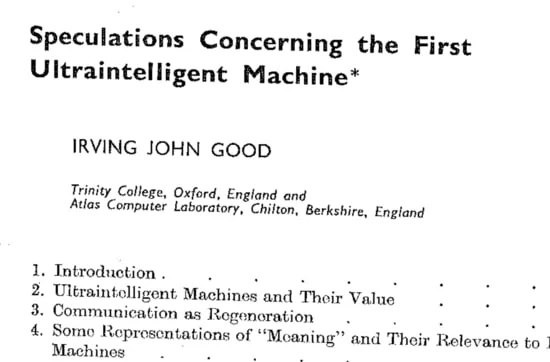
The author rereads I. J. Good's 1964 paper "Speculations Concerning the First Ultraintelligent Machine" and checks how its ideas held up. Good argued that an ultraintelligent machine could design better machines, causing an "intelligence explosion[1]," and that it would be the last invention people need to make if it were docile enough to be kept under control. The author notes that the AI Futures Project now estimates an intelligence explosion starting in 2027.
The author calls the control remark prescient, since it resembles today's plan of having AI research how to align AI. Good was uncertain whether the outcome would be good, though he was optimistic in places. When a critic argued there was no reason to build AI, Good replied that a machine reaching ultraintelligence might cost only double. The author calls this a miss, because a machine doing human-level work far more cheaply can still be economical, and he expects the jump to be much larger.
On the technical side, the author says Good was right about much of the path: he expected a large artificial neural network that learns from experience through reinforcement, strong language handling, use of traditional computers as tools, and a period of human-machine collaboration. Good also proposed randomized chess, which is very close to Chess960[2], a variant Bobby Fischer proposed decades later. The author found that this variant had been known for centuries.
Read the original lesswrong.com
Sources
-
LessWrong
Reading Speculations Concerning the First Ultraintelligent Machine


