Protest TLS certificate hides a message in its RSA public key
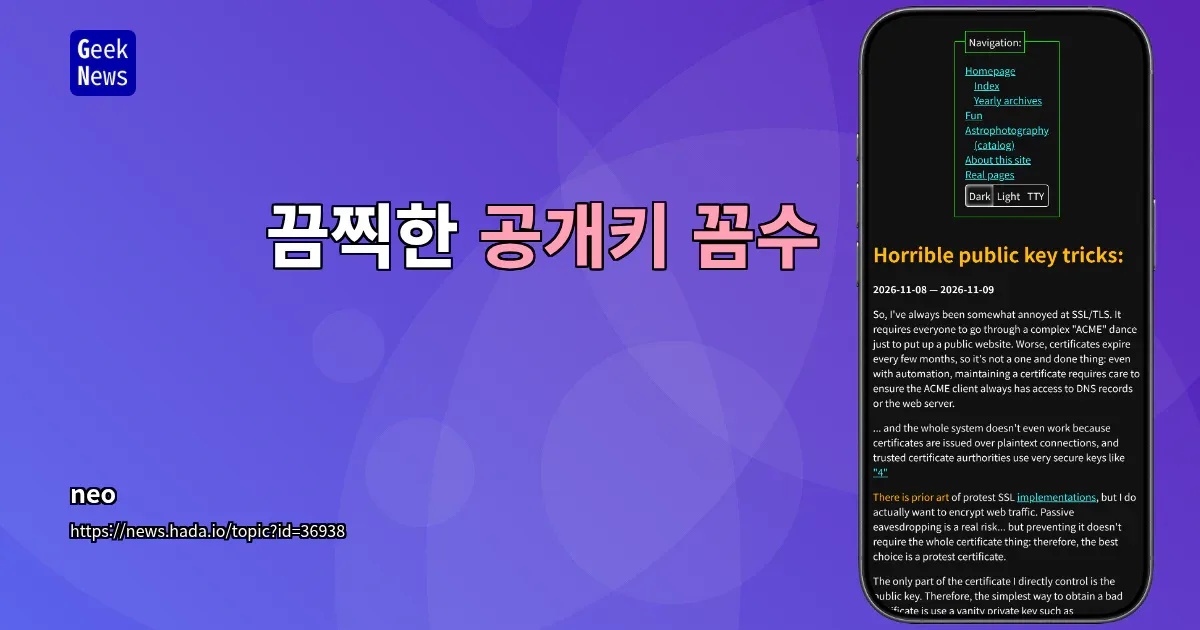
The author describes a "protest" TLS certificate: a publicly trusted certificate whose RSA public key hides a message. The author criticizes the ACME process, which is complicated for publishing a website, and the need to renew certificates every few months. The author also states that certificates are issued over plaintext connections and that some certificate authorities use very weak keys, such as the number 4.
The message goes into the modulus[1] n, which is 2,048 or 4,096 bits long. The author picks two random primes, changes the bytes of n to insert the text in base64[2], and sets q to n divided by p. The result is rounded and moved to the next prime, which usually takes a change of a few hundred. Because the message is placed in the upper half of n, it survives the calculation. If base64 groups of three bytes shift the text out of alignment, the placement is adjusted, which should take fewer than four attempts.
The message can hold about 150 characters in a 2,048-bit key or about 320 in a 4,096-bit key. The author warns that the method lowers the key's entropy and that p and q may end up close together, which makes factoring easier. The author would not trust these keys for anything important but considers them fine for a public website, since forward secrecy[3] means eavesdropping requires a man-in-the-middle attack even if the private key is compromised. Renewal means resubmitting the certificate request and repeating the ACME challenge, which can be automated.
Read the original maurycyz.comDiscussion on GeekNews
Sources
-
KRGeekNews KO
끔찍한 공개키 꼼수
-
maurycyz.com
Horible public key tricks

