Prospero: a lightweight C++ coding harness for local LLMs
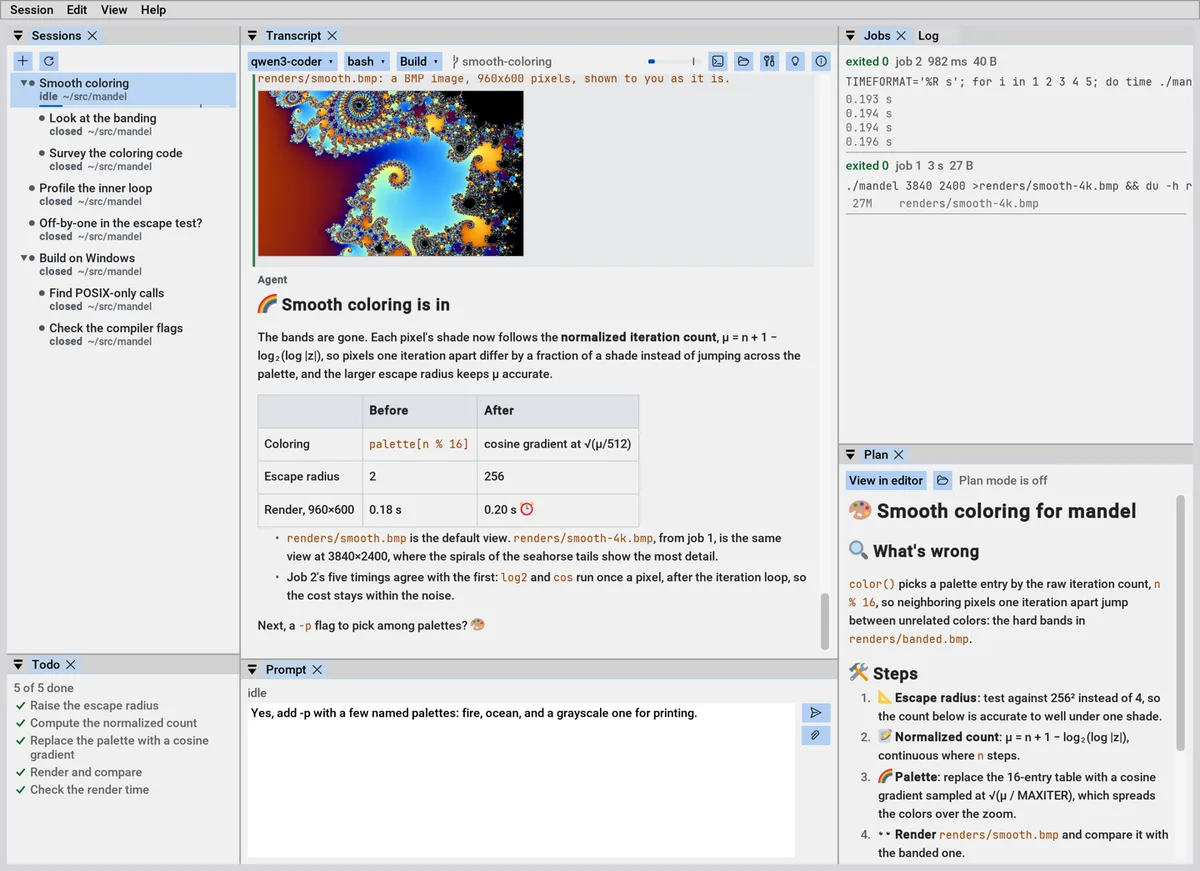
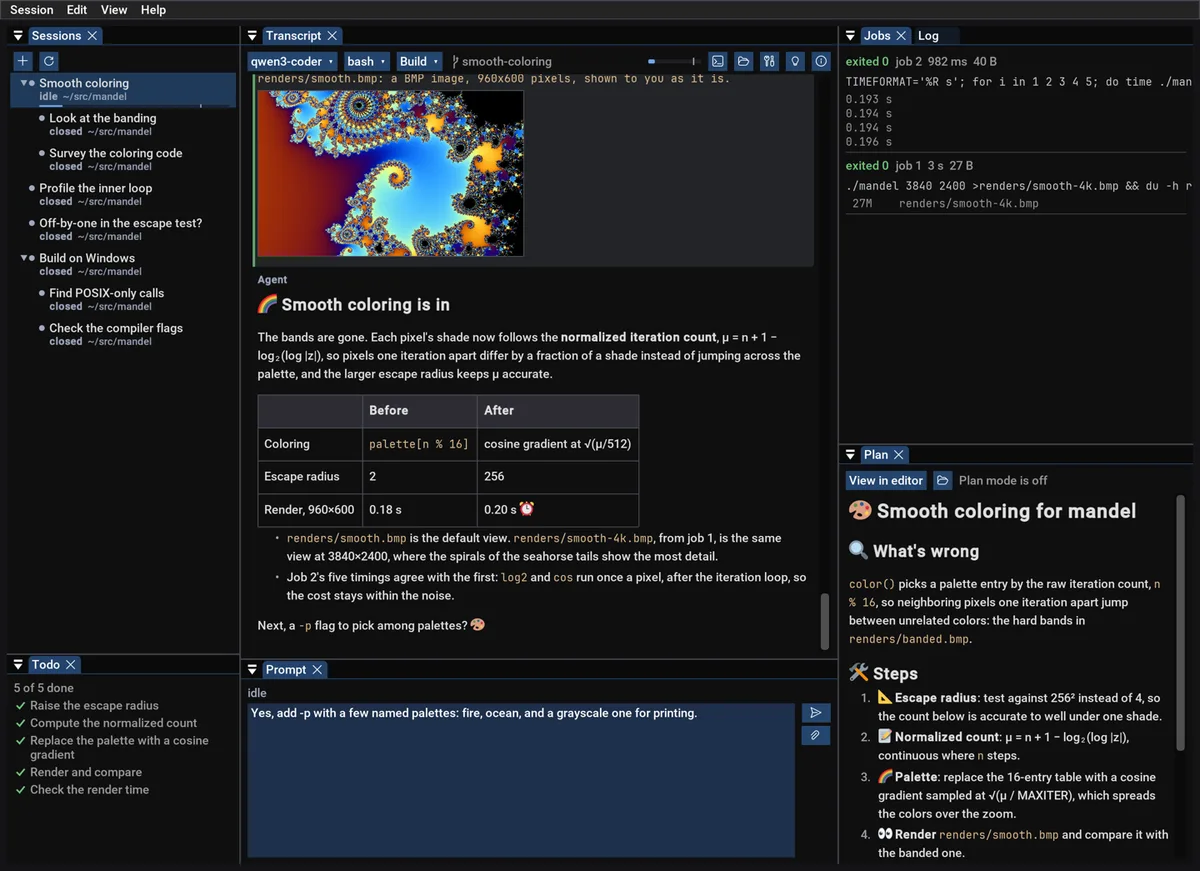
The author of the nullprogram blog has built Prospero, a coding harness for local LLMs, written in the author's own C++ style with a Dear ImGui docking interface. The author was disappointed by this year's harness offerings, most of which are built with web stacks and consume enormous amounts of memory, even though a coding harness is essentially curl glued to popen()[1]; the claim is that Prospero uses around two orders of magnitude fewer resources without sacrificing features. It comes with no model providers built in: you supply your own, such as llama.cpp, a workplace on-prem model, OpenRouter, the Anthropic API, or the OpenAI API, and a Claude subscription can't be used. In a coding harness the AI calls tools that read or write files or run shell commands and loops over the results; agents can spawn subagents that work in parallel or keep their context clean, and can message one another to coordinate.
Given SSH access to another machine, or over plain WSL, Prospero can deploy a headless copy of itself to other hosts so agents can operate on those systems. With a vision-capable model it can see the desktop and click, type, and drag to test and debug GUI applications live, without a specialized per-app MCP[2] assist. The author says it may be the only harness lean enough to drive a fuzz campaign[3] on a system without a graphical interface without the Linux OOM killer[4] targeting the harness instead of the out-of-control fuzz target, and the agent can fix discovered bugs on the fly to keep the campaign going.
The design principle 'never wait forever' gives every operation a deadline: permission requests get a denial by timeout, network requests time out, watchdogs prevent endless waiting, agent mailboxes are bounded, and shell commands that hit their timeout convert to asynchronous background commands — the only exception is Plan mode, which waits indefinitely after offering a plan or asking the user. The whole process tree lives and dies together, so a stopped command really stops — trivial on Windows, more difficult on macOS and Linux, but Prospero follows through. Configuration lives in an INI file at ~/.config/prospero/prospero.ini that can include other INI files or URLs, and a built-in skill lets the agent answer questions about Prospero, provide hyperlinks to the relevant places in the UI, and edit and reload the configuration itself.
Read the original nullprogram.comDiscussion
Discussion
Commenters compare GUI and terminal coding agents: one is building their own GUI agent because terminal interfaces like Claude Code, Codex, and opencode feel barely usable, and wants clickable text, asynchronous answers to questions, and handing single task-list items to subagents. A longtime Linux sysadmin who is not a programmer says they also prefer the Codex desktop app over terminal agents and finds Prospero simpler than what they need.
Sources
-
nullprogram.com
Prospero: A new coding harness for a more civilized age
-
KRGeekNews KO
Prospero - 경량 설계와 원격 실행을 지원하는 새로운 코딩 하네스


