Project Zero to Shorten Vulnerability Disclosure Deadline from 90 to 30 Days in Steps
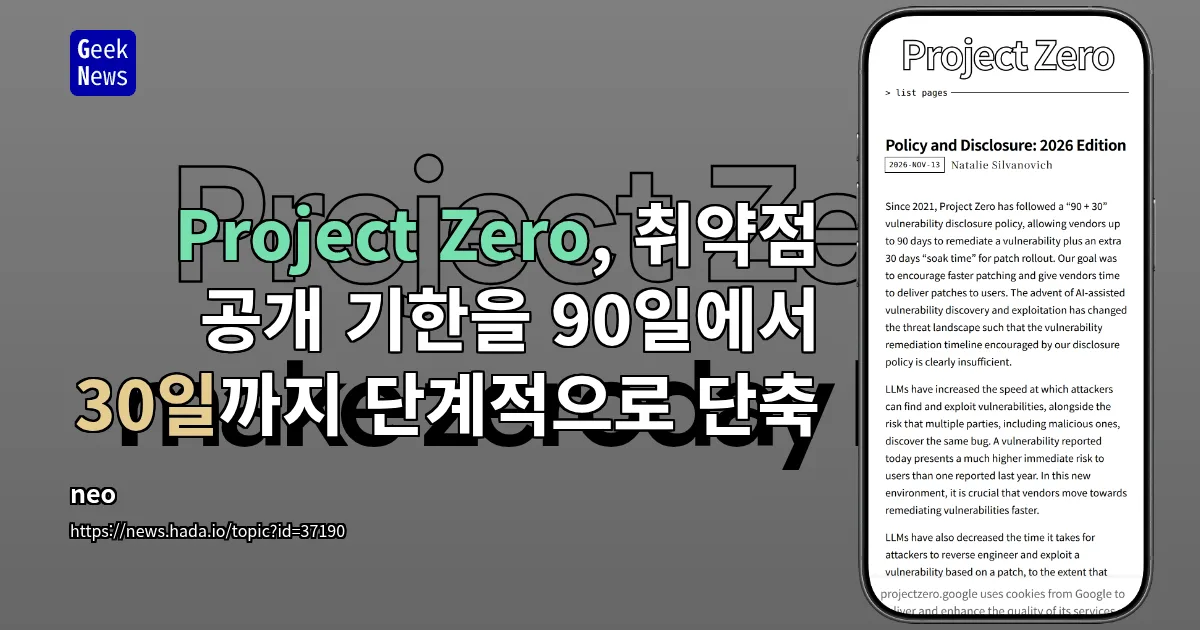
Google Project Zero[1], a Google team that reports security flaws to software vendors, is changing its disclosure policy to Full X[2]. Under this policy, details of a vulnerability are published X days after it is reported to the vendor, whether or not a patch exists. Previously, vendors had up to 90 days to fix a bug, and users got up to 30 more days to install a patch after it was released.
The deadline shrinks in steps: Full 90 applies from 13 November 2026, Full 60 from 2 February 2027, and Full 30 from 3 January 2028. Each vulnerability follows the policy that was in effect when it was reported. Most special rules, including grace periods and variant-flaw rules, are removed. Exceptions apply to bugs exploited in the wild, bugs already disclosed by others, and vendor requests.
Project Zero says that LLMs[3] speed up both the discovery and exploitation of bugs, and that attackers can work out fix details from a patch almost immediately. The post-patch grace period therefore no longer matches the risk. The change is gradual because an abrupt cut could leave unfixed bugs exposed and distort fix priorities. Project Zero will keep tracking whether bugs are fixed, but it will not use that status to decide when to disclose, and it aims to reduce the patch gap[4].
Google shares (GOOGL)
265.29 USD −10.3% since the news day, November 14
Close on November 20 Quotes: CNBC Chart by TradingView
Read the original projectzero.googleDiscussion on GeekNews
Discussion
Commenters are divided. Some welcome a faster process, while others say 30 days is too short for vendors such as Ubuntu and for on-premises systems that cannot update automatically. One commenter asks whether the change is a push toward cloud or SaaS products.
Sources
-
KRGeekNews KO
Project Zero, 취약점 공개 기한을 90일에서 30일까지 단계적으로 단축
-
projectzero.google
Project Zero will disclose vulnerabilities 90 days after reporting