ProgramBench measures how well AI models rebuild command-line programs from binaries
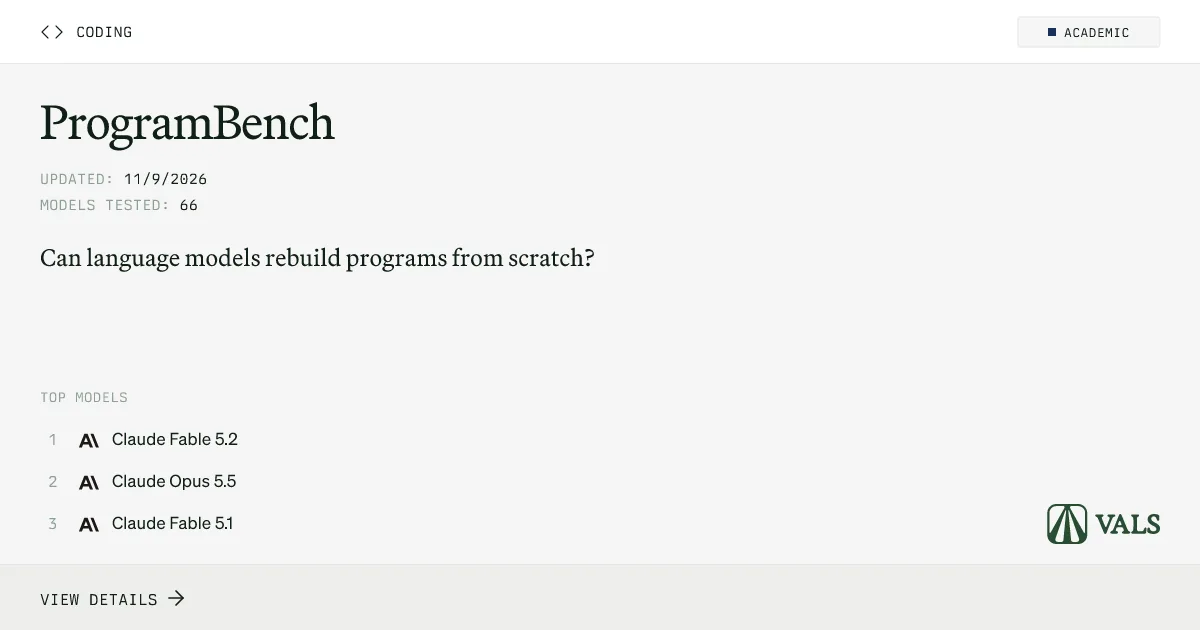
ProgramBench evaluates whether models can reconstruct command-line programs from an executable binary and a behavioral specification. For each task, the model must produce an implementation from scratch that compiles and passes the benchmark's hidden tests. A task counts as Fully Resolved only when the submitted implementation passes all tests; Almost Resolved marks the tasks where at least 95% of hidden tests pass, and Raw Pass Rate is the average percent of hidden behavioral tests passed per task.
In the results, the top models each pass at least half of the hidden tests on most tasks, and they separate at the 95% threshold. Many tasks reach a 95% pass rate for at least one model, and some are fully solved by at least one model.
The evaluation covers the 200 public ProgramBench tasks, where each task gives the model a compiled command-line program and a behavioral specification and asks for a cleanroom[1] implementation that matches the original program's behavior. All models use the same mini-SWE-agent[2] harness, orchestrated through Valkyrie with model calls routed through model-library, and the agent gets a bash tool, an offline sandbox and the ProgramBench cleanroom prompt. It may inspect the provided files and run the executable, but it may not use the internet, look up source code or package registries, wrap the provided binary, reuse object files, or use decompilers[3], disassemblers, tracing or instrumentation; the provided binary is execute-only. Models get 1,000 steps, a 6 hour wall-clock limit, a 180 second action timeout and 10,000 character head/tail tool-output truncation, and a submission consists of source files and a compile script. The submission is compiled once, then each hidden test branch runs in a fresh container created from the compiled image, with first-pass branch evaluations using 10 xdist[4] workers.
Sources
-
vals.ai
ProgramBench Leaderboard and Methodology | Vals AI


