Pre-auth remote root bug in the Linux kernel's NFS server, present since 2014 (CVE-2026-99362)
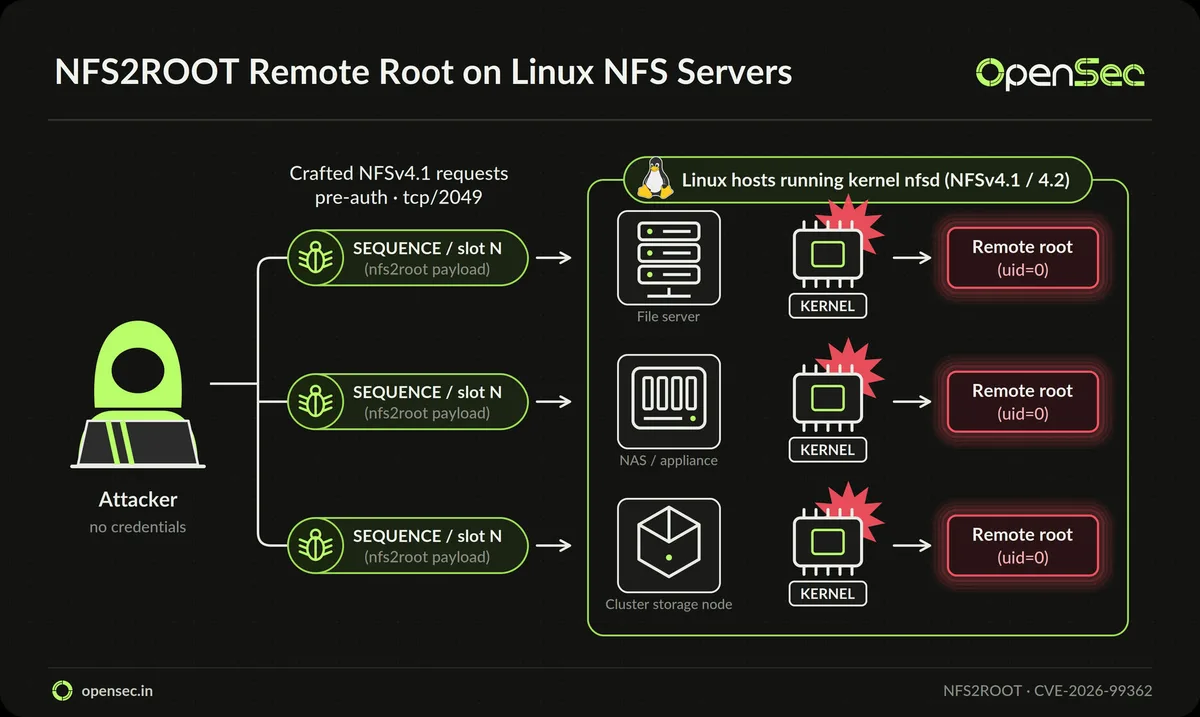
A pre-auth[1] heap overflow[2] in the NFS server (nfsd) of the Linux kernel is tracked as CVE-2026-99362 and scored 9.8 (Critical). It affects any Linux host that serves NFSv4.1 or 4.2, the default, on a reachable tcp/2049, and the code has been in place since Linux 3.16 in 2014.
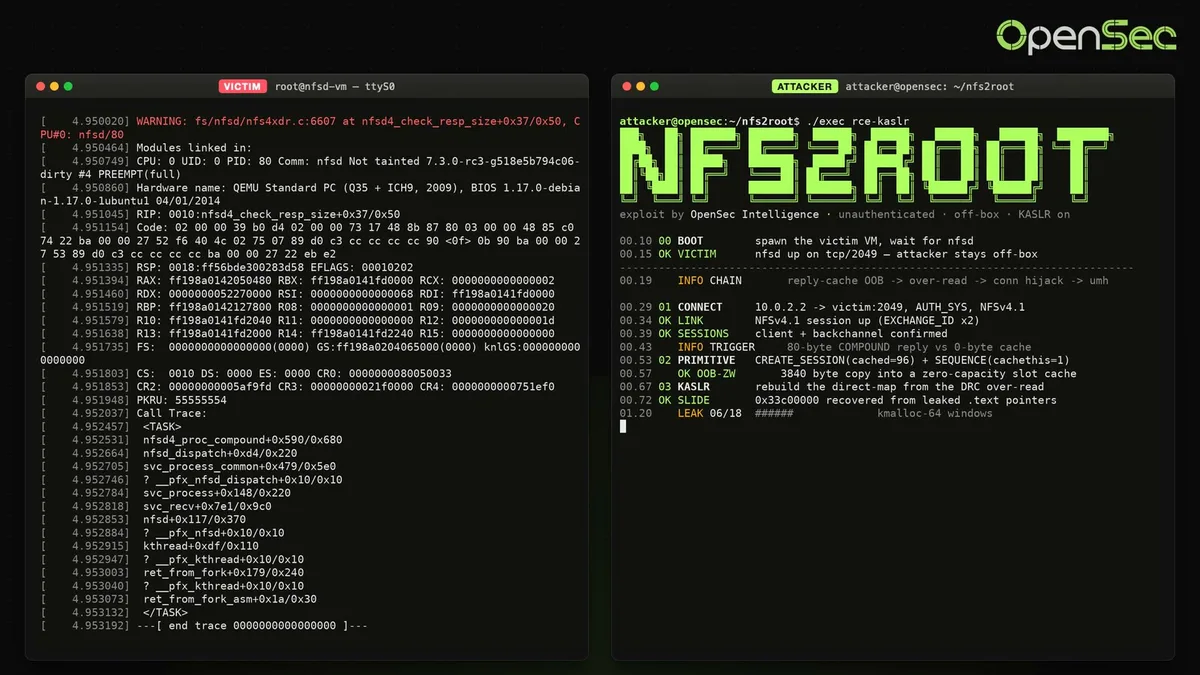
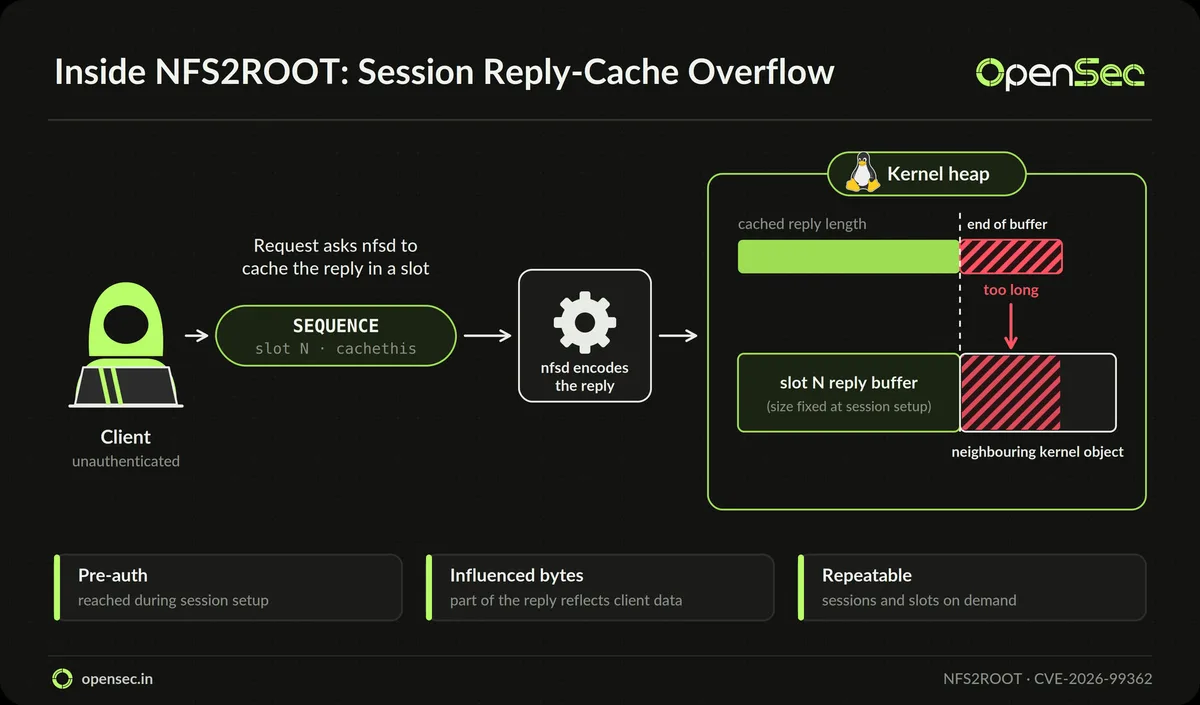
A client can shrink its reply cache to zero bytes and then make the server copy an 80-byte reply into it. 61 of those bytes land past the end of a kernel heap object, and the client chooses 40 of them. Chained with further requests, one TCP connection gives a root shell without any login.
OpenSec's Antara, its own white-box harness, found the bug, scored it, and built the root-shell exploit without a human in the loop. Jérémy Jean of ANSSI found it independently and wrote the upstream fix. The bug was reported on 22 September 2026 and published with fixes on 20 November. Fixed kernels are 6.12.117, 6.18.61, 7.3.2 and 7.4-rc1. Until a host is patched, the advice is to block tcp/2049 with a firewall or turn off NFSv4.1 and 4.2, which removes some 4.2 features.
Read the original opensec.inDiscussion
Primary sources and details
- Primary source Upstream fix commit by Jérémy Jean (nfsd SEQUENCE) github.com
- Primary source Follow-up commit: set op->status in NFSv4 encoder github.com
- Primary source CVE-2026-99362 record on cve.org cve.org
- Primary source Commit 47ee52986472 that introduced the bug (3.16) github.com
- Primary source Patch thread for the NFS fix on patch.msgid.link patch.msgid.link
- Primary source OpenSec's patch submission on the linux-nfs list lore.kernel.org
Sources
-
OpenSec
NFS2ROOT: a 12-year-old pre-auth remote root in the Linux kernel's NFS server


 archive