Practical principles for building software with coding agents
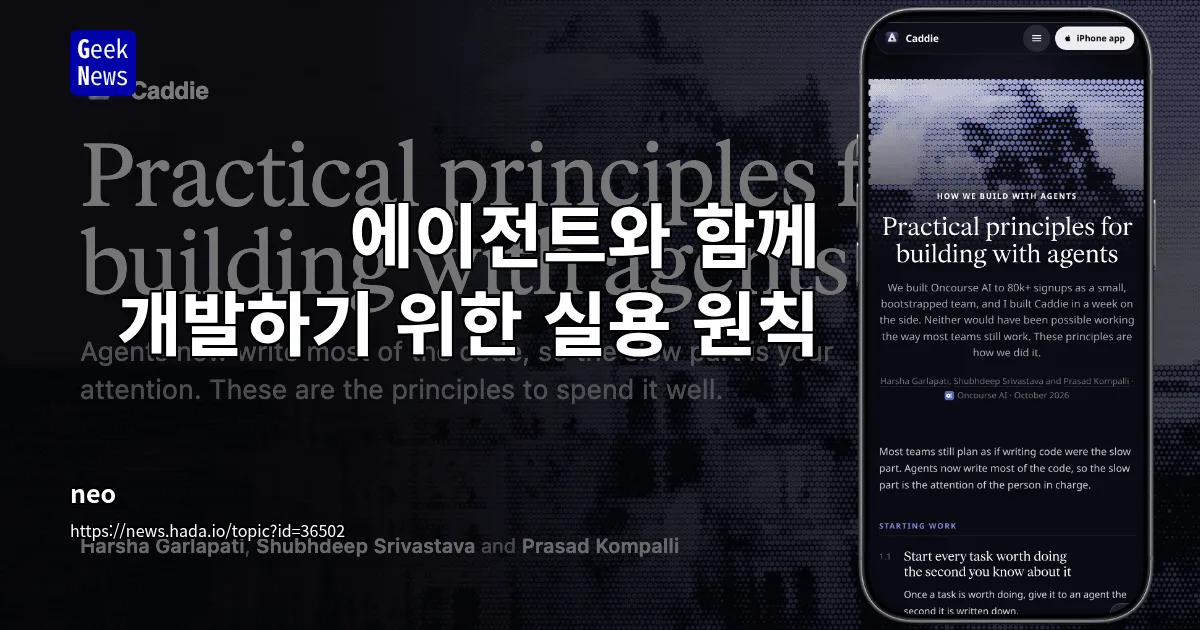
A post from the Caddie team lays out operating principles for building software with coding agents, arguing that when agents write most of the code the bottleneck moves to human attention, leaving people with task triage, result verification, and teaching agents what a good result looks like. The authors are a small bootstrap team that has secured more than 80,000 Oncourse AI subscribers; Caddie itself is developed by one person working alongside agents, built as a side project in a week, with a separate 15-day stretch logging 730 commits. Valuable tasks start immediately and run five or more in parallel, per-project coordinator agents handle assignment, deadlines are kept while start dates are dropped, and the cap on parallelism is the workload a person can properly review.
Before a merge, three checks run in order — whether the problem is real, whether the fix works, and who should decide — and bugs reported by agents are first confirmed in the code by a human, since agents can report false findings with confidence. Verification goes beyond review bots that only read code to actual app behavior through screenshots and clicked-through flows, with tests, type checks and builds on every change; maintenance fixes such as speed improvements can auto-merge, while new features get human PR review. In place of checklists, audits use a shared library of 20-30 customer personas with over 120 variants in actual use, and support work is measured as time to happy[1] — from the moment a problem arrives to the customer being satisfied with the fix — with a target of 5 minutes.
Successful procedures are saved as skills[2], instruction files that agents read before a task, and a weekly review of execution traces collected through a single AI proxy turns recurring detours and mistakes into new rules. Goals follow the MAD[3] pattern: measurable, absurdly large, and retryable fresh every night. A dictation experiment on 8 real speech clips cut the word error rate[4] from 13.3% to 7.0%, below Wispr Flow's 7.9%, and ideas are tested from three angles — demand, need, and conviction — for example by posting 15-second demo videos on TikTok, Instagram and YouTube Shorts and judging saves and comments rather than views.
Read the original usecaddie.appDiscussion on GeekNews
Discussion
The top commenter says recording successful procedures as skills matches their experience using agents for game design: when the same mistake appears twice, it becomes a rule or skill in that day's retrospective, and the next session reads it first. The key, they write, is placing rules where they are automatically read at session start, not only in documents a human has to open.
Sources
-
KRGeekNews KO
에이전트와 함께 개발하기 위한 실용 원칙


