Pinterest builds an LLM that infers long-term user goals from activity history
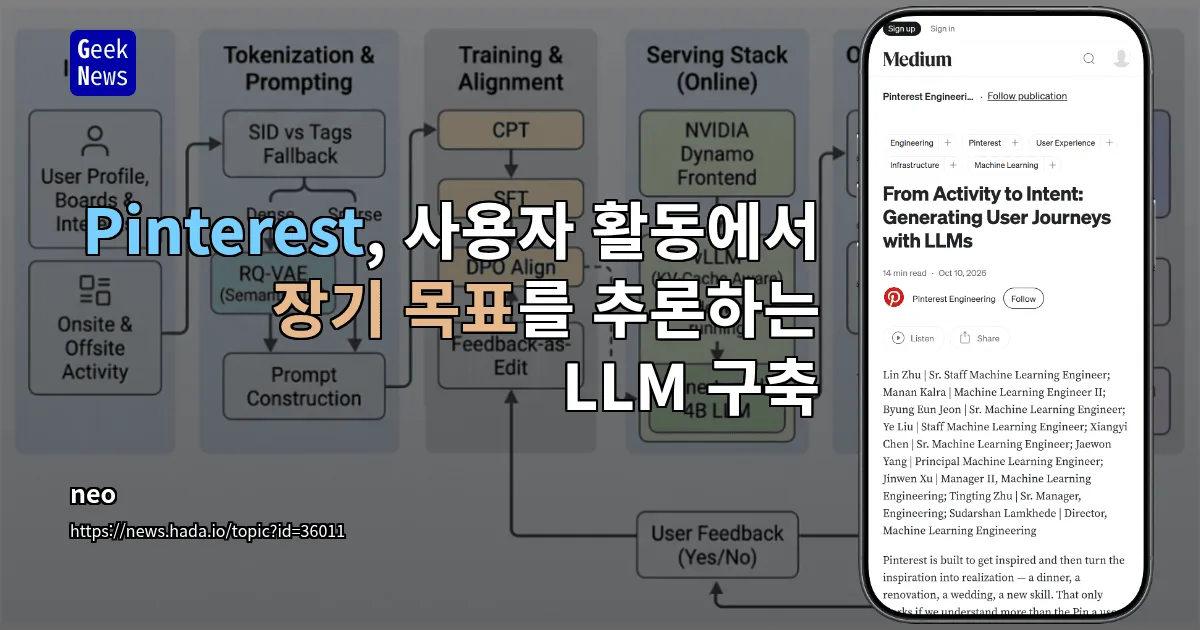
Pinterest has built a system that reads users' search and save histories to infer long-term goals such as 'kitchen remodel' or 'learning sourdough', and uses these inferred journeys[1] for recommendations and notifications. Instead of a multi-stage pipeline that extracted keywords, clustered them and picked names, one fine-tuned LLM with 4 billion parameters receives profile data, the user's boards and a chronological activity log of up to 360 days and 150 events in a single prompt, and returns as JSON a prioritized list of about 12 journey names of one to five words each in the user's language. After comparing open-weight Qwen3 models at 0.6B, 1.7B, 4B and 8B parameters, the team adopted the 4B variant, fine-tuned with LoRA[2] on examples generated by a larger model, for the best balance of quality and throughput.
The earlier clustering system had already outperformed interest-based notifications, with email click rate 88% higher, push open rate 32% higher and survey positive responses up 23%. But errors accumulated across its stages: a single kitchen remodel split into separate journeys for cabinets, countertops and wall finishes, high-frequency vague names like 'Art', 'Recetas' or 'Shopping' won out, and temporarily viewed memes or celebrity content rose to the top as if they were important goals. The new pipeline runs on about 100 L40S GPUs with vLLM and NVIDIA Dynamo, using PagedAttention[3], continuous batching and prefix caching, and processes about 775 requests per second, with a median response time of about 1.2 seconds and 95% of requests completing within about 3.0 seconds. The biggest efficiency gain came not from adding GPUs but from skipping users already analyzed in the last few days, since long-term goals rarely change.
In early experiments in the US and Canada, the approach raised email click rate by 1.1% and push open rate by 1.3% over the clustering system, and after both experiments were rolled out, daily, weekly and monthly active users increased. Input keywords and generated names pass content and safety filters, the model is explicitly told not to infer or target topics involving health conditions, politics, religion, sexual orientation, gender identity or race, and users under 18 in the European Economic Area, Switzerland and the UK remain excluded. Experiments still under way include Semantic IDs[4] that compress each Pin into five 11-bit codes, short summaries of external site activity for dormant users, notification titles generated together with journey names, and training on real Yes/No user feedback, now in an online A/B test.
Read the original medium.comDiscussion on GeekNews
Sources
-
KRGeekNews KO
Pinterest, 사용자 활동에서 장기 목표를 추론하는 LLM 구축


