Personal Agent Protocol (Poppy): how companies can accept AI agents
Personal AI agents, such as Meta's Muse, increasingly book, shop and handle inquiries for users, but companies have no standard way to accept them. Companies cannot tell whether a visitor is the user, an agent acting for the user, or a malicious bot, so some block agents altogether. In October 2026 Sierra, together with Meta, announced the Personal Agent Protocol (Poppy), and v1.0 was released on 13 November.
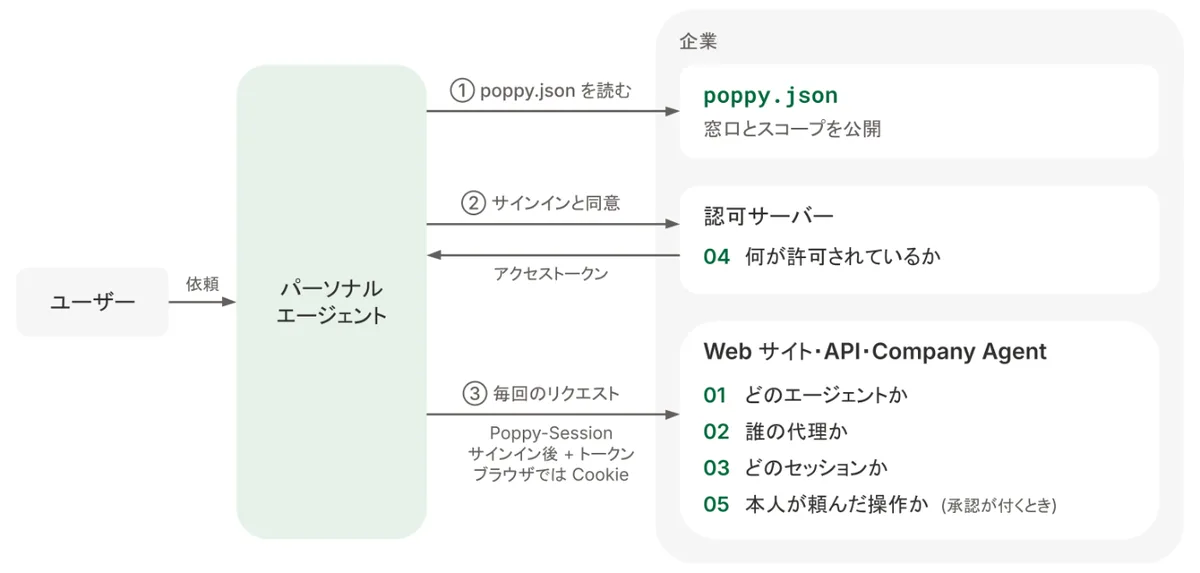
Under the protocol, a company publishes a poppy.json file at /.well-known/poppy.json that describes how agents can reach it. Users decide how far an agent may access their account, while the company decides which actions are allowed and enforces these limits in both its API and its Company Agent. Sign-in uses standard OAuth[1], and an agent can ask questions before signing in, asking the user to sign in only when a task needs an account. In the article's example, a customer asks an agent to exchange a jacket: the company first returns the price difference without making any change, the user approves the terms, and only then is the exchange carried out.
Each agent request carries a Poppy-Session header with a JWT[2] signed for that specific request. It contains a session ID and a user ID that the company receives for each user-company pair and that does not reveal who the person is. The agent identifies itself with a URL used as its client_id, and the company checks the signature against a public key on the same domain. Companies can also bind access tokens to a per-user key with DPoP[3]; if they do, a stolen token alone is not enough.
Sources
-
JPZenn JA
Personal Agent Protocol (Poppy) が解く問題と仕組み




 archive