PdM and PdE: responsibility from customer problems to post-release
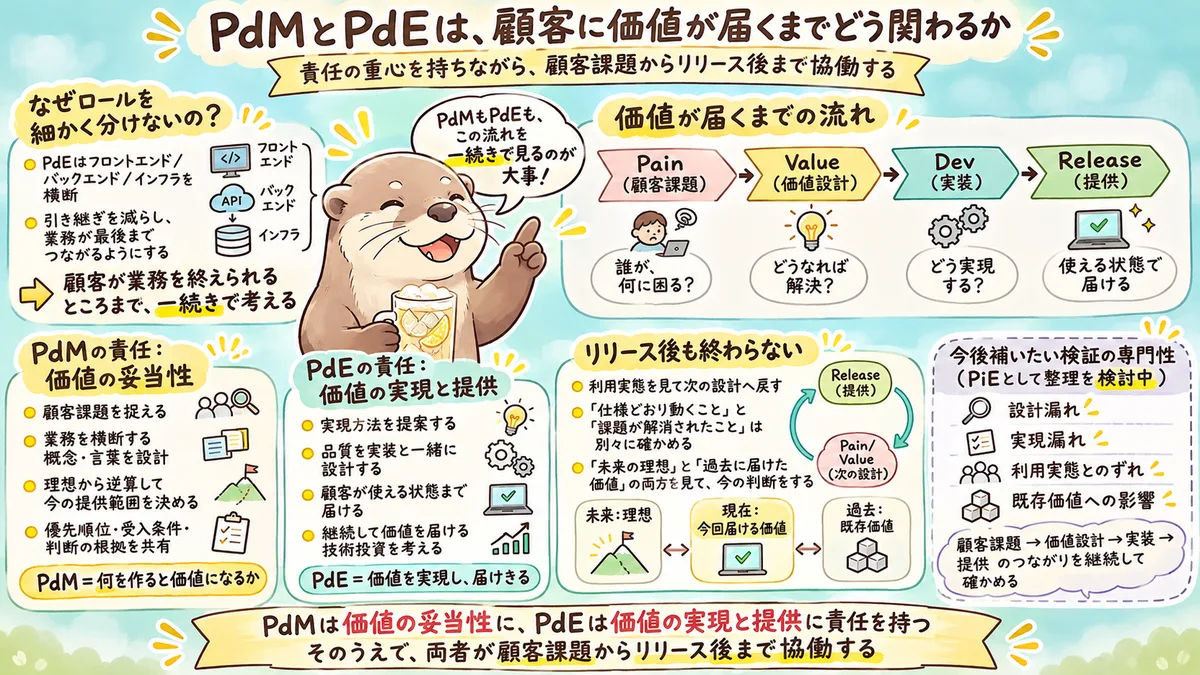
At Dress Code, product development roles are narrowed to two — PdM[1] and PdE[2] — and engineers are not split into narrow specialties such as frontend, backend or infrastructure. The author argues that the simple picture of 'PdM decides what to build, PdE designs and releases it' does not hold in practice: implementation surfaces business constraints, and design gaps become visible only after release. Instead, PdM is responsible for the validity of the value to be delivered and PdE for realizing and delivering it, with both involved from the customer's problem through the period after release, while cross-cutting areas such as authorization and tenant isolation[3] are owned by the common platform.
Development is framed in four stages — Pain (the customer problem), Value (value design), Dev (implementation) and Release (delivery) — illustrated with bulk registration of employees from a CSV file, where even deciding to 'support CSV upload' does not by itself settle the outcome, since rows with input errors and duplicate registrations on re-execution still have to be handled. PdM duties include examining the business behind a request, aligning concepts and terms across business areas, and setting the delivery scope through 'subtraction thinking' — describing the ideal business first and cutting back to what ships now, so bulk registration and corrections ship this time, automatic external-system integration is postponed, but prevention of registering the same employee twice stays in. PdM also explains why an issue is addressed now — weighing impact on target customers, business frequency and return on investment — separates facts heard from customers from still unverified hypotheses, and feeds both into PMF (Product Market Fit) meetings, where scope, priorities and the roadmap are discussed.
PdE duties start with understanding the customer problem and proposing technical options, such as validating every row before registering versus registering the valid rows and resending the error rows. Quality is designed together with the implementation through unit, integration and E2E tests[4], PdE's delivery responsibility covers settings, data migration, staged release, monitoring and recovery, and PdE also proposes technical investment in platform upkeep, performance, security, and CI/CD and tooling for developer experience. Each decision has a main owner with agreed conditions for consulting the other role, and this division is not a table of final approval authority — decisions on releases and accepting major risks are defined separately within each organization. Going forward, the author wants to bring in QA expertise and is considering a separate role, tentatively named PiE, that would continuously verify the chain of value from design to real-world usage.
Sources
-
JPZenn JA
PdMとPdEは、顧客に価値が届くまでどう関わるか