OpenAI proposes perplexity as a shared metric for AI progress and safety limits

Update · : The new article gives the publication date of November 22, 2026, and names Chief Scientist Jakub Pachocki as the author of the post. It also reports that GPT-2, GPT-3 and GPT-3.5 are described by their capabilities and that the post cites the same weaknesses of perplexity as the brief, without the brief's figures for below 0.8, 0.76 or the 0.68 to 0.7 range.
OpenAI published a post arguing that perplexity[1] should become a shared metric for comparing AI model developers and for setting common safety standards. As a first step, the company is publishing its internal perplexity measurements for pretraining[2] progress, and it says the risk of giving competitors a clearer picture is outweighed by the need for shared safety measures. Perplexity measures how well a model predicts the next token on average, and lower values mean better predictions.
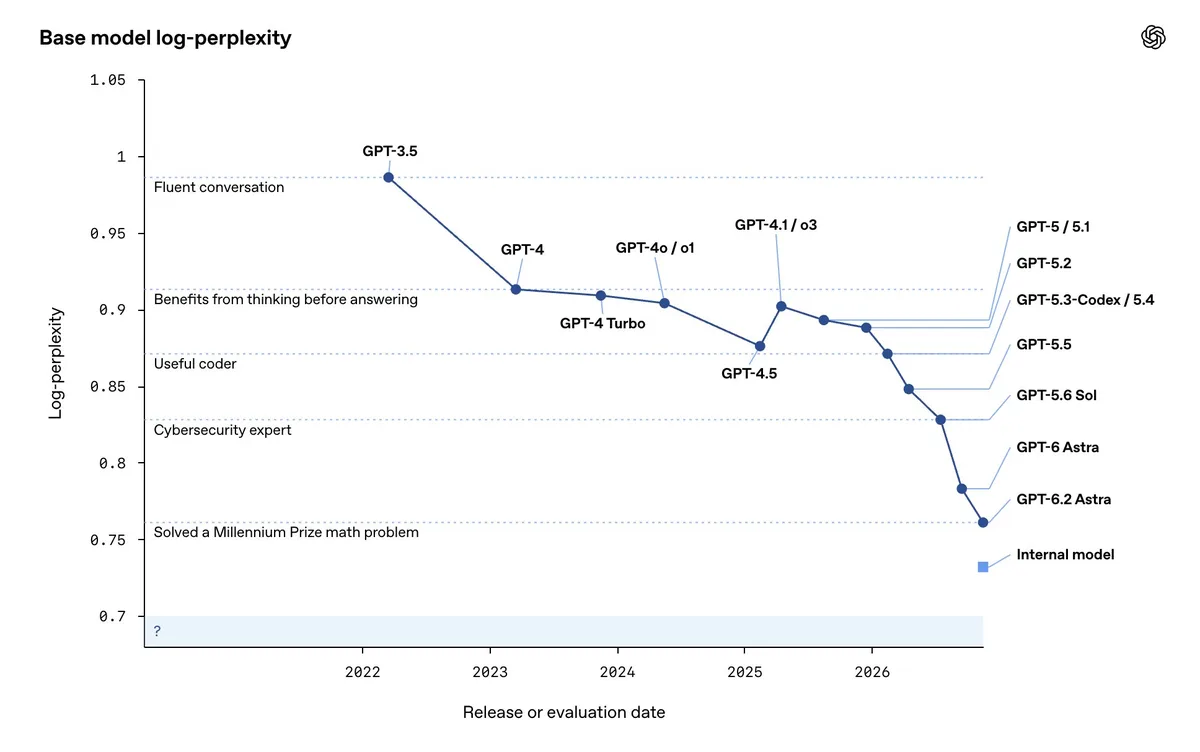
The post links falling perplexity to new abilities. On OpenAI's main evaluation dataset, GPT-3.5 reached a log-perplexity of about 0.99 and GPT-4 about 0.91, and below 0.8 the company saw transformative capabilities in cybersecurity and mathematics. A model at about 0.76 began producing results on open math problems that OpenAI had posed. The author expects further transformative capabilities in the 0.68 to 0.7 log-perplexity range and says AI could speed up pretraining research, possibly as soon as 2027.
The author proposes that developers agree on shared evaluation norms, red-team safety cases and common limits based on perplexity and other measurements, which labs would not cross until a concrete milestone in monitoring AI is reached. The post also lists challenges: labs use different datasets, so comparison is difficult; perplexity is not tied to a specific task; and chain-of-thought[3] reasoning raises capabilities without lowering perplexity.
Read the original openai.comDiscussion
Discussion
Most comments are short reactions. One reader asks about the perplexity of an average person, and others say they want other labs to follow. One commenter points out that the chart places GPT-4o far behind OpenAI's current models, and another asks that model weights be preserved.
Sources
-
OpenAI
Perplexity and Intelligence
-
OpenAI
We decided to provide more transparency into pretraining progress at OpenAI for the sake of moving toward shared safety bars. In “Perplexity and Intelligence” I argue for common limits based on perple…
-
KRGeekNews KO
퍼플렉시티와 지능: OpenAI의 공동 개발 한계선 제안
-
Vector Wire new source ·
OpenAI publishes internal perplexity data, urges industry pacing limits ahead of possible 2027 capability surge
-
X new source ·
This is the most important thing OpenAI has published in awhile. We are providing a lot of transparency into our pretraining progress and hope we can agree as a frield to common limits. I think that w…


