OpenAI pipeline found 948 Linux privilege escalation vulnerabilities for $1.2 million

Update · : The new article names the model that produced the comparison as GPT-5.5 Cyber, which found more than 5x more novel LPEs than GPT-5.6 Sol, and notes that the scans were separated by three months of Linux kernel hardening and patches.
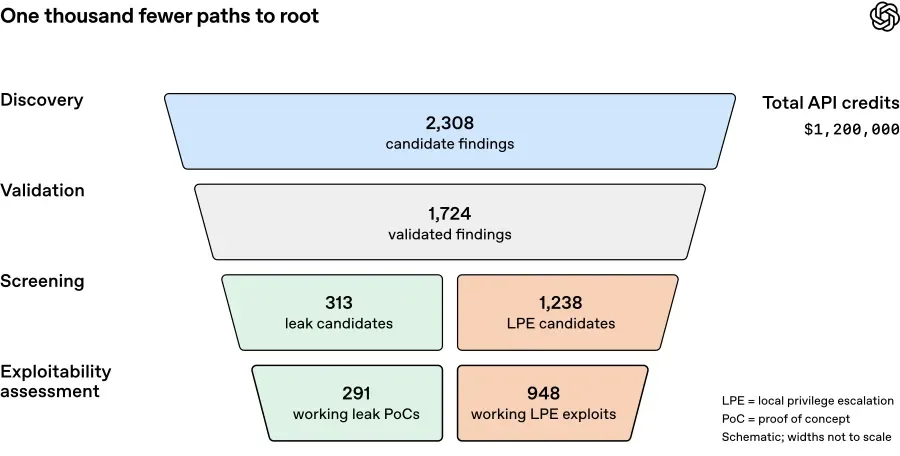
OpenAI's cyber team built an autonomous vulnerability discovery, exploitation, and patching pipeline for the Linux kernel. In a mid-October 2026 run with an upcoming cyber model, it analyzed 2,308 candidate findings, dynamically reproduced 1,724 vulnerabilities, and generated 948 working local privilege escalation (LPE) exploits plus 291 information leak PoCs for a commonly used Linux distribution. The full run cost $1,213,430 in API credits, or $1,279 per LPE exploit.
The pipeline has five stages: it selects security-relevant kernel code, statically scans it, reproduces findings in an isolated environment, creates proof-of-concept exploits, generates patches, and has a human researcher review the results. Targets ran a stock desktop operating system under the same threat model as competitions like Pwn2Own and TyphoonPWN. Using historical bug bounty amounts from those competitions ($20,000 and $70,000 per LPE), the 948 exploits would be hypothetically worth $18.9M–$66.3M, roughly 16x to 55x the run cost. On a kernelCTF environment with a reduced attack surface, the pipeline produced 25 information leak PoCs and 21 LPE exploits for about $32,936.
The team says the agents used at least 10 novel Linux exploitation techniques, and that the newer model found over 5x more novel LPEs than a GPT-5.6 Sol run in July despite three months of hardening. Within 10 days of the scan, over 100 Linux LPEs were patched or had staging patches from other contributors, with about 300 more publicly discussed, so OpenAI argues automated patch generation is needed to keep pace. It recommends treating low-privileged access to an unpatched system as functionally equivalent to root access for well-resourced attackers, and points to sandboxing (Firecracker, gVisor), secure-by-default model training, attack-surface reduction, and formal verification as future directions.
Read the original openai.comDiscussion
Discussion
A member of the OpenAI cyber team confirmed the project is their team's work and offered to answer questions or relay them to the team, noting the team is hiring.
Sources
-
openai.com
A thousand fewer paths to root
-
Phoronix new source ·
OpenAI finds 948 local privilege escalation bugs in the Linux kernel
Terms
- LPE (local privilege escalation) — A class of vulnerability that lets an unprivileged local user gain higher privileges, typically root access.
- PoC (proof of concept) — A minimal demonstration, often a crashing input or small exploit, that shows a vulnerability is real.
- kernelCTF — A Google-run bug bounty program that accepts exploits against a hardened version of the Linux kernel with a reduced attack surface.
- 0-day — A vulnerability that is unknown to the vendor or maintainers and has no patch available yet.


