OpenAI describes how it detects and blocks adversarial distillation of its models
OpenAI published an article on adversarial distillation[1], in which an actor uses a frontier model's outputs without authorization to train another model with similar capabilities, then deploys it without comparable protections. The company says such a model could help with cyberattacks that the original model would have refused. OpenAI's approach combines adversarial testing, model training, classifiers, API-level protections, and investigations into coordinated attempts to extract model capabilities.
OpenAI places particular emphasis on protecting the chain-of-thought[2] of its models, the intermediate steps a model generates internally while working toward an answer. In an internal test using automated red-teaming[3], the average attack success rate fell from 54.0% against GPT‑6 Astra with its original safeguards to 0.2% against GPT‑6.2 Astra with updated safeguards. In a separate internal cyber study, students trained on exact reasoning traces generally outperformed students trained on reasoning summaries after supervised fine-tuning, and after reinforcement learning the exact-trace student still scored higher at the largest inference budget tested on both benchmarks shown.
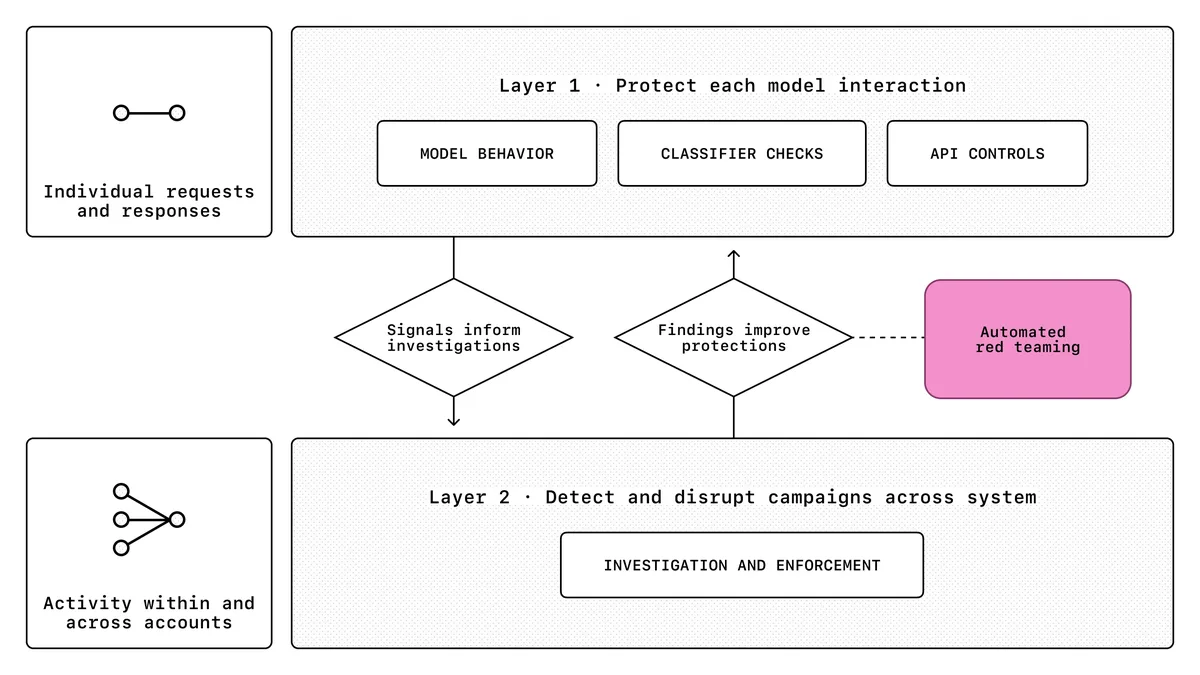
Defenses work at two levels: the request level, where model behavior, classifier checks, and API controls limit reasoning extraction, and the campaign level, where OpenAI looks for patterns across accounts. With GPT‑6.2 Astra and GPT‑6.2 Sol, protected reasoning is tied to the conversation history that produced it, and if an earlier message is rewritten, the API drops the reasoning that followed. When OpenAI detects a campaign, it investigates the accounts involved, enforces against the network of accounts, and shares indicators of compromise with other model providers.
Read the original openai.comDiscussion
Discussion
Commenters are mostly skeptical. Several argue that distillation has already happened and that much of the knowledge behind these models is open science, so the protections will not stop it. Others call the position hypocritical because of training on others' work or see it as a PR move by American AI firms, while a few warn about theft of model weights.
Links from the post and discussion
Sources
-
OpenAI
How OpenAI detects and responds to model distillation attempts
-
OpenAI
Distillation can reproduce powerful AI capabilities without the safeguards built around them. We’re sharing new research on our work to combat distillation of our models, how these capabilities transf…


