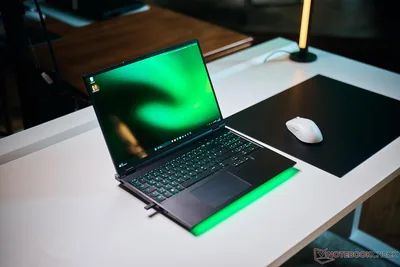
Nvidia RTX Spark laptop drops to 13.9 tokens per second on native Linux over encrypted power firmware




Linux installs and runs on Nvidia RTX Spark laptops like the MSI Prestige N16 Flip AI Plus, with GPU acceleration via Nvidia's open kernel driver, 4K output at 120Hz, and working audio, keyboard, and touchpad. The catch is clock speed: when plugged into wall power, the GPU locks to roughly 780 MHz instead of the 2 GHz-plus it reaches on Windows. When the laptop runs on battery, Linux performs normally at around 61 to 67 tokens per second, so the problem only appears on AC power.
The root cause is a Windows-only component called the Nvidia Platform Controllers and Framework, which manages power delivery between CPU and GPU. Its power table is encrypted, and only the Windows driver can decrypt it; disabling the controller in Windows reproduced the same slowdown on Windows, dropping throughput from around 83 to about 31 tokens per second. Benchmarks on GPT-OSS-120B show the gap: Windows hit 65.4 tokens per second, WSL hit 65.1, the DGX Spark desktop unit hit 61, and native Linux managed only 13.9. A longer benchmark run took about 8 minutes on Windows with the GPU near 2.2 GHz, versus 37 minutes on Linux at around 790 MHz, with temperatures between 40 and 47°C, ruling out thermal throttling. With vLLM running eight concurrent clients, WSL reached 127 tokens per second while native Linux reached 39.5.
Installation was not plug-and-play: Omarchy initially failed on the MSI Prestige with a flickering display, and Debian needed a USB Ethernet adapter and lacked keyboard, touchpad, and GPU support until a kernel with Nvidia's open-source driver was used. The firmware also reserves 96GB of the 128GB unified memory for the GPU by default, and only Windows exposes a setting to change that split; lowering the GPU reservation to 4GB freed 120GB for Linux. WSL is the practical option today because it rides on the Windows driver stack and keeps full GPU boost. A real fix depends on Nvidia porting the controller's power management logic into its Linux driver.
Read the original mindstudio.aiDiscussion
Sources
-
mindstudio.ai
Nvidia RTX Spark encrypted firmware slows inference speed to 35% on Linux
Terms
- WSL — Windows Subsystem for Linux, a feature that runs a Linux environment inside Windows, using the Windows driver stack.
- tokens per second — A measure of how fast a language model generates output text, commonly used to benchmark inference hardware.
- unified memory — A design where CPU and GPU share the same physical memory pool instead of having separate RAM and video memory.
- vLLM — An open-source inference engine for serving large language models on GPUs, built primarily for Linux.