New approach enables physically consistent AI models of chaotic systems
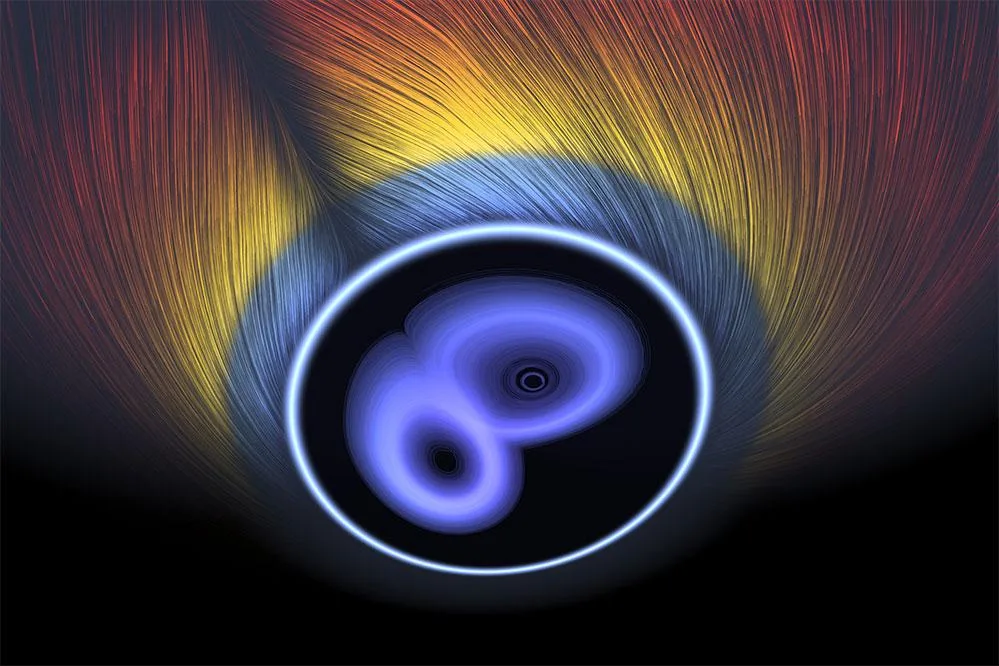
Researchers from MIT's Laboratory for Information and Decision Systems (LIDS) describe a way to add physics-based limits to machine learning models of chaotic systems such as weather, climate and turbulent flows, so that predictions stay within what is possible in the real world. Without such limits, these models can drift into physically impossible predictions over time. The paper, by graduate student Sunbochen Tang and professors Navid Azizan and Themistoklis Sapsis, was published in PNAS, and open-source code is available with it.
Earlier methods mostly added penalties during training, which gave no guarantee at test time, while capping values at an arbitrary limit could block realistic behavior. The team instead has the model learn an energy-like function and a boundary that its chaotic behavior should stay within. A projection layer[1] then enforces energy dissipation as a hard constraint[2], so trajectories outside the boundary are pulled back toward the bounded region. According to the authors, this gives theoretical guarantees that predictions remain bounded over arbitrarily long forecast windows.
In tests on well-known physical systems, from simple textbook cases to complex multidimensional ones, the approach closely matched the true outcomes, while conventional approaches deviated into impossible predictions. The authors also say the layer works with different neural network architectures and is useful where data is limited. A follow-up work by team members won the Best Paper Award at the Learning for Dynamics and Control conference.
Read the original news.mit.eduDiscussion
Sources
-
MIT News | Massachusetts Institute of Technology
New approach enables physically consistent AI models of chaotic systems


