Muxflow moves from Tauri to native GPUI: 76% less idle memory, plus the downsides
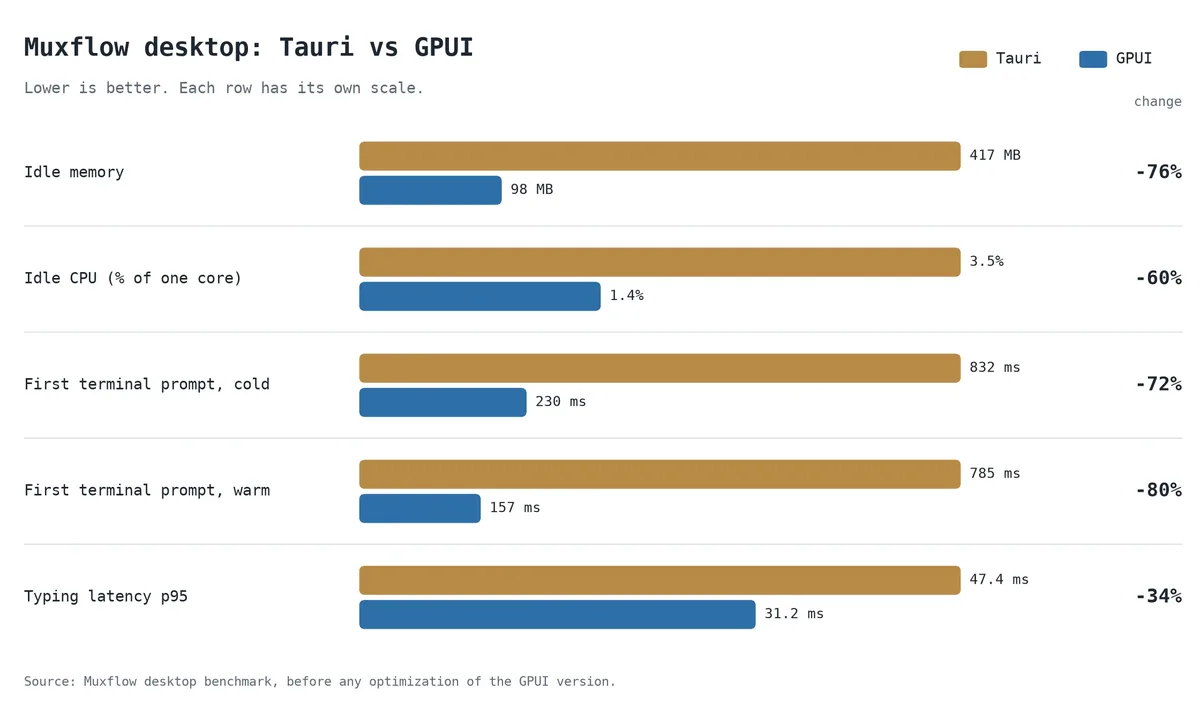
Muxflow is now fully native GPUI, with Tauri removed. Compared with the Tauri version, the author reports 76.5% lower idle memory usage, 60% lower idle CPU, a first terminal prompt 72% faster when cold and 80% faster when warm, and typing latency p95[1] 34% faster, all before any optimization of the GPUI version.
The author says the migration was done because it was possible, and that LLMs[2] make such work cheap. Without LLMs, the author says, writing the whole UI in Rust instead of React would have been very costly. Listed benefits are better performance, a codebase that is 100% Rust beyond mobile, and no Tauri rendering differences between Mac and Linux. The absolute gains are small, a few tens of megabytes and milliseconds, because the app was already thin.
The GPUI crate[3] ecosystem is much smaller than React's. With Tauri the author used CodeMirror, but with GPUI no available crate could be used, because the Zed libraries are GPL[4] licensed and Muxflow is MIT, so the author wrote a lightweight markdown WYSIWYG and code editor. Rust build times are slow, and running several agents in parallel puts heavy I/O pressure on the machine; the author has not tried optimizing builds yet.
Product Muxflow reporank.net
Remote-first tmux IDE for running coding agents across hosts, with mobile notifications, SSH transfers, files, ports and Git.
Read the original galvered.comDiscussion
Sources
-
galvered.com
Migrating a desktop app from Tauri to native GPUI: 76% less idle memory, and the ugly parts

 archive